
Showcase your capabilities
If you design, build or supply Interceptor Drones, create a profile to showcase your capabilities and connect with visitors who have an active requirement for your solutions.




Interceptor drones are unmanned aircraft designed to pursue, engage, capture, disrupt, or defeat other UAS within a counter-UAS system. These airborne interceptors can respond to tracked threats using kinetic collision, net capture, electronic attack, or purpose-built payloads, with reusable and expendable configurations supporting different operational requirements.
This category highlights leading interceptor drone suppliers with solutions for military base protection, mobile force defense, critical infrastructure security, and maritime operations.
Read the Technology Overview
Battlefield-Proven Autonomous Counter-UAS, Tactical Drones, & Custom Battery Solutions

Versatile Fixed-Wing & VTOL Unmanned Aerial Vehicles (UAVs) for Long-Range Civilian, Commercial & Military Applications

AI-Powered Autonomous Drone Solutions for Public Safety, Defense, and Industrial Inspection

If you design, build or supply Interceptor Drones, create a profile to showcase your capabilities and connect with visitors who have an active requirement for your solutions.

Interceptor drones are unmanned aircraft designed to pursue, engage, capture, disrupt, or physically defeat other drones. Within a counter-UAS architecture, an interceptor drone provides an airborne response that can move toward a detected target rather than relying exclusively on a fixed effector positioned around the protected site. This mobility can be particularly valuable when hostile or unauthorized UAS approach from changing directions, operate close to terrain, or remain outside the effective engagement zone of ground-based systems.
A drone interceptor system may receive target tracks from radar, radio-frequency sensors, electro-optical equipment, or a wider counter-drone command-and-control network before launching an aircraft toward the threat. Depending on the design, the interception drone may use a kinetic impact, entanglement device, electronic countermeasure, or another purpose-built payload. Interceptor drones can therefore form one element of a layered counter-UAS system alongside detection sensors, electronic warfare equipment, directed-energy technologies, and other defeat mechanisms.
A kinetic interceptor drone physically collides with the target UAS at sufficient speed or force to disable it. These aircraft place significant demands on propulsion, maneuverability, structural strength, terminal tracking, and guidance accuracy because the interceptor must generate a viable collision path against a potentially small and agile target. High closing speeds can shorten engagement times, but they also leave less margin for correcting errors during the final stages of a drone intercept.
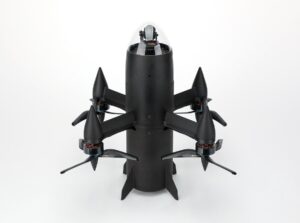
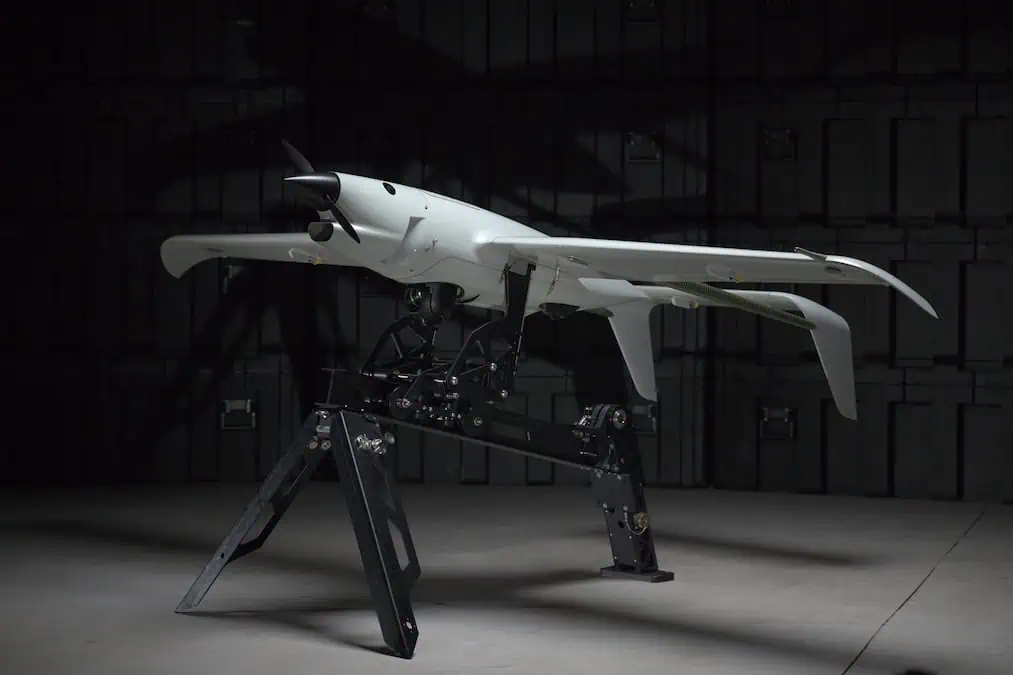
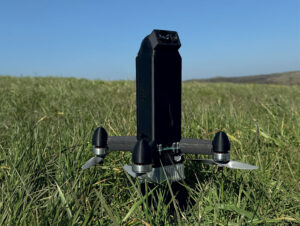
Kinetic interceptor UAV from Nearthlab, KAiDEN.
A drone-catcher drone uses a net device or similar entanglement mechanism to restrict the target aircraft’s propellers or otherwise prevent continued controlled flight. Some drone-catching designs retain the captured UAS, while others cause it to descend after entanglement. This approach can be useful where operators want to avoid a direct high-energy collision, although interception performance depends on accurate positioning and effective deployment of the capture mechanism.
Some anti-drone UAVs engage from a short stand-off distance using a purpose-built payload rather than requiring direct airframe-to-airframe contact. The payload and delivery mechanism determine the effective engagement range, targeting requirements, aircraft size, and operating constraints. Such drone interception systems must also account for where the payload and defeated target may travel after engagement, particularly when operating near personnel, infrastructure, or other aircraft.
Anti-drone UAVs may carry RF equipment intended to disrupt command, telemetry, or navigation signals from a position closer to the target. Moving the countermeasure through the air can provide favorable geometry and reduce some line-of-sight limitations encountered by ground-based equipment. Effectiveness depends heavily on the target’s communications and navigation architecture, however, and autonomous or RF-silent aircraft may not respond to techniques that rely on interrupting an external control link.
Reusable interceptor UAVs are designed to return after an engagement or unsuccessful pursuit so that they can be prepared for subsequent missions. Their operational value depends not only on interception performance but also on battery charging, inspection, replacement of consumable components, recovery procedures, and turnaround time. A recoverable anti-drone interceptor may offer advantages where sustained protection is required and aircraft can be safely returned to a launch site.
Expendable or attritable drone interceptors prioritize rapid deployment and mission effectiveness without requiring recovery after each engagement. A kinetic drone interceptor, for example, may inherently be consumed during a successful collision, while other expendable designs use destructive payloads. Designers can potentially reduce complexity by removing recovery-specific equipment, but the resulting cost per engagement and the number of ready interceptors become important considerations when defending against repeated attacks or large numbers of inexpensive UAS.
Interceptor aircraft can be deployed in several ways, with the appropriate method determined by readiness requirements, mobility, available infrastructure, and the size of the area being protected.
Deployment architecture has a direct effect on response time. An interceptor that is technically fast enough to defeat a threat may still be ineffective if launching, target assignment, or flight-path establishment consumes too much of the available engagement window.
Military installations and temporary operating locations may use interceptor drones as part of layered protection against small UAS approaching from outside the immediate perimeter. An anti-drone interceptor can be launched toward a tracked threat while ground sensors maintain the broader air picture. This provides a mobile engagement option without requiring the hostile aircraft to enter a narrowly defined fixed defeat zone.
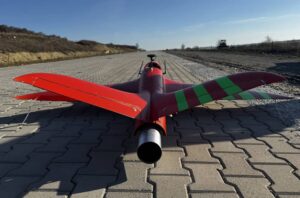
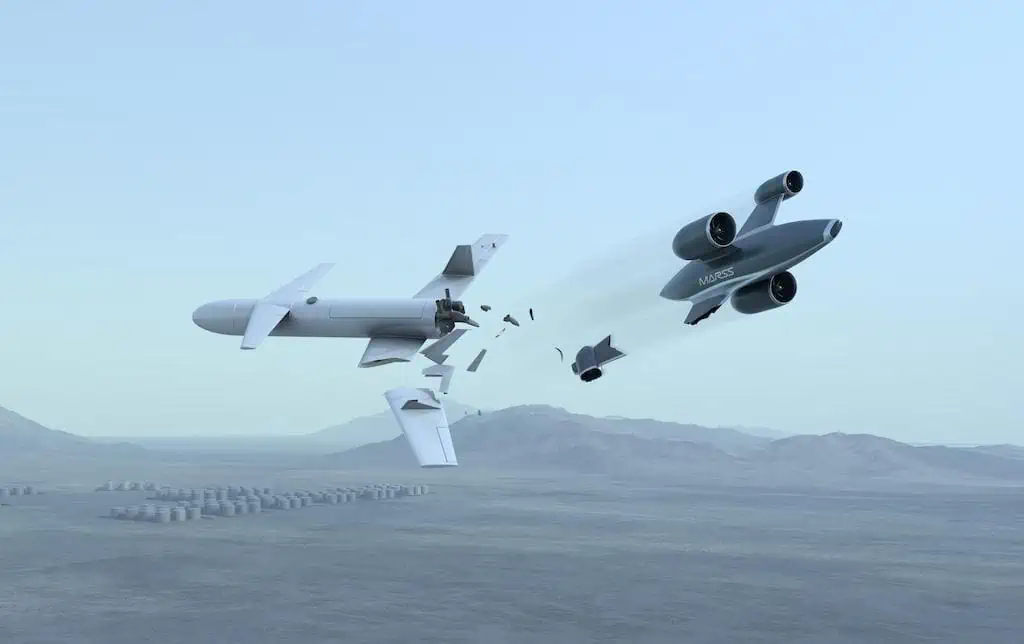
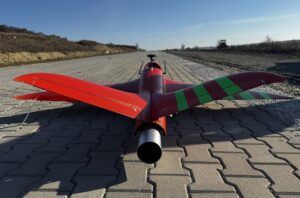
Jet drone for drone intercept missions, Vimana, from BraveX.
Counter-drone systems can support units whose position changes regularly, including maneuver formations, convoys, and temporary command or logistics sites. A compact FPV interceptor drone or other rapidly deployable aircraft can move with the protected force and be launched when a threat is detected. Such applications place particular emphasis on transportability, launch readiness, resilient communications, and the ability to operate without extensive fixed infrastructure.
Drone interception technology may also be applicable to selected critical infrastructure sites where unauthorized UAS present safety or security concerns. Potential environments include energy installations, communications sites, transport infrastructure, and other sensitive facilities. Operational use is highly dependent on national and local regulations because authorities to interfere with, capture, or physically defeat an aircraft differ significantly between jurisdictions and operator types.
Large perimeters create different requirements from point defense because an incoming UAS may appear at considerable distance from the asset ultimately being protected. Drone hunter platforms can move toward a detected aircraft, potentially allowing security forces to investigate or intercept a target before it reaches a more sensitive inner area. Effective operation requires suitable surveillance coverage, reliable target handoff, and sufficient interceptor range for the geography involved.
Ships, offshore installations, and ports can face UAS threats from directions that change continuously with vessel movement and surrounding activity. An interceptor drone launched from a maritime platform can pursue a target beyond the immediate structure of the vessel, although operations must account for wind, salt exposure, moving launch points, limited recovery areas, and demanding communications conditions. Maritime use therefore places additional emphasis on robust flight control and reliable launch and recovery procedures.
Multiple simultaneous targets create one of the most demanding scenarios for drone interceptor technology. Defenders may need to assign several interceptors, prioritize different threats, avoid conflicts between friendly aircraft, and maintain enough ready systems for subsequent engagements. The effectiveness of counter-drone drones in this
role depends as much on command-and-control architecture, automated tasking, launch capacity, and inventory depth as on the performance of an individual interceptor.
Development is increasingly focused on reducing reaction time, improving scalability, and allowing drone interceptors to address faster or more numerous unmanned threats.
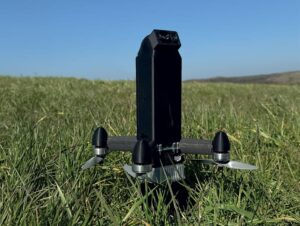
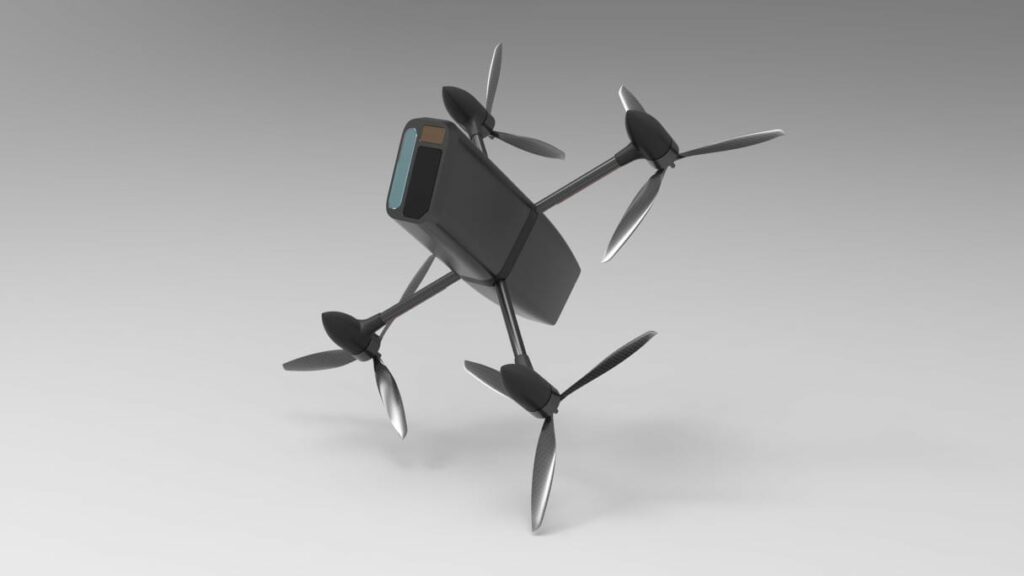
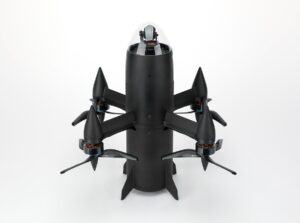
Drone interceptor technology from OMD Industries, the X7.
Future interceptor drone systems are likely to be judged not simply by maximum speed or the effectiveness of a single engagement, but by how reliably they integrate sensing, target assignment, launch, pursuit, defeat, and rearming or recovery.


 Searching Companies & Products