

Showcase your capabilities
If you design, build or supply Drone Testing Equipment, create a profile to showcase your capabilities and connect with visitors who have an active requirement for your solutions.




Drone testing equipment is used to verify UAV propulsion, avionics, navigation, payload, and environmental performance before operational deployment. Solutions range from motor test stands, UAV test benches, GNSS simulators, telemetry analyzers, and environmental chambers to indoor labs, outdoor test ranges, and BVLOS corridors.
This page showcases leading drone testing equipment suppliers, supporting repeatable component qualification, flight envelope expansion, and regulatory evidence gathering.
Read the Technology Overview



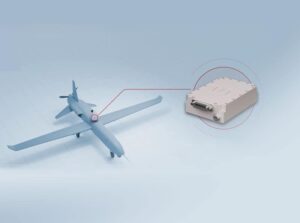
Anti-Jam GPS-GNSS Devices, Tactical Data Links, Telemetry Systems, Electronic Warfare Equipment & Flight Termination Systems


Drone Motor Controllers & NDAA-Compliant Drone ESCs for Brushless Electric Motor Control

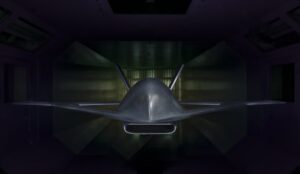
Experimental Aircraft | Advanced Manufacturing | Autonomy | Flight Testing

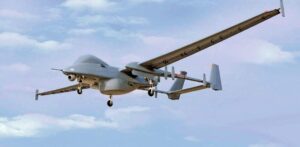
Reliability Engineering Services, RAMS Engineering & Analysis for Drone & UAV Manufacturers

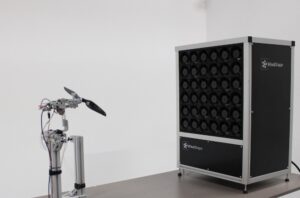
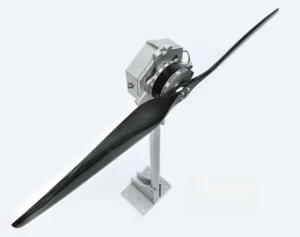
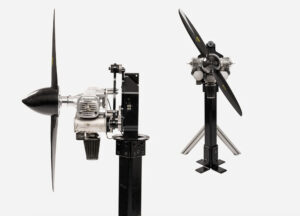
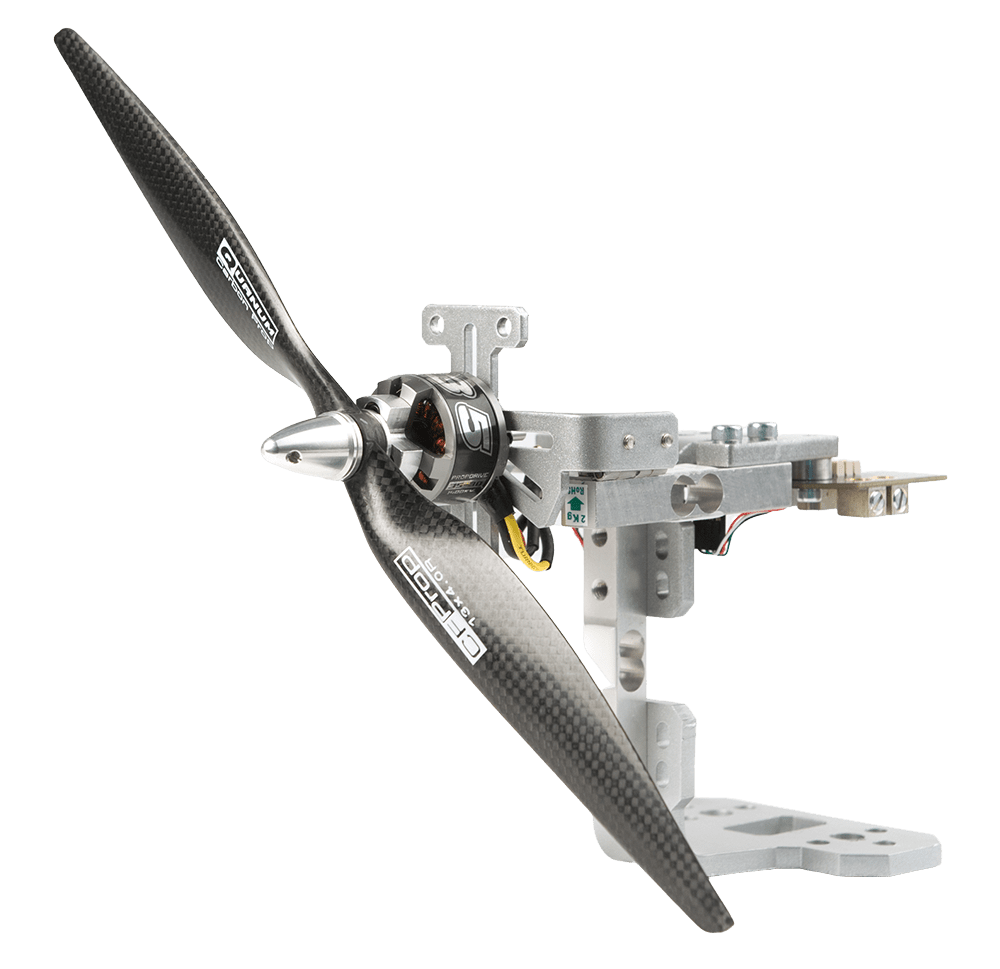
Drone Thrust Stands for Motors, Propellers & Gas Engines, Wind Walls for Drone & Aircraft Wind Tunnel Testing

Drone Software Engineering Consultancy Providing Comprehensive UAV Platform Development Services

Embedded Systems Software Development, Firmware Programming & Drone Software Design/Testing Services

PCB Fabrication & Assembly; RF, Military Grade, Flex, & Metal Core PCB Capabilities for Unmanned Systems

If you design, build or supply Drone Testing Equipment, create a profile to showcase your capabilities and connect with visitors who have an active requirement for your solutions.

Drone test equipment is used to verify that an Unmanned Aerial Vehicle (UAV) performs safely, repeatably, and within its design limits before it is released for operational use. This includes hardware and software for evaluating propulsion, power distribution, avionics, flight control, navigation, communications, payloads, and environmental resilience. For engineering teams, test equipment provides the measured evidence needed to move from design assumptions to verified performance, whether the platform is a small inspection quadcopter, a long-endurance fixed-wing UAV, a tactical VTOL aircraft, or an autonomous maritime drone.
Drone test facilities provide the controlled environments, airspace access, instrumentation, and safety processes required to evaluate UAVs under realistic conditions. Indoor laboratories support component qualification, tethered flight, and simulation, while outdoor ranges support envelope expansion, BVLOS trials, and mission testing in representative terrain. As drone systems become more autonomous and more tightly integrated into commercial, industrial, and defense operations, structured testing has become central to establishing airworthiness and long-term fleet reliability.
Electrical and power system testing verifies that the drone’s energy architecture can safely support propulsion, avionics, payloads, and onboard computing under all expected load conditions. This hardware setup normally includes programmable DC power supplies, electronic loads, power analyzers, and high-current measurement equipment. For electric UAVs, the power system is highly safety-critical because propulsion, flight control, and recovery systems often depend on a shared battery or power distribution bus. Engineers use power test equipment to characterize voltage stability, current draw, transient response, and failure isolation, helping identify brownout risks or thermal overload before flight testing.
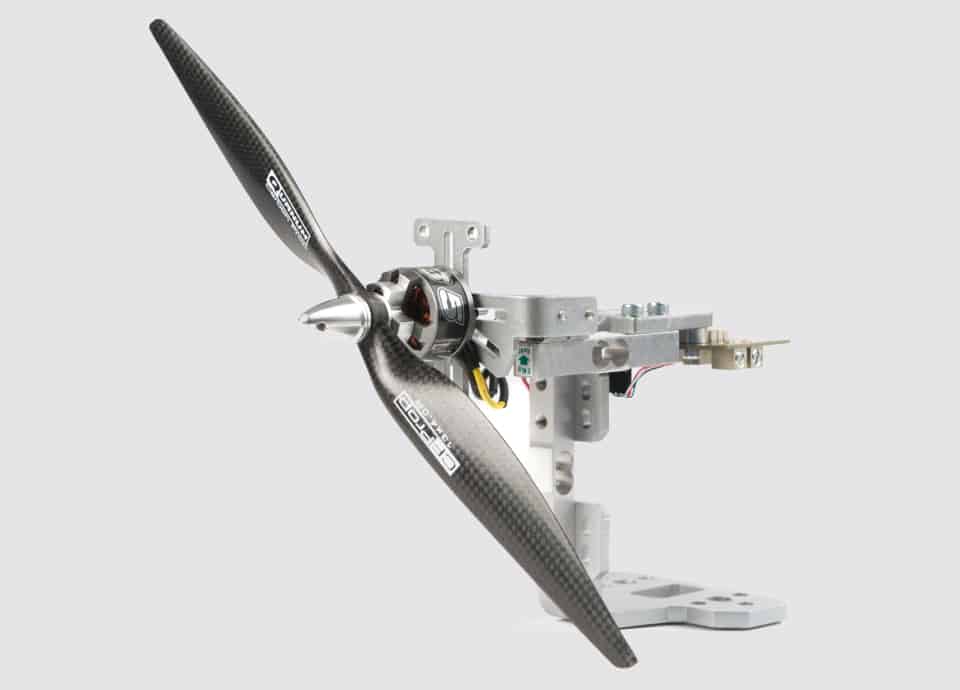
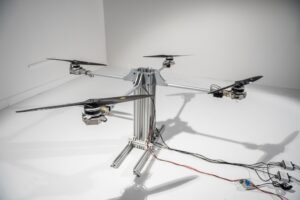
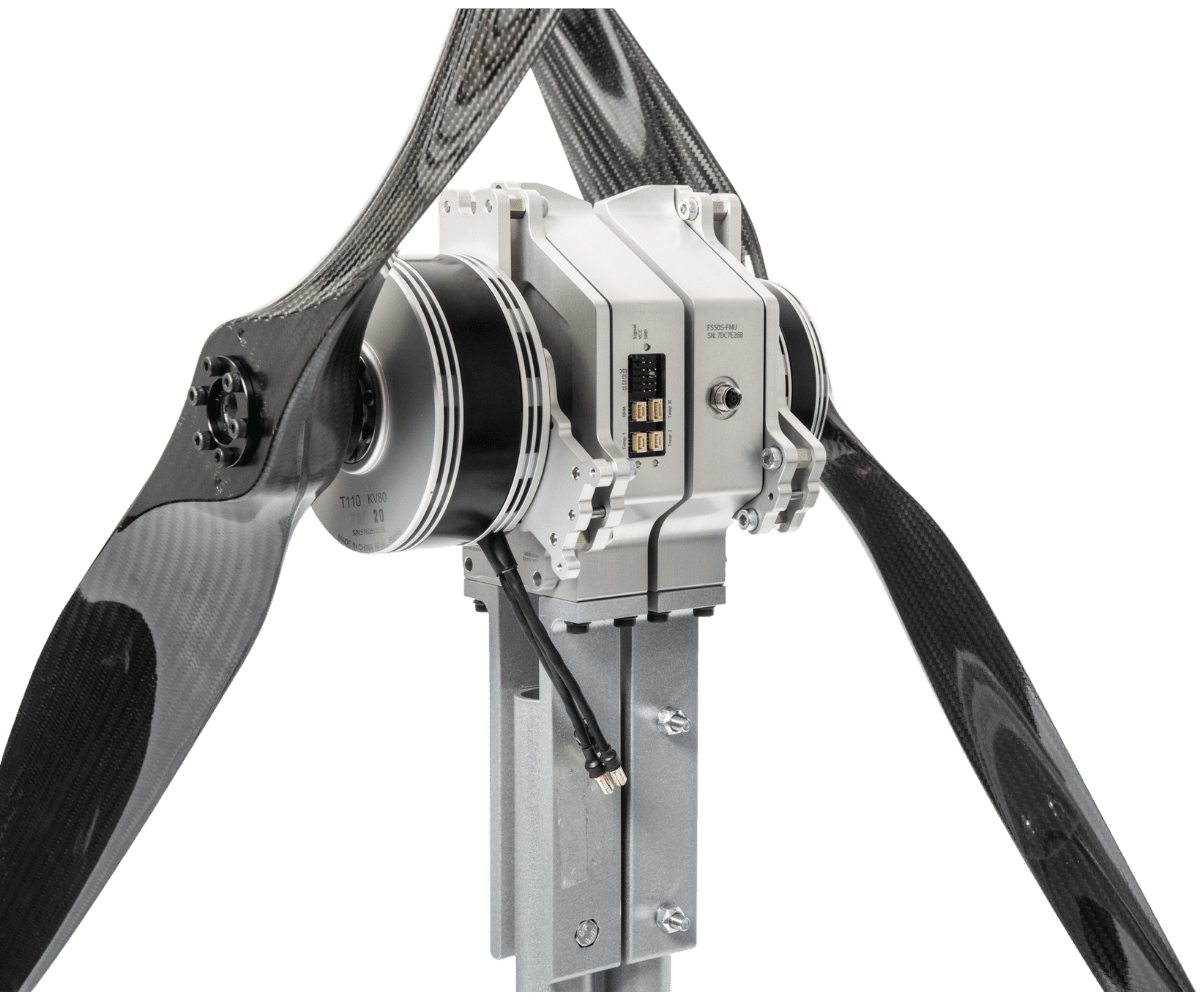
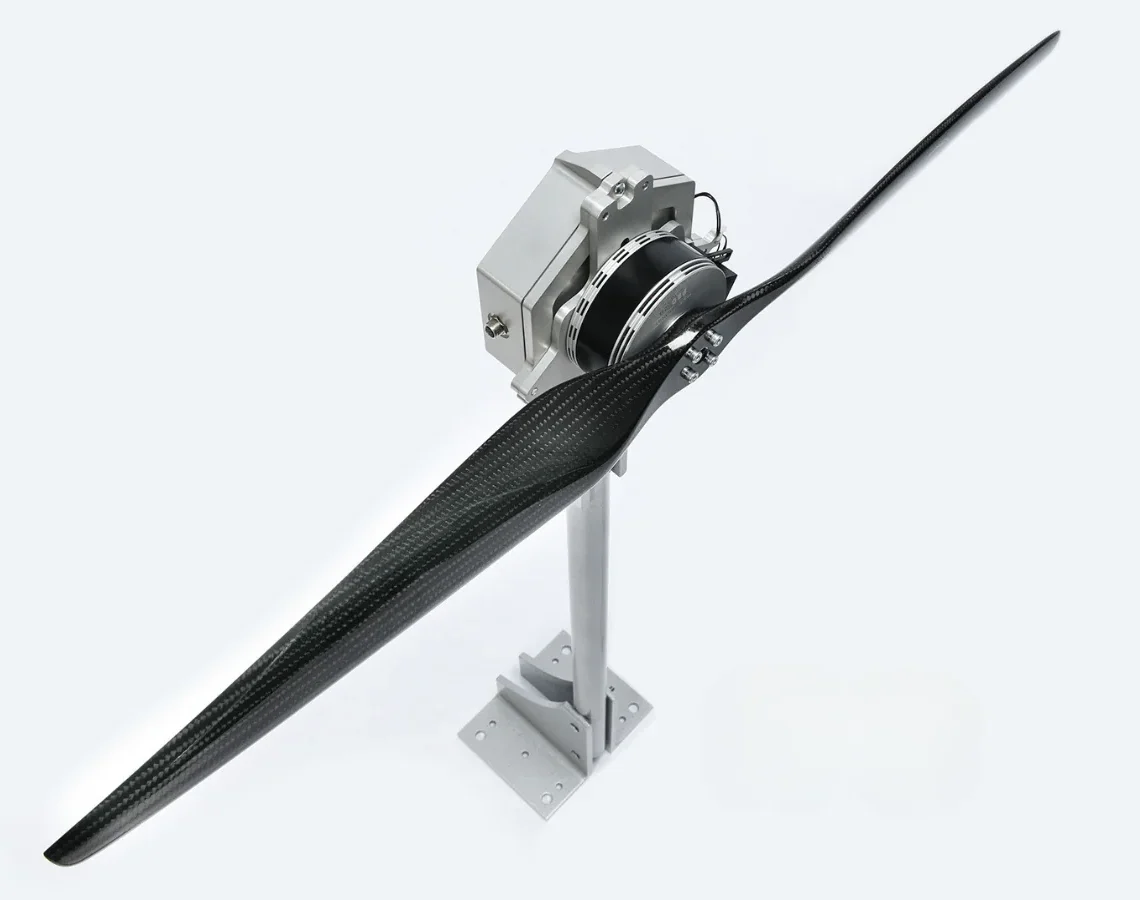
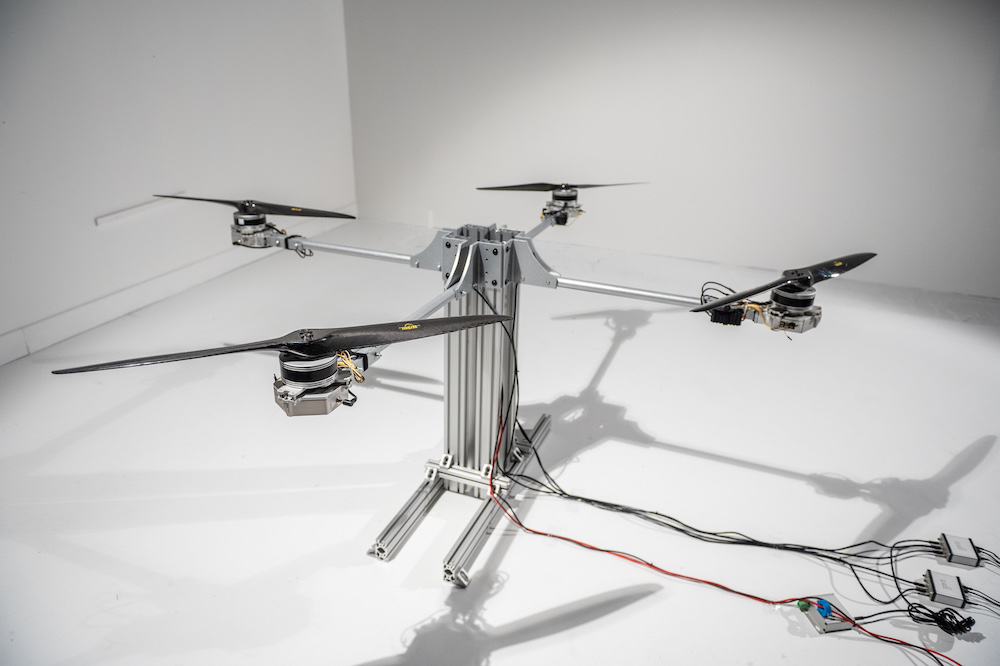
Series 1585 Quadcopter Test Stand by Tyto Robotics
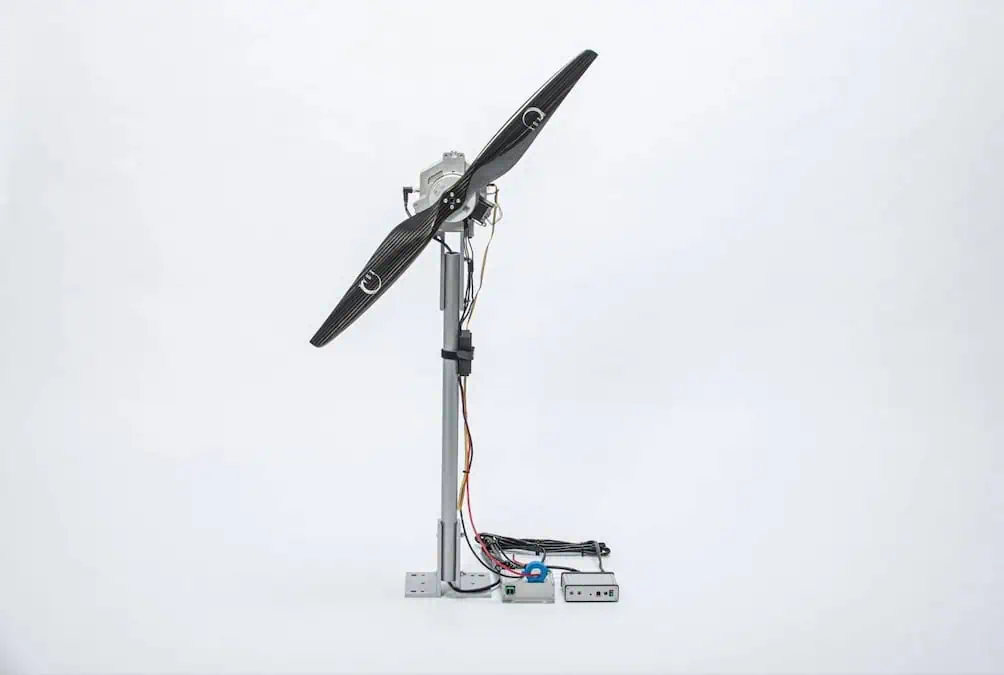
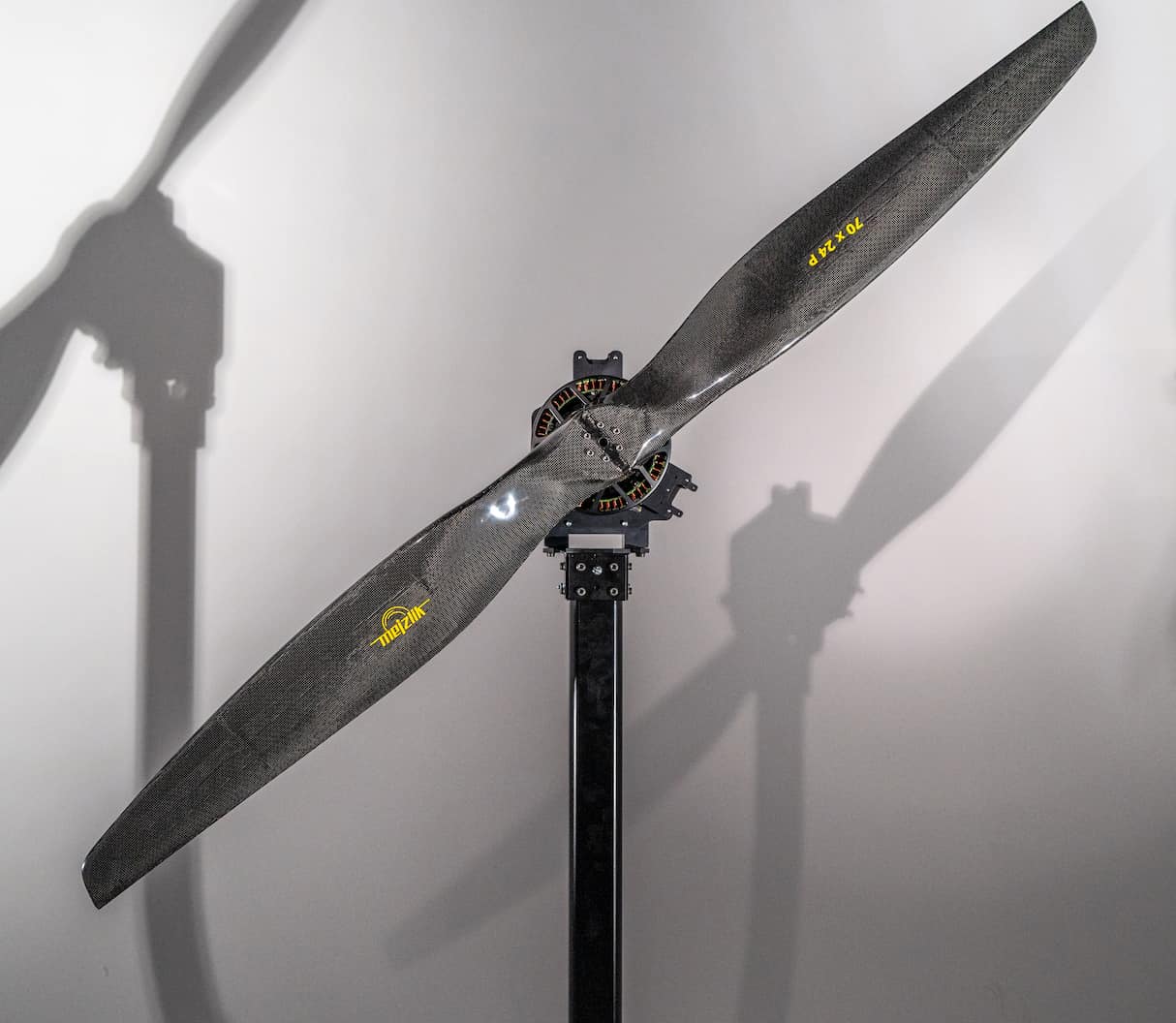
Propulsion test stands are used to measure thrust, torque, efficiency, vibration, and thermal behavior across drone motors, propellers, Electronic Speed Controllers (ESCs), and hybrid units. Choosing a motor-propeller combination requires understanding efficiency across the full operating range, cooling performance at representative airspeeds, and vibration output. Propeller testing may also include structural bending, loading, and fatigue evaluation to confirm that blades can withstand aerodynamic and inertial forces during flight.
A typical drone motor test stand includes load cells, torque sensors, tachometers, temperature probes, and high-speed data acquisition units. Advanced test stands may support single-motor, back-to-back, and face-to-face coaxial configurations to characterize multirotor and lift-system performance. By correlating thrust, RPM, and electrical input, engineers can assess whether a propulsion system delivers the required endurance without exceeding safe limits.
Avionics and flight controller test systems verify the behavior of the autopilot, flight management software, inertial sensors, actuator interfaces, and safety logic. This is achieved through a combination of an integrated UAV test bench, software-in-the-loop simulation, and hardware-in-the-loop (HIL) setups.
HIL testing allows physical flight controller hardware to interact with simulated aircraft dynamics and environmental conditions in real time. Test benches may also replicate drone ground control stations, actuator interfaces, and fly-by-wire control pathways, allowing operators to evaluate command inputs, telemetry feedback, and control logic before live flight. This enables engineers to safely test software updates, failsafe behavior, and autopilot configuration changes before committing an aircraft to live drone flight testing.
Sensor and payload test equipment validates the performance of mission equipment and ensures it remains synchronized with the aircraft navigation system and onboard data recorders. Depending on the application, payload testing solutions involve camera calibration, LiDAR range validation, radar performance assessment, and gimbal stabilization checks. Testing helps determine whether isolation mounts, thermal management, or shielding are required to maintain data integrity. This is critical for professional mapping, inspection, and surveillance missions where data quality is as important as flight performance.
Communications and telemetry testing verifies the reliability, range, latency, throughput, and security of command-and-control links and payload datalinks. Datalink test equipment includes spectrum analyzers, vector network analyzers, signal generators, and channel emulators. These systems allow engineers to evaluate link budgets, antenna placement, packet loss, and interference susceptibility. For platforms operating beyond visual line of sight, comprehensive communications testing ensures that the command link remains predictable and recoverable over the entire operating area.
GNSS, navigation, and positioning test equipment verifies that a drone can accurately determine its position, velocity, attitude, and timing. GNSS simulators are used to reproduce satellite constellations, signal attenuation, and outages within a laboratory environment. This allows development teams to evaluate receiver behavior and test how the autopilot responds when positioning quality degrades. Navigation test setups also incorporate IMU rate tables and vibration tables to benchmark sensor fusion algorithms and verify dead-reckoning performance in GNSS-denied environments.
Indoor drone testing facilities provide controlled spaces for early development, repeatable flight trials, autonomy testing, and safety-critical evaluation without airspace restrictions. These spaces often include motion capture systems, netted flight arenas, tethers, and controlled lighting. They may also incorporate high-fidelity 3D simulation environments, enabling avionics, control software, and operator interfaces to be tested against realistic mission scenarios.
The primary advantage of an indoor drone testing center is repeatability, allowing engineers to isolate variables and safely evaluate unproven software or hardware. While indoor facilities are ideal for testing obstacle avoidance and precision landing, they are typically paired with outdoor testing to validate true mission dynamics.
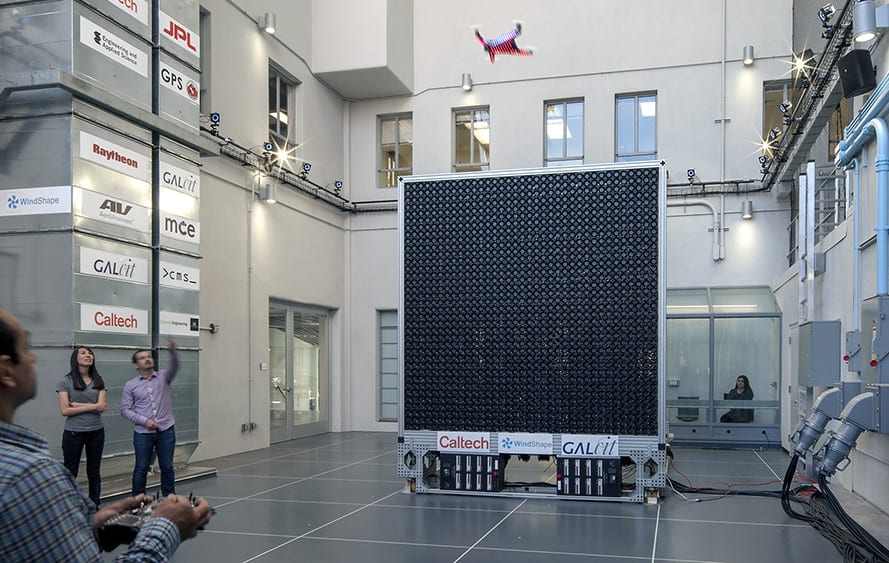
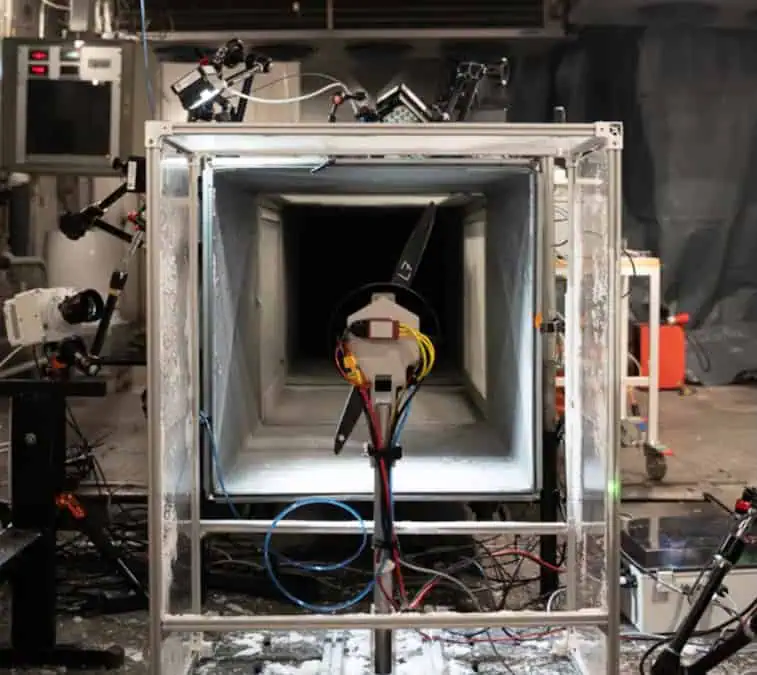
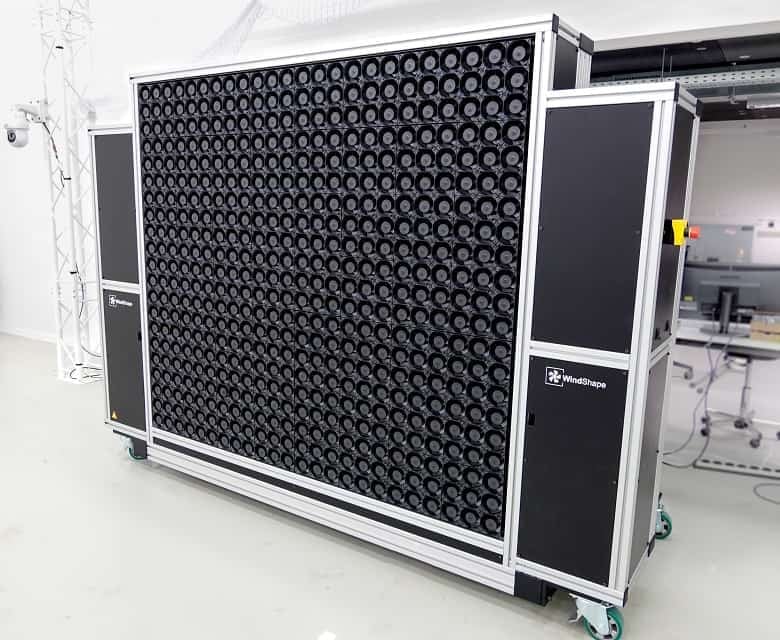
Windshapers for Aircraft Wind Tunnel Testing by Tyto Robotics
Outdoor UAV test ranges allow aircraft to be flown under realistic environmental, terrain, and operational conditions. A well-equipped outdoor drone testing facility provides managed airspace, launch and recovery areas, telemetry infrastructure, and optical or radar tracking.
These sites are essential for envelope expansion, endurance testing, and regulatory evidence gathering. Operating at established drone test sites allows engineering teams to observe how the aircraft behaves in real wind, turbulence, and changing light conditions.
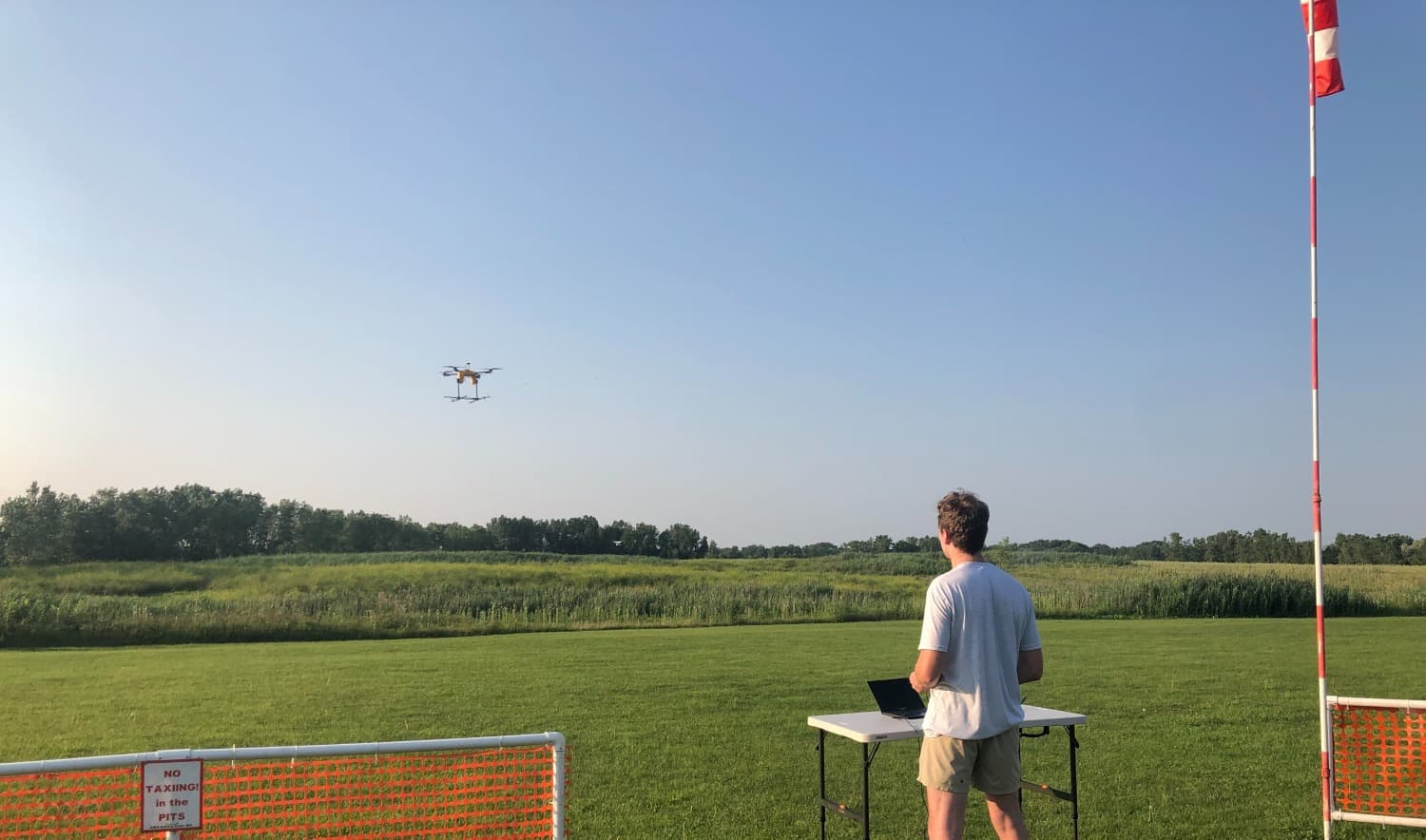
Testing beyond visual line of sight requires specialized, instrumented flight corridors equipped with secondary radar, ADS-B receivers, and long-range tracking. These restricted airspaces allow operators to prove that their platform can safely navigate extended distances and handle non-cooperative aircraft traffic. This extensive UAV flight test program generates the necessary data on communication reliability and detect-and-avoid response times required to secure regulatory permissions.
Secure test facilities are required when UAV programs involve classified payloads, military communications, electronic warfare equipment, or sensitive mission profiles. These defense-oriented facilities provide controlled physical access, protected data handling, and specialized RF spectrum management. Proving grounds of this type support test scenarios involving active GNSS denial, contested electromagnetic environments, and tactical teaming. This ensures that military platforms can be evaluated thoroughly against representative electronic interference and spoofing threats.
Evaluating a system’s resilience against harsh climate conditions and mechanical stress is necessary to guarantee long-term field reliability.
Completing these environmental qualifications allows manufacturing teams to establish clear operational boundaries and certify that the platform meets strict industrial or military standards.
A structured testing program provides the defensible data required to secure operational approvals from civil and military aviation authorities.
Integrating these standards into the initial design phase ensures that compliance documentation remains traceable and complete throughout the product lifecycle.
Selecting the right drone testing equipment begins with analyzing the specific class of aircraft, mission profile, and level of operational risk. Fixed-wing UAVs require extensive aerodynamic validation, launch testing, and stall-margin assessment, whereas multirotors place greater emphasis on propulsion redundancy, power efficiency, and high-frequency structural vibration. VTOL and heavy-lift platforms introduce the complexities of transition flight modes and massive kinetic energy profiles, while highly autonomous systems necessitate extensive simulation and fault-injection testing to verify behavioral logic under stress.
Organizations must also weigh the balance between building an in-house test capability and utilizing external specialist facilities. Maintaining an internal UAV test bench or motor test stand supports rapid engineering iteration, routine component checking, and software regression testing. However, capturing complex performance metrics requires leveraging external centers for wind tunnels, certified environmental chambers, and monitored BVLOS test sites, ensuring scalability, repeatable calibration, and lower overall lifecycle costs for the program.


 Searching Companies & Products