Tyto Robotics discusses research into Lagrangian particle tracking using drones, highlighting academic research that explores how Unmanned Aerial Vehicles (UAVs) can be used as mobile elements within airflow rather than as fixed measurement platforms.
This approach reflects growing interest in treating drones as flow-following instruments for studying atmospheric dispersion.
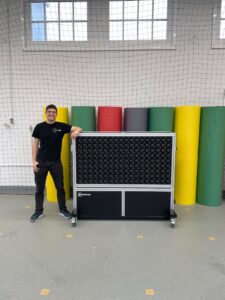
Nathaniel Simon of the Intelligent Robot Motion (IRoM) lab with their 6×3 Windshaper
Lagrangian particle tracking seeks to characterize how suspended particles move and disperse within airflows. Conventional techniques rely on optically tracking seeded particles or helium-filled bubbles, typically using camera systems and computer vision. While effective, these methods can be limited in flexibility and sensing capability.
As a result, researchers have begun investigating whether lightweight drones could act as proxies for individual particles while carrying onboard sensors.
One such investigation was conducted by researchers at the Princeton University, who examined the feasibility of using drones to study wind-driven transport and pollution dispersion.
Eulerian & Lagrangian Measurement Approaches
Eulerian and Lagrangian methods represent two distinct ways of measuring flow behavior. Eulerian approaches collect data from fixed locations as particles pass through, while Lagrangian approaches follow the motion of individual particles over time.
Although Eulerian measurements are generally easier to implement, Lagrangian techniques provide direct insight into dispersion paths and particle-level dynamics that cannot be observed from stationary sensors alone.
Drone-Based Lagrangian Flow Tracking
To explore drone-enabled Lagrangian tracking, Princeton researchers developed a micro aerial platform known as LaDrone.
The system was designed to approximate fluid particle behavior through a low-mass airframe of approximately 40 grams, a control strategy that compensates only for gravity so that aerodynamic forces govern motion, and high-precision GNSS-based position tracking with sub-centimeter accuracy.
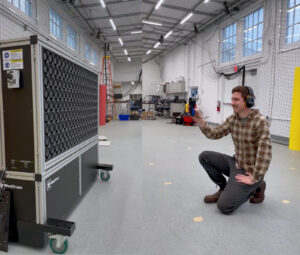
6×3 Windshaper at Princeton’s IRoM lab
Testing was performed in a controlled wind environment using a programmable wind generation system with independently controlled flow regions. Initial trials showed that the drone responded quickly to changes in airflow but traveled more slowly than surrounding particles. By adjusting the control strategy to amplify the influence of wind gusts, researchers improved the platform’s ability to match particle velocities and follow the flow more closely.
Relevance and Applications
Lagrangian particle tracking is well suited to environmental and atmospheric studies, including wildfire smoke propagation, airborne disease transmission analysis, and air quality impact assessment. When implemented using drones, the approach is enhanced by the ability to collect flow measurements from within the moving air mass using onboard sensors.
As discussed by Tyto Robotics, this body of research demonstrates how drone-based Lagrangian tracking can expand the tools available for studying complex airflow and dispersion phenomena, while remaining grounded in experimentally validated academic work.