Showcase your capabilities
If you design, build or supply Marine Transducers, create a profile to showcase your capabilities and connect with visitors who have an active requirement for your solutions.




Marine transducers are electroacoustic devices that convert electrical signals into acoustic pressure waves and incoming pressure fluctuations into signals for processing, enabling communication, sensing, navigation and positioning on unmanned maritime platforms.
This category features leading underwater and marine transducer suppliers, delivering solutions used across AUVs, UUVs, ROVs and USVs.
Read the Technology Overview
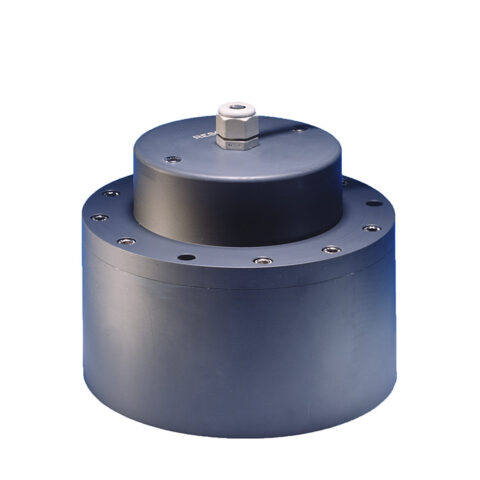

Autonomous and Unmanned Marine Vehicles: USV, AUV, Marine ROV; Profiling Floats & Towed Systems

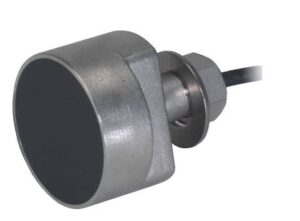
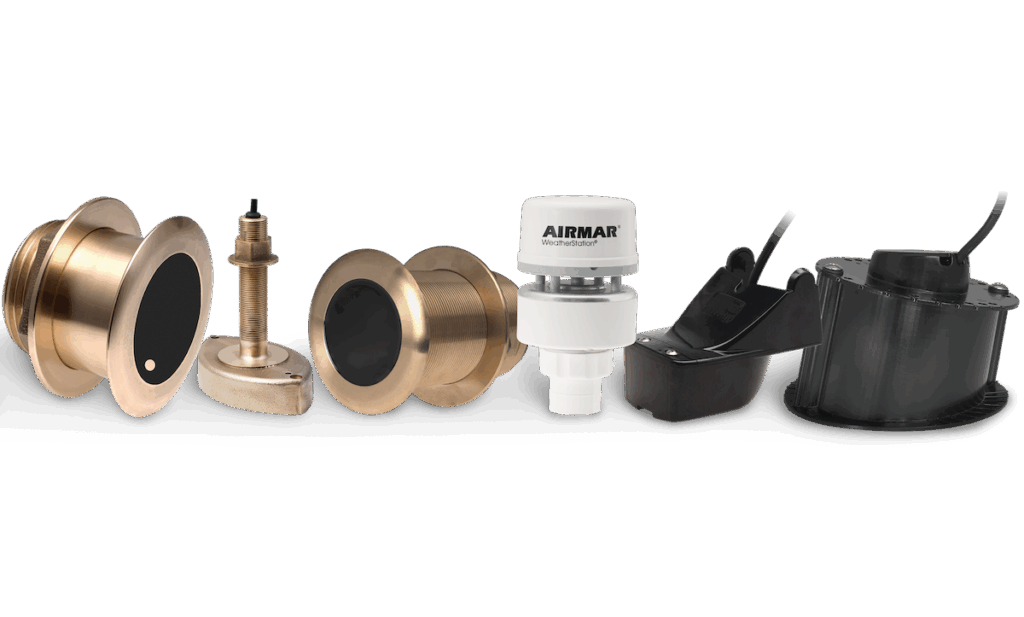
Weather Monitoring Stations, Marine Transducers, Side-Scan Sonar & Underwater Altimeters

If you design, build or supply Marine Transducers, create a profile to showcase your capabilities and connect with visitors who have an active requirement for your solutions.

Marine transducers provide the electroacoustic link between unmanned marine platforms and the surrounding water. When transmitting, these acoustic transducers convert electrical signals into acoustic pressure waves. In receive mode, they convert incoming pressure fluctuations into electrical signals for processing. This supports sensing, communication, navigation, and positioning across Autonomous Underwater Vehicles (AUVs), Unmanned Underwater Vehicles (UUVs), Remotely Operated Vehicles (ROVs), and Unmanned Surface Vessels (USVs).
Integrating an underwater sonar transducer requires balancing acoustic performance, available space, power consumption, and mounting requirements. The correct transducer architecture depends on the platform layout, operating depth, acoustic environment, and mission objectives.
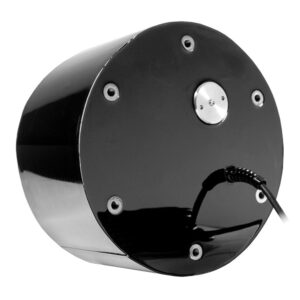
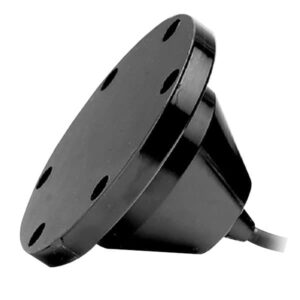
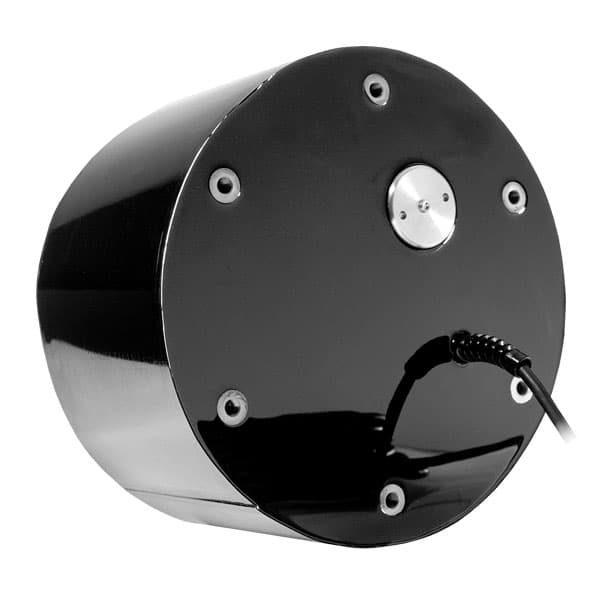
M190 Survey Ultrasonic Transducer from Airmar Technology Corporation
An underwater acoustic projector is an active sonar transducer designed to project high-energy sound into the marine environment. Driven by power amplifiers, projectors generate controlled pressure waves for active sonar, acoustic modems, positioning transponders, and subsea releases. High-frequency projectors often use compact piezoceramic plates or composites, while low-frequency units generally require larger radiating surfaces or resonant structures.
A hydrophone transducer is a passive receiving device that converts pressure fluctuations into electrical signals. These sensors detect vessel signatures, biological calls, seismic activity, and active sonar returns across wide frequency ranges. Modern units use lead zirconate titanate ceramics, piezopolymer films, or optical fibers coupled to low-noise preamplifiers.
An acoustic transceiver combines transmitting and receiving functions within a single housing, simplifying installation on space-constrained platforms. Common applications include acoustic modems, altimeters, and echosounder transducer assemblies. Transmit/receive switching circuits protect sensitive preamplifiers during high-voltage pulses, while digital filtering and receiver blanking reduce transducer ringing.
A transducer array combines multiple acoustic elements in a known geometry to form focused beams, determine signal arrival angles, and reject unwanted noise. Systems can electronically steer transmit pulses or form multiple receive beams without mechanical pan-and-tilt hardware. Modern platforms may use an underwater multi-axis transducer array, hull-conformal layout, or towed hydrophone array.
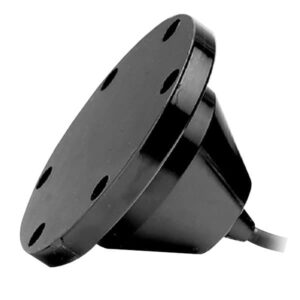
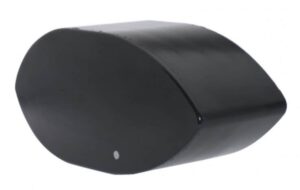
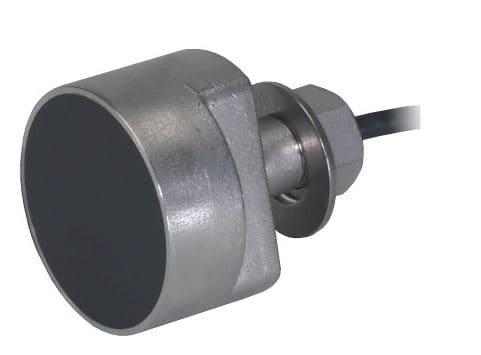
M194 Broadband 200 kHz Transducer from Airmar Technology Corporation
Because radio frequency signals attenuate rapidly in seawater, acoustic communication is the primary method for long-range wireless data exchange with submerged platforms. An acoustic modem uses a specialized transducer to transmit telemetry, control commands, and sensor data through the water column. Lower frequencies support longer ranges, while higher frequencies enable shorter-range, higher-bandwidth links.
Submerged unmanned platforms rely on acoustic transducers for positioning without continuous satellite availability. Ultra-Short Baseline (USBL) transducer heads measure phase or time differences to locate target transponders, while Long Baseline (LBL) networks use seabed transponders as position references. Doppler Velocity Logs (DVLs) measure Doppler shifts for velocity tracking, altimeters measure seafloor altitude using a single beam transducer, and subsea pressure transducers provide depth data.
Active sonar systems use marine transducers for mapping, target detection, and obstacle avoidance. Side-scan sonar transducers produce narrow horizontal beams for seabed backscatter mapping, while multibeam transducers generate wide acoustic swaths for bathymetric surveys. Forward-looking sonars use high-frequency ultrasonic transducer underwater arrays to identify hazards and obstacles in real time.
Passive acoustic monitoring enables unmanned platforms to track sound sources without emitting acoustic energy. Calibrated hydrophones support marine mammal monitoring, oceanographic research, and covert naval surveillance. Onboard processing can convert raw recordings into targeted data summaries, reducing storage and transmission requirements.
Autonomous Underwater Vehicles (AUVs) and Unmanned Underwater Vehicles (UUVs) require compact, energy-efficient transducers that fit within limited payload spaces without disrupting hydrodynamic performance. Acoustic windows and flush-mounted transducers protect sensor faces while maintaining smooth hull lines. Appropriate grounding, shielding, and separation from high-power motor drivers help prevent electromagnetic interference.
Remotely Operated Vehicles (ROVs) use tethered power to operate high-power imaging sonars, multi-axis sonar systems, acoustic cameras, and processing-intensive sensor suites. Thruster noise, structural vibration, and tether strumming can degrade acoustic performance. Positioning sonar heads away from thruster plumes and using vibration isolators helps preserve image clarity.
Unmanned Surface Vessels (USVs) carry hydrographic transducers, current profilers, and subsea acoustic gateways but must operate through hull slap, wave action, and entrained air bubbles. USV operators may use retractable poles, rigid drop keels, or towed bodies to position transducers below the aerated surface boundary layer.
Buoyancy-driven gliders and profiling floats use ultra-low-power transducers and passive hydrophones for long-duration environmental data collection. Their lack of active propellers provides quiet listening conditions during glide phases. Duty-cycling, event-triggered processing, and pressure-tolerant housings help conserve energy and maintain performance during repeated dives.
Subsea landers provide static platforms for long-duration passive acoustic monitoring and oceanographic sensing. Their lack of platform motion and thruster noise supports clear acoustic data, provided the structure is isolated from seabed vibration and cable movement. Extended deployments require biofouling protection, corrosion-resistant housings, and disciplined clocks.
Advances in acoustic materials, silicon fabrication, and additive manufacturing are improving modern marine transducer performance.
These technologies continue to expand subsea sensing capabilities while reducing platform integration requirements.


 Searching Companies & Products