Showcase your capabilities
If you design, build or supply Turbidity Sensors, create a profile to showcase your capabilities and connect with visitors who have an active requirement for your solutions.




Turbidity sensors are optical instruments that measure the effects of suspended particles in water, supporting continuous assessment of water clarity and particle loading. These sensors support water quality mapping, sediment plume tracking, environmental surveys, dredging oversight, and benthic monitoring.
This category features leading turbidity sensor manufacturers with solutions designed for USVs, AUVs, UUVs, ROVs, monitoring buoys, and seabed landers.
Read the Technology Overview
Hydrographic & Oceanographic Equipment for Unmanned & Autonomous Surface Vessels & Underwater Vehicles

If you design, build or supply Turbidity Sensors, create a profile to showcase your capabilities and connect with visitors who have an active requirement for your solutions.

A turbidity sensor measures the optical effects of suspended particles in water, providing an indirect indication of water clarity and particle loading. It is not a direct measurement of suspended sediment concentration, and sensor response can vary with particle size, shape, color, and composition. In marine and freshwater monitoring, these instruments support continuous observation where manual sampling is limited. A water turbidity sensor may be deployed as a standalone turbidity probe, integrated into a multiparameter sonde, or connected to an autonomous vehicle or fixed monitoring station.
Turbidity monitoring is widely used in environmental surveys, sediment studies, dredging oversight, and water quality assessment. Unlike a laboratory water turbidity meter, an ocean turbidity sensor or underwater turbidity monitor must operate under changing pressure, temperature, biofouling, ambient light, bubbles, and particle conditions. Instrument selection therefore depends on range, optical geometry, response time, deployment duration, integration, calibration, and suspended material.
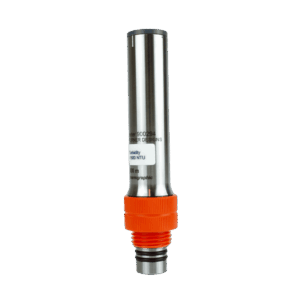
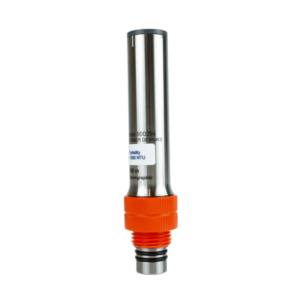
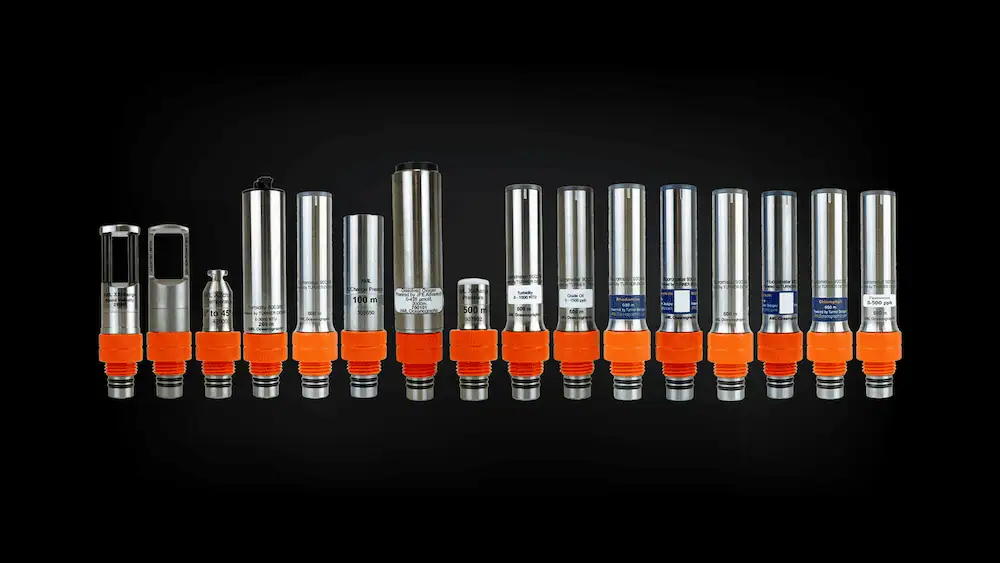
Turbidity Sensor by AML Oceanographic.
Different turbidity sensors use different optical arrangements to detect how particles scatter or attenuate light. The method affects sensitivity, range, comparability, and deployment suitability.
Nephelometric turbidity sensors measure light scattered at approximately 90 degrees to the incident beam. This geometry provides good sensitivity at relatively low turbidity. A nephelometric turbidity probe may use visible or near-infrared light depending on the applicable method and instrument design. Near-infrared systems are generally less sensitive to interference from water color.
An optical turbidity sensor based on backscatter detects light returned from particles at angles greater than 90 degrees. Compact backscatter designs suit submerged instruments and elevated sediment conditions. Response can vary with particle size, shape, composition, and concentration, while very high particle loads can cause nonlinear response or sensor saturation.
Submersible turbidity probes are designed for direct immersion in rivers, lakes, estuaries, coastal waters, and the ocean. They typically use pressure-resistant housings, sealed optical windows, and underwater connectors. For long deployments, fouling protection, depth rating, power consumption, cleaning access, window orientation, and sediment accumulation are important. Mechanical wipers or other anti-fouling measures may be required.
In-line and flow-through turbidity sensors measure water passing through a controlled sampling path rather than exposing the optics directly to the environment. These configurations suit pumped systems, research vessels, autonomous surface platforms, and laboratory-linked setups. Stable flow can improve consistency, but tubing residence time, bubbles, deposition, pump behavior, and contamination must be considered during turbidity testing.
Multiparameter sondes combine turbidity measurement with parameters such as conductivity, temperature, pressure, dissolved oxygen, pH, or fluorescence. Integrating a turbidity sensor for water quality into a shared package simplifies synchronized data collection and can reduce payload complexity. The additional measurements help distinguish sediment-driven changes from biological or chemical influences.
Autonomous and remotely operated platforms allow turbidity monitoring to move beyond fixed-point observations. Vehicle-mounted turbidity sensors can map plumes and combine optical data with navigation, current, depth, and other measurements.
Unmanned Surface Vehicles (USVs) can carry a turbidity monitor or turbidity logger along programmed transects to map surface or near-surface water quality. This is useful where turbidity varies over short distances in rivers, reservoirs, ports, estuaries, and coastal zones. Sensor placement should minimize interference from hull reflections, bubbles, propeller wash, and disturbed sediment.
Autonomous Underwater Vehicles (AUVs) and other Unmanned Underwater Vehicles (UUVs) can use turbidity probes to characterize suspended sediment through three-dimensional surveys. Applications include dredging plumes, natural resuspension, construction disturbance, and sediment transport. Navigation data allow measurements to be georeferenced, while adaptive mission logic can increase sampling density when a turbidity threshold or gradient is detected. Sampling frequency and vehicle speed should be matched to sensor response time to limit spatial smearing.
Remotely Operated Vehicles (ROVs) can provide real-time turbidity measurements during subsea inspection, construction, intervention, and scientific operations. Operators can relate turbidity sensor output to video, sonar, position, and task activity. Careful mounting is important because thrusters can resuspend seabed material and create readings that do not represent background conditions.
Monitoring buoys can support turbidity sensors at fixed depths or on profiling systems, while gliders can collect repeated measurements through the water column over wider areas. They can observe stratification, runoff, sediment transport, storms, and tidal changes. Low-power operation, data storage, and effective anti-fouling measures are particularly important during long deployments.
Seabed landers and benthic observatories use turbidity sensors to monitor particle conditions close to the seafloor. These measurements can characterize resuspension, settling, benthic boundary-layer processes, and disturbance. Instrument orientation, sampling height, local currents, and sediment deposition on the optical window should be considered when interpreting long-term records.
Turbidity values require a clear measurement method and reporting convention. Common references include:
Field programs should document calibration, optical configuration, reference standards, maintenance, and instrument procedures. Factory calibration supports traceability, but site-specific calibration against collected water samples may be needed when turbidity data are used to estimate suspended sediment concentration.
Turbidity sensing is increasingly combined with onboard processing, autonomous control, and complementary measurements:
These developments support turbidity sensors as active components of autonomous observing systems. For underwater applications, reliable results still depend on appropriate calibration, careful integration, suitable anti-fouling measures, and an understanding of how local particle properties influence optical response.


 Searching Companies & Products