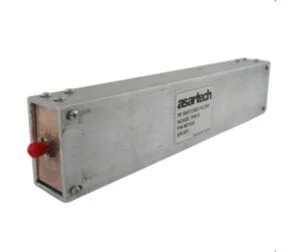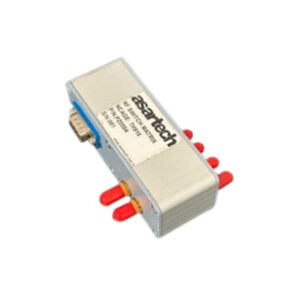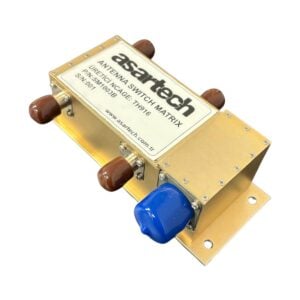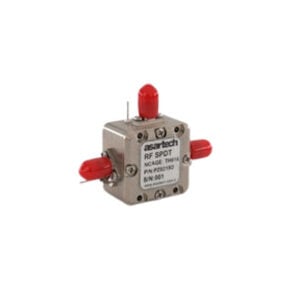

Showcase your capabilities
If you design, build or supply RF Switches, create a profile to showcase your capabilities and connect with visitors who have an active requirement for your solutions.




RF switches are electronic and electromechanical components that route radio frequency signals between antennas, transmitters, receivers, and RF circuits in UAVs, drones, and other unmanned systems. These components are available in solid-state, electromechanical, MEMS, and coaxial designs.
This page features RF switch manufacturers offering solutions for antenna selection, signal path switching, transmitter/receiver isolation, and RF front-end reconfiguration.
Read the Technology Overview
If you design, build or supply RF Switches, create a profile to showcase your capabilities and connect with visitors who have an active requirement for your solutions.

Radio Frequency (RF) switches are electronic or electromechanical components that route RF signals between different circuits, antennas, transmitters, and receivers. Used in drones, Unmanned Aerial Vehicles (UAVs), and other unmanned systems, these devices support signal path selection, antenna switching, and reconfiguration across communications, radar, navigation, and Electronic Warfare (EW) equipment.
RF switches use switching elements and control circuitry to connect or isolate RF ports in response to electrical or mechanical commands. They are available in solid-state, electromechanical, and Microelectromechanical Systems (MEMS) designs, with configurations ranging from individual coaxial switches to multiport RF switch matrices. Selection depends on factors including operating frequency, insertion loss, isolation, switching speed, RF power handling, and integration requirements.
RF switching allows communications and sensing systems to select, isolate, and reconfigure signal paths without physically changing connections. Key functions include:
These functions support adaptable RF architectures in unmanned platforms that operate across multiple communications, navigation, and sensing environments.
RF switches use different switching mechanisms and semiconductor technologies, each offering distinct characteristics in terms of signal loss, isolation, switching speed, power handling, control requirements, and physical integration.
| RF Switch Type | Operating Principle | Characteristics | Typical Applications |
| Electromechanical RF Switches | Mechanical contacts physically connect or disconnect RF signal paths. | Low insertion loss, high isolation, strong power handling, and relatively slow switching. | High-power RF systems, antenna routing, and test equipment. |
| Positive-Intrinsic-Negative (PIN) Diode RF Switches | Bias-controlled PIN diodes change RF impedance to establish or block signal paths. | Fast switching, good power handling, and suitability for microwave circuits. | Radar systems, transmit/receive switching, and RF front ends. |
| Gallium Arsenide (GaAs) RF Switches | GaAs field-effect transistors control RF signal conduction. | Fast switching, low loss, and good high-frequency performance. | UAV radios, microwave communications, and antenna selection. |
| RF Silicon-On-Insulator (SOI) and Complementary Metal-Oxide-Semiconductor (CMOS) Switches | Silicon-based transistor networks control signal paths electronically. | Compact integration, low control power, and compatibility with integrated RF circuits. | Multi-band radios, compact UAV electronics, and RF modules. |
| Gallium Nitride (GaN) RF Switches | GaN semiconductor devices provide electronically controlled RF paths. | High RF power handling potential and suitability for demanding microwave applications. | High-power communications, radar, and electronic warfare. |
| MEMS RF Switches | Micromechanical structures establish or interrupt electrical connections or capacitive paths. | Low insertion loss, high isolation, and very low static power in suitable designs. | Microwave payloads, antenna networks, and precision RF routing. |
| Solid-State RF Switches | Semiconductor devices perform switching without moving mechanical contacts. | Fast operation, compact packaging, and high switching endurance. | Communications, radar, and electronically reconfigurable RF systems. |
Radio frequency switches are manufactured in different port configurations to support applications ranging from basic on/off control to complex multi-channel signal routing. Common architectures include:
Coaxial RF switches and connectorized RF switch boxes provide externally accessible routing for test systems, ground equipment, and larger RF installations, while integrated solid-state devices support compact Printed Circuit Board (PCB) implementations. Larger RF switching matrices may incorporate programmable control, remote operation, and automated signal path configuration.
RF switches support Command and Control (C2), telemetry, video transmission, and payload data links in UAVs by routing signals between antennas, radios, filters, amplifiers, and other RF front-end components. Antenna switches allow communications equipment to select between different antenna paths, while multi-band systems use switching networks to connect the appropriate filtering and amplification stages for the selected operating frequency.
High-speed RF switches also support Software-Defined Radios (SDRs) and other reconfigurable communications systems by enabling electronically controlled routing between different signal paths and operating modes.
Radar systems use RF switches to select antennas, route signals through different receiver channels, and coordinate transmit and receive paths. PIN diode and other solid-state RF switches are suited to architectures requiring rapid switching, while selected high-power devices can be used where transmitter power levels place greater demands on the switching hardware.
RF switch matrices can also route signals between radar channels, sensing subsystems, and test equipment. In some phased-array or switched-beam architectures, switching networks support antenna subarray selection or predefined beam configurations.
Electronic Warfare (EW) and spectrum-monitoring payloads use RF switches to select between antennas, receivers, filters, and signal-processing paths across multiple operating bands. Wideband devices and remotely controlled switching networks allow Electronic Support Measures (ESM) and spectrum-monitoring systems to reconfigure signal acquisition paths as mission requirements change. High-power RF switches and switch matrices may also be incorporated into electronic attack systems to route transmit signals between amplifiers, antennas, and associated RF circuitry.
RF switches support Global Navigation Satellite System (GNSS) receivers and other radio-based navigation equipment by enabling antenna selection, redundant receiver routing, and controlled signal distribution. These functions can support both operational navigation systems and test environments where several RF sources or receiver paths must be selected electronically.
In UAVs and Unmanned Ground Vehicles (UGVs), switching circuits can connect alternative RF inputs to navigation receivers or measurement equipment. Coaxial switching assemblies are also used in GNSS testing and validation systems where receivers must be connected to different antennas, RF distribution paths, or simulated satellite signals.
RF switches operate alongside several related components used to control, distribute, and condition radio frequency signals, but their primary role is the active or electromechanical selection of signal paths. Key distinctions include:
These components are frequently integrated within RF front-end assemblies, where switches provide configurable signal routing alongside filtering, amplification, attenuation, and signal protection.
RF switching technologies continue to evolve to support higher operating frequencies, greater integration, increased power handling, and increasingly reconfigurable communications and sensing systems. Key developments include:
These developments are enabling more compact, adaptable, and highly integrated RF subsystems for UAVs, autonomous vehicles, and other platforms requiring reliable radio frequency signal management.


 Searching Companies & Products