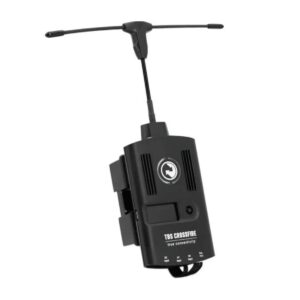

Showcase your capabilities
If you design, build or supply Radio Transmitters, create a profile to showcase your capabilities and connect with visitors who have an active requirement for your solutions.




Radio transmitters for drones and unmanned systems convert command, telemetry, sensor, video, or identification data into modulated signals. Used across UAVs, UGVs, USVs, and robotic systems, these transmitters support command-and-control links, health monitoring, payload data transfer, Remote ID broadcasts, emergency signaling, and multi-vehicle networking.
This page showcases leading drone radio transmitter suppliers and high-power transmission solutions for unmanned systems.
Read the Technology Overview
Software Defined Radios (SDRs) and IP Mesh Radios for UAV, Drones, UGVs and Robotics

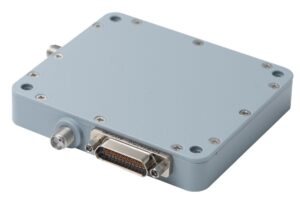
Anti-Jam GPS-GNSS Devices, Tactical Data Links, Telemetry Systems, Electronic Warfare Equipment & Flight Termination Systems

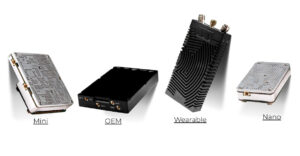
Mesh Radio, WiFi Transceivers & Wireless Mesh Network Technology for Drones, UAVs, UGVs & Robotics

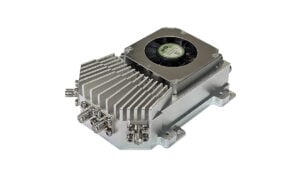
SDR Technology, UAV Data Links & Tracking Antennas for Long-Range Communications

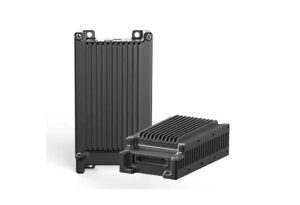
Cognitive Wireless MANET Radio & Mesh Technology for Tactical, Mission-Critical Datalinks

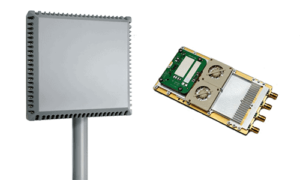
Wireless Radio Communications, Tactical Data Links & Radio Transceivers for Unmanned Systems

If you design, build or supply Radio Transmitters, create a profile to showcase your capabilities and connect with visitors who have an active requirement for your solutions.

Radio transmitters are core communication components within unmanned systems. Across air, ground, and maritime platforms, a robust radio transmitter helps commands, telemetry, payload data, and identification messages pass between the vehicle and control station as part of a wider radio link. In complex deployments, a radio transmitter for drone operations, UGVs, and USVs supports safety when paired with suitable receivers, antennas, software, and interference management.
The transmit function converts digital or electrical information into modulated radio-frequency signals. These components are often integrated into transceivers, telemetry modules, or radio data transmitter systems rather than operating alone. Selecting a drone radio transmitter and receiver setup is critical, as inadequate specifications can restrict range, increase latency, or create co-site interference with onboard GNSS receivers and flight controllers.
The command and control link sends flight or operational instructions to an unmanned vehicle. Dedicated UAV radio control channels are used for flight mode changes, waypoint updates, manual inputs, payload steering, and return-to-home overrides. UGVs use RF links for throttle, steering, braking, manipulator control, and emergency stops, while USVs use them for heading, speed, navigation modes, and collision-avoidance commands.
Professional systems often isolate C2 traffic from high-bandwidth payload data, or prioritize it through quality-of-service controls. Redundant platforms may use an independent transmitter and receiver for drone architectures, isolated power supplies, and failover logic.
Telemetry transmission gives operators and autonomy systems real-time diagnostic insight, including battery state, current draw, motor temperature, electronic speed controller status, inertial data, GNSS quality, mission progress, and link statistics.
Although telemetry requires less throughput than video, it still depends on reliable link design. Narrowband modulation, forward error correction, and suitable antenna placement can help a telemetry drone transmitter maintain contact where high-bandwidth payload links fail.
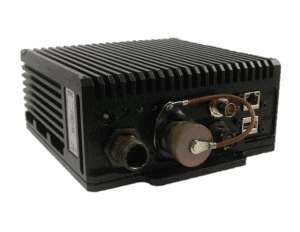
Drone Radio Transmitter by DTC
Payload data is often the most bandwidth-heavy requirement for a drone transmitter. EO/IR gimbals, LiDAR scanners, hyperspectral cameras, and maritime sonar payloads can generate large data volumes, although subsea systems usually require a tether, acoustic relay, surfacing antenna, USV relay, or topside radio link rather than direct underwater RF transmission.
Drone video transmitters support First-Person View (FPV) piloting, industrial inspection, and Intelligence, Surveillance, and Reconnaissance (ISR). Digital links use adaptive encoding, error correction, and link-aware bitrate control to reduce packet loss and frozen imagery when RF conditions degrade.
Unmanned systems transmit PNT data to maintain situational awareness within a wider mission network. Platforms may send GNSS coordinates, altitude, velocity, heading, and navigation confidence back to the GCS. In collaborative autonomy and drone swarming, airborne transmitter systems allow vehicles to exchange relative location data for formation flight, collision deconfliction, and distributed mapping.
Regulatory frameworks in many regions require certain unmanned aircraft to broadcast or make available identity and tracking data. In the United States, FAA Remote ID rules apply to many drones and can include identity, position, altitude, velocity, time mark, emergency status, and control station or takeoff location, depending on the compliance method. These low-power Wi-Fi or Bluetooth functions must be integrated to avoid degrading GNSS reception or primary control links.
When a primary data link is lost or degraded, onboard failsafe logic may trigger loiter, land, hold-position, or return-to-home behavior. A secondary low-rate link, beacon, or emergency transmitter can also alert the ground crew and transmit last-known coordinates or status. Professional systems treat emergency signaling as a redundancy function, separate from high-throughput payload radios where required.
For manual flight override, prototyping, and short-range commercial work, handheld transmitters remain common. They combine control sticks, switches, and a radio frequency module in one mobile unit.
For BVLOS operations, military missions, and long-endurance applications, teams often use Ground Control Station radios with ruggedized enclosures, tracking antennas, higher link budgets, and Ethernet/IP integration for telemetry and mission planning software.
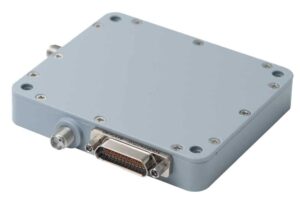
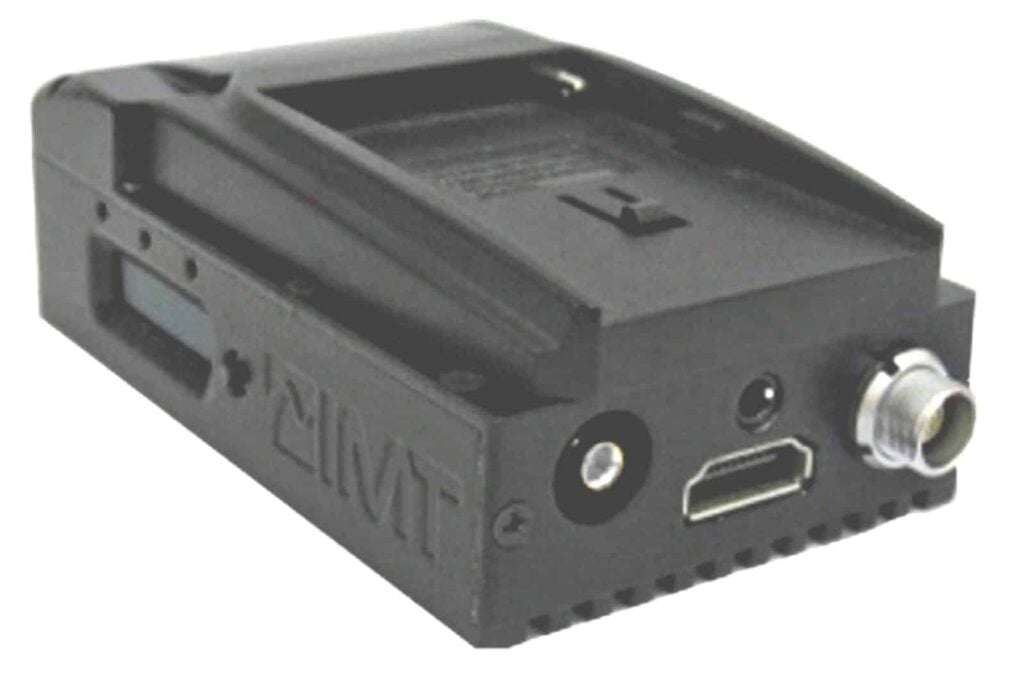
FM Flight Termination Transmitter by TUALCOM
Airborne transmitter selection is shaped by size, weight, and power limits, as well as cooling, antenna placement, frequency, and interference control. An appropriate airborne transmitter helps maintain link quality without excessive battery draw, heat, or electromagnetic interference.
Onboard UAV transmitters must balance output power with thermal efficiency and spectrum compliance. Fixed-wing aircraft carrying a high-grade drone transmitter require careful antenna placement to avoid airframe masking. A leading UAV transmitter supplier can support integration, but filtering, testing, and installation remain essential for a reliable UAV radio transmitter architecture.
Unmanned Ground Vehicles (UGVs) use radio transmitters, but their RF environment differs from aircraft. Terrain blockage, urban clutter, foliage, metal structures, and multipath reflections can make standard line-of-sight radio transmitters unsuitable.
UGV engineers may select lower-frequency bands for diffraction and obstruction tolerance, or use mobile ad-hoc mesh networking to maintain connectivity through relay nodes.
Radio transmitters are also used on Unmanned Surface Vehicles (USVs), where RF communications normally occur above the waterline. Challenges include over-water multipath fading, vessel motion, wave action, salt fog, and low antenna heights that limit the radio horizon.
Marine platforms require ruggedized connectors, RF coaxial cables, antennas, and enclosures built from corrosion-resistant materials and sealed against moisture ingress.
When operations demand extended range, throughput is often traded for link margin. Long-range telemetry transmitters use narrow-bandwidth modulation and coding to maintain command or status connectivity. Real-world range depends on antenna gain, Fresnel zone clearance, terrain, atmospheric conditions, local RF noise, and regulatory power limits.
Legacy analog video transmitters are still used where very low-latency FPV piloting is required, but professional operations increasingly use digital video transmitters. Digital systems can support encryption, error correction, and IP streaming, producing clearer imagery than analog links affected by static, breakup, or rolling lines.
Mobile Ad-hoc Networks use mesh radio transmitters to turn unmanned assets into network nodes. If a ground robot moves behind an obstacle, it can route telemetry and video through a nearby airborne drone acting as a relay. Mesh transmitters support swarming, collaborative tactical operations, and wide-area search and rescue.
For beyond-line-of-sight control, engineers may combine local RF links, cellular LTE/5G networks, and Satellite Communications. Cellular transmitters provide IP-native connections in covered areas, while SATCOM terminals support remote maritime USVs and high-altitude, long-endurance aircraft where coverage, terminal capability, antenna pointing, and service access are available.
3GPP Non-Terrestrial Networks enable hybrid cellular-satellite modems to move between terrestrial and space-based networks without requiring completely separate heavy radio payloads.
Software-Defined Radios use programmable digital processing to support configurable waveforms and link functions. With suitable RF front ends, filters, antennas, power amplifiers, bandwidth, software, cooling, and spectrum approval, SDR-based systems can support telemetry, video, or encrypted tactical data links. This flexible aerospace transmitter approach is used by integrators adapting hardware to different mission and regulatory requirements.
| Frequency Band | Common Frequencies | Typical Application | Primary Characteristics |
| UHF / ISM | 433 MHz, 868 MHz, 915 MHz | Long-Range Telemetry, C2 | Good penetration, long range, low data bandwidth. |
| S-Band / ISM | 2.4 GHz | RC Control, Wi-Fi Data Links | Balanced range and bandwidth, higher congestion risk. |
| C-Band / ISM | 5.8 GHz | FPV Video, High-Throughput Data | High data rates, compact antennas, primarily line-of-sight. |
| L/S/C-Licensed | Varies by national allocation | Military & Tactical Links | Coordinated spectrum use, good range and throughput when paired with suitable waveform design and encryption. |
| Ku / Ka-Band | 12 GHz to 40 GHz | SATCOM Beyond-Line-of-Sight | High throughput and wide-area coverage, with susceptibility to rain fade. |
Recent advances in electronic components and signal processing are changing how unmanned platforms manage data transmission in contested or congested RF environments.
These developments help future communication frameworks remain stable as spectrum congestion increases, provided system design, spectrum compliance, antenna integration, and interference testing are properly addressed.


 Searching Companies & Products