




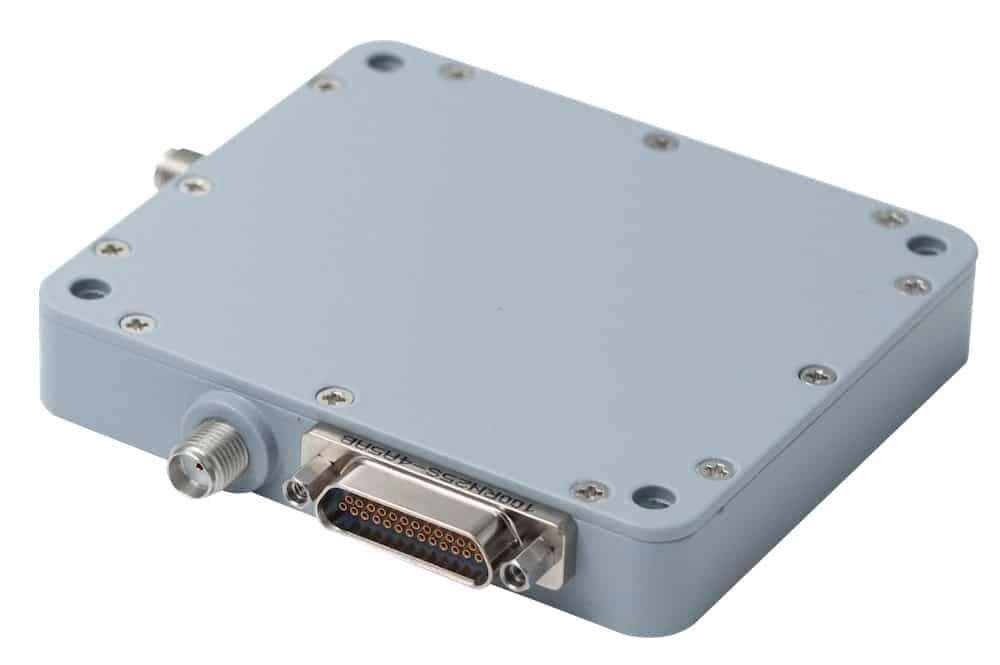
The Flight Termination Transmitter (TUALFTT) from TUALCOM generates precise FM-based termination signals in response to control console or PC commands. Designed for use in flight safety systems, it supports the configuration of IRIG tone sequences and programmable RF center frequencies between 390 MHz and 450 MHz. The system can be programmed via PC software through an RS-232 interface, where users can select Tone A, B, C, D, SAFE, ARM, and TERM modes, and monitor system status through an intuitive graphical interface.
Compact, lightweight, and ruggedized, the transmitter can be integrated with high-power amplifiers for mobile or fixed ground stations, as well as air and naval platforms. An optional embedded signal level measurement module provides real-time feedback on transmitted power. Built to meet RCC 319 and MIL-STD-810G standards, TUALFTT delivers a robust and reliable flight termination solution with long operational life and reverse-polarity power protection for demanding test and range safety operations.
Specifications:
| Frequency Range: | 390–450 MHz |
| Max RF Output Power: | Max. 20 dBm (Adjustable) |
| Input Voltage (V): | 18–36 VDC |
| Operating Voltage & Input Current: | Max. 150 mA @ 28 VDC |
| Power Consumption (W): | < 4 |
| Tone Frequencies: | 20 IRIG Tones |
| Outputs: | 4 Tone Outputs |
| Programming Interface: | RS-232 |
| Connectors: | SMA, 25-pin Micro-D Socket |
| Dimensions (cm): | 7.5 × 6.5 × 1.25 |
| Weight (g): | 108 |
| Operating Temperature (°C): | -40 to +85 |
| Environmental Condition: | MIL-STD-810G |
| Compliance: | RCC 319-14, MIL-STD-810G |





