
Showcase your capabilities
If you design, build or supply Fuel Flow Sensors, create a profile to showcase your capabilities and connect with visitors who have an active requirement for your solutions.




Fuel flow sensors for UAVs and drones provide real-time monitoring of fuel consumption, propulsion efficiency, and mission endurance across fixed-wing, VTOL, and long-endurance aircraft. Integrated into military drones, ISR platforms, cargo UAVs, and industrial inspection systems, fuel flow meters support autonomous fuel management and propulsion health monitoring under demanding SWaP constraints.
This page features leading UAV fuel flow sensor manufacturers and fuel flow meters for unmanned aircraft, offering solutions available in turbine, ultrasonic, Coriolis, thermal, and MEMS-based configurations.
Read the Technology Overview
High-Accuracy Ultrasonic Fuel Flow Meters for UAVs | Real-Time UAV Fuel Monitoring

If you design, build or supply Fuel Flow Sensors, create a profile to showcase your capabilities and connect with visitors who have an active requirement for your solutions.

Fuel flow sensors provide real-time measurement of fuel consumption within UAV propulsion systems, allowing operators and onboard flight systems to monitor engine performance, fuel burn, and remaining endurance. As unmanned aircraft undertake long-range and Beyond Visual Line of Sight (BVLOS) missions, precise fuel monitoring is a core component of operational safety and mission planning.
Modern UAV fuel flow sensors operate within constrained SWaP environments while maintaining accuracy under vibration, thermal cycling, and fluctuating altitudes. They are integrated into fixed-wing UAVs, VTOL platforms, military drones, and long-endurance ISR aircraft to support autonomous fuel management and propulsion health monitoring. Accurate data ensures mission parameters remain viable and provides a safety buffer for recovery.
Turbine fuel flow sensors utilize a rotating internal turbine wheel to measure fuel velocity. As fluid passes through, the rotational speed is converted into a flow rate output via magnetic or optical pickups. These are utilized in gasoline-powered UAVs due to their compact footprint and simple integration. Engineering teams must account for sensitivity to fuel contamination and the pulsating flow profiles generated by small piston engines.
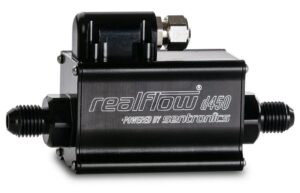
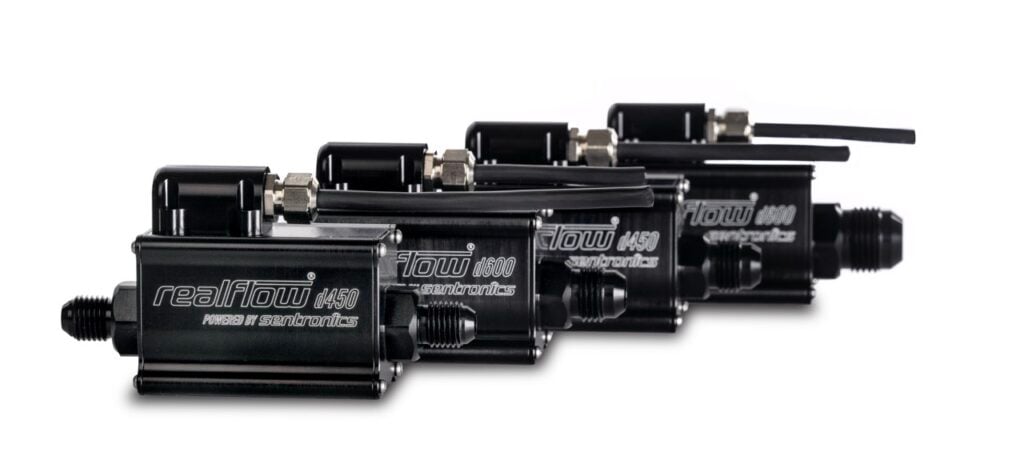
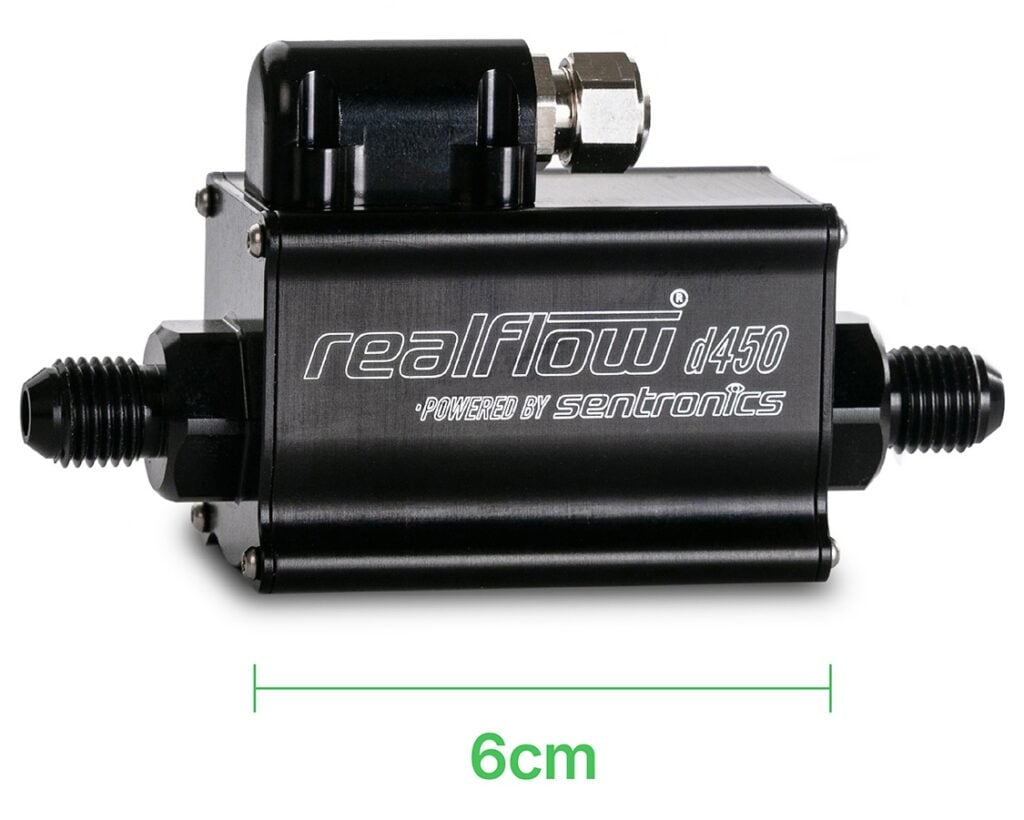
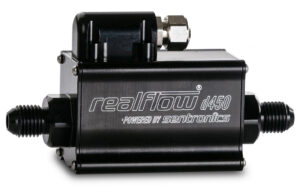
RealFlow® D-Series ultrasonic fuel flow meter by Sentronics
Positive displacement sensors measure fuel flow by mechanically isolating and counting fixed fluid volumes. This technology provides measurement accuracy at low flow rates. They are often selected for endurance-focused UAV applications where range prediction is a priority. This precision involves increased mechanical complexity and higher weight compared to turbine counterparts.
Using acoustic wave propagation to determine flow rates, ultrasonic sensors eliminate moving parts and reduce mechanical wear. The non-invasive nature is suitable for platforms requiring a low pressure drop. Performance can be compromised if the fuel becomes aerated or contains air bubbles.
Coriolis sensors measure fuel mass flow by analyzing inertial forces inside vibrating sensor tubes. Unlike volumetric systems, they remain accurate regardless of changes in fuel density or temperature. Sensitivity to high-frequency engine vibration often requires specialized damping.
These sensors determine flow rates by monitoring heat transfer characteristics within the fuel stream. They offer low-flow sensitivity but require clean fuel to maintain accuracy, as contamination on the sensing element can lead to thermal dissipation drift.
Leveraging semiconductor fabrication, MEMS-based sensors offer a reduced SWaP profile. These are integrated into micro-UAVs and small VTOL platforms where payload capacity is limited. Digital compensation is used to improve the accuracy and reliability of these sensors.
By measuring the pressure drop across a Venturi restriction, these systems offer a lightweight solution. They require real-time compensation for fuel density and temperature to remain accurate across varying flight envelopes.
Smart digital fuel flow sensors integrate onboard processing for real-time diagnostics and error compensation. In modern architectures, UAVCAN (Cyphal) and CAN Bus interfaces are utilized for high-reliability telemetry communication with the Flight Control Computer and Electronic Control Unit.
ISR platforms rely on fuel flow meters to monitor loiter time and facilitate recovery during surveillance missions. Fuel flow rate sensors provide endurance data for mission planning and autonomous flight management.
For long-endurance missions, measurement errors can compound into a safety margin violation over several hours. Stable sensors allow for mission re-tasking based on actual burn rates rather than theoretical estimates.
Military platforms utilize heavy-fuel engines in contested environments. Sensors in these systems are ruggedized to withstand vibration and fuel contamination.
Ship-launched UAVs expose fuel flow sensors to salt fog, humidity, shock loading, and corrosion. Marine-capable sensor designs emphasize environmental sealing and operation during high-vibration launch and recovery cycles.
Industrial UAVs conducting infrastructure inspection use combustion propulsion systems for extended endurance. Fuel flow monitoring helps operators optimize flight planning and maintenance scheduling.
Autonomous cargo UAVs use fuel flow sensors to calculate endurance and mission range based on varying payload conditions, supporting route optimization.
HAPS platforms operate in low-pressure and low-temperature environments for long mission durations. While most systems are solar powered, jet-powered variants may require fuel monitoring for propulsion efficiency and endurance management.
Hydrogen and hybrid-electric UAVs require fuel monitoring approaches capable of handling gaseous or cryogenic fuels. These propulsion systems drive the development of sensing technologies for alternative-energy aircraft.
Fuel flow sensors for gasoline systems are designed to tolerate volatile fuels while maintaining performance during throttle changes and altitude variation.
Heavy-fuel UAV engines operating on JP-8 or diesel support military logistics. Sensors for these systems handle higher fuel viscosity and military fuel additives.
Fuel monitoring systems within diesel platforms operate under higher pressures and varying fuel temperatures compared with gasoline engines.
Fuel flow sensors accommodate varying fluid properties and maintain compatibility with synthetic and sustainable fuel blends.
Alternative fuel UAVs present chemical compatibility challenges. Sensor materials and seal technologies are selected to ensure reliability within these propulsion systems.
Chemical resistance is used for maintaining sensor reliability and calibration stability. Aerospace-grade coatings and chemically stable elastomers help prevent degradation.
Sensor placement is important for maintaining stable measurement. Plumbing design should avoid turbulence or trapped air that affects accuracy.
Fuel system design helps minimize cavitation during altitude changes and maneuvering, ensuring stable readings.
Certain sensor technologies require specific installation orientations to maintain calibration and internal operation within the propulsion bay.
Shielded wiring, filtered power inputs, and grounding practices are used to ensure signal transmission and noise reduction.
Sensors are installed in locations that allow inspection and replacement during field maintenance operations, particularly in expeditionary deployments.
Digital sensors support field calibration and built-in diagnostic functionality to manage maintenance requirements.
Integration engineers account for the mass of the sensor and associated plumbing when optimizing aircraft balance and center-of-gravity.
When selecting a UAV fuel flow sensor manufacturer, engineering teams evaluate measurement accuracy, fuel compatibility, SWaP characteristics, and environmental ruggedization. For defense and long-endurance applications, manufacturers with aerospace qualification experience and integration support are often prioritized.


 Searching Companies & Products