



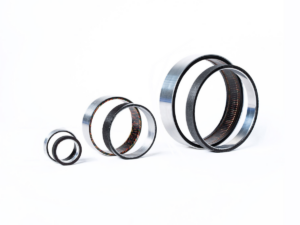

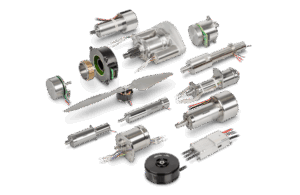

Showcase your capabilities
If you design, build or supply Custom Drone Motors, create a profile to showcase your capabilities and connect with visitors who have an active requirement for your solutions.




Custom drone motors are application-specific electric motors engineered to meet the performance, efficiency, and integration requirements of UAVs, multirotor drones, fixed-wing aircraft, and VTOL platforms. Customization options typically include bespoke windings, motor KV ratings, dimensions, mounting interfaces, and environmental protection.
This page features custom drone motor suppliers providing OEM design, prototyping, precision manufacturing, and testing services.
Read the Technology Overview
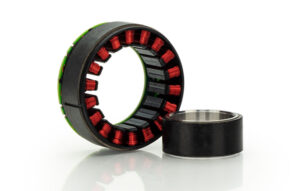
Cutting-Edge Precision Motor & Motion Solutions for Unmanned Aerial Vehicles

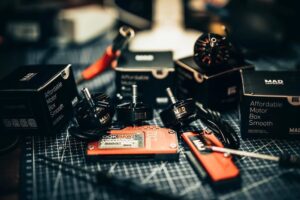
Power & Propulsion Solutions for UAVs: Drone Motors, ESCs, Batteries & Propellers

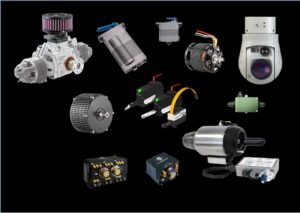
COTS & Custom Drone Propellers, Brushed & BLDC motors, and ESCs for UAVs

If you design, build or supply Custom Drone Motors, create a profile to showcase your capabilities and connect with visitors who have an active requirement for your solutions.

Custom drone motors are application-specific electric motors designed and manufactured to meet the mechanical, electrical, and performance requirements of Unmanned Aerial Vehicles (UAVs). Unlike standard off-the-shelf motors, custom designs can be optimized for specific torque and speed characteristics, electrical efficiency, weight constraints, thermal conditions, and integration requirements. Most use a wound stator and permanent-magnet rotor, with electronically controlled currents generating the magnetic fields required to produce rotational torque.
Custom drone motor solutions are available for multirotor drones, fixed-wing UAVs, Vertical Takeoff and Landing (VTOL) aircraft, and specialized unmanned platforms. Drone motor Original Equipment Manufacturer (OEM) services include bespoke motor engineering, prototyping, testing, and production for UAV developers requiring tailored components or alternatives to standard motor configurations.
Custom drone motors can be engineered around specific aircraft architectures, operating conditions, and electrical requirements. Manufacturers offer a range of customization options to meet UAV performance targets and mechanical integration constraints.
These modifications allow manufacturers to adapt motor performance and construction to specific UAV requirements rather than relying on fixed, commercially available configurations.
Custom drone motors can be manufactured using different electromagnetic architectures, rotor configurations, and drive arrangements. The appropriate design depends on the required torque, operating speed, installation space, and electrical system architecture. These classifications describe different aspects of motor design and are not mutually exclusive.
| Motor Type | Characteristics and Customization Options |
| Brushless Direct Current (BLDC) Motors | Electronically commutated permanent-magnet motors with customizable winding configurations, magnetic pole arrangements, KV ratings, and operating characteristics. |
| Outrunner Motors | External-rotor designs offering relatively high torque at lower rotational speeds, with options for customized stator dimensions, rotor geometry, and propeller mounting arrangements. |
| Inrunner Motors | Internal-rotor configurations often suited to higher-speed operation, with customized winding designs, shaft arrangements, and optional gear reduction. |
| Axial Flux Motors | Motor architectures with magnetic flux parallel to the shaft axis, offering alternative packaging and torque-density characteristics for specialized UAV designs. |
| Direct-Drive Motors | Motors designed to drive propellers without mechanical gear reduction, with torque and speed characteristics matched to the intended propeller load. |
| Geared Motors | Motor assemblies incorporating reduction gearboxes to achieve application-specific output torque and rotational speed. |
| Frameless and Integrated Motors | Motor stator and rotor assemblies designed for incorporation into custom structures, with options for integrated sensing, cooling, and motor control electronics. |
These categories include overlapping configurations. For example, a custom BLDC motor may use an outrunner architecture and operate as a direct-drive motor.
Selecting a custom drone motor requires evaluating the complete operating profile rather than relying solely on maximum power or peak thrust. Motor sizing involves matching torque-speed characteristics, propeller loading, electrical limits, and thermal performance to the aircraft’s intended operating conditions.
Motor manufacturers may use performance simulations, dynamometer measurements, and motor-propeller testing to validate sizing decisions before finalizing a custom design.
Heavy-lift UAVs and cargo drones require motors capable of sustaining high torque under demanding operating loads. Custom designs may incorporate larger stators, optimized windings, and improved heat dissipation to support sustained hover, payload transport, and repeated takeoff and landing cycles.
Long-endurance and BVLOS UAVs benefit from motors optimized for efficiency at their principal operating points. Custom KV ratings, winding configurations, and magnetic designs can be selected to reduce electrical losses during sustained cruise or other mission-critical flight conditions.
Tactical UAVs used for ISR may require custom motors with reduced acoustic signatures and controlled Electromagnetic Interference (EMI). Manufacturers can optimize electromagnetic design, mechanical balance, bearing selection, and integration with motor controllers to reduce noise and electrical interference affecting onboard equipment.
UAVs operating in coastal, offshore, and industrial environments may require enhanced protection against moisture, salt spray, dust, and chemical exposure. Custom drone motors can incorporate corrosion-resistant components, protective coatings, sealed housings, and winding impregnation. Sealing must be balanced against cooling requirements, while fully submerged operation requires a motor specifically designed and qualified for that environment.
High-speed UAV interceptors and aerial target drones may require motors designed for rapid throttle response, high rotational speeds, and short-duration peak power. Custom motor designs can prioritize rotor strength, low rotational inertia, electrical efficiency at high speed, and thermal capacity during demanding acceleration profiles.
Compact UAVs and specialized airframes may require motors with unconventional dimensions or mounting arrangements. Frameless assemblies, hollow-shaft configurations, and integrated motor structures can reduce packaging requirements while accommodating wiring, mechanical interfaces, and other airframe components.
Prototype development involves translating electrical and mechanical specifications into functional motor assemblies for initial evaluation. Manufacturers may use electromagnetic simulation, mechanical modeling, and experimental testing to assess performance before committing to production tooling.
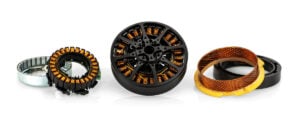
Custom stator manufacturing includes producing or sourcing electrical steel laminations, assembling stator stacks, and applying electrical insulation. Stator diameter, stack length, slot geometry, and lamination materials influence electromagnetic performance, manufacturing complexity, and motor efficiency.
Rotor production involves machining or forming rotor components, installing permanent magnets, and verifying dimensional accuracy. Magnet positioning, retention methods, rotor concentricity, and mechanical strength are particularly important for high-speed custom drone motors.
Motor windings can be produced using automated winding equipment or manual processes, depending on motor geometry, winding complexity, and production volume. Wire selection, winding patterns, insulation, and termination methods influence resistance, inductance, thermal behavior, and manufacturing consistency.
Assembly includes integrating stators, rotors, bearings, shafts, housings, and electrical connections. Rotor balancing and mechanical inspection help minimize vibration, bearing loads, and mechanical losses, particularly in motors intended for sustained high-speed operation.
Custom drone motor OEM services may support small engineering batches, limited production runs, and larger manufacturing programs. Production requirements influence tooling selection, assembly automation, component procurement, quality inspection, and unit costs.
Manufacturing quality assurance may include dimensional inspection, winding resistance measurement, insulation testing, and functional motor checks. Production traceability can link individual motors or manufacturing batches to component records, inspection results, and test documentation.
Custom drone motor testing verifies whether a design meets specified electrical, mechanical, thermal, and environmental performance requirements. Manufacturers may conduct the following evaluations during development, qualification, and production acceptance:
Testing results provide evidence to refine motor designs, verify performance specifications, and establish production acceptance criteria.
Custom drone motor manufacturers may work to different electrical, manufacturing, and environmental requirements depending on the intended aircraft, customer specifications, and certification obligations. Applicable standards depend on the motor design and its integration into the aircraft.
Applicable standards and qualification procedures should be established according to the motor’s intended use, aircraft integration requirements, and customer acceptance criteria.


 Searching Companies & Products


