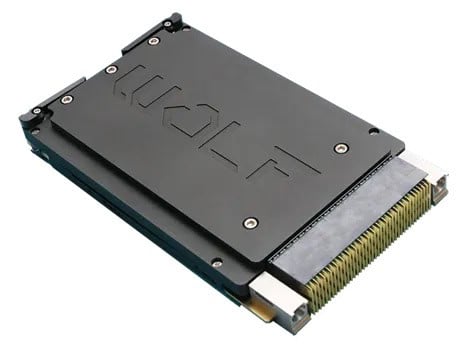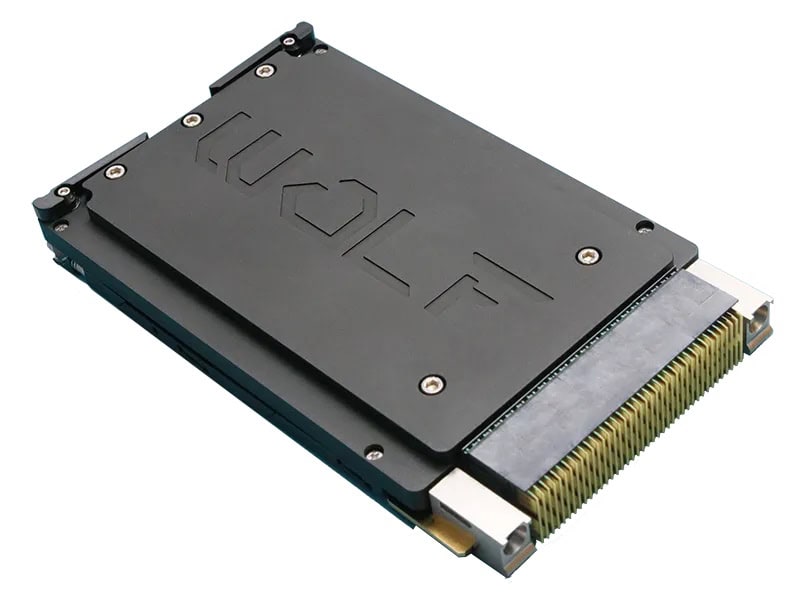
WOLF Advanced Technology’s whitepaper, AI at the Tactical Edge: Rugged GPU + FPGA Solutions for Next-Gen Unmanned Systems, explores how the company combines NVIDIA’s latest GPU architectures with its proprietary FGX FPGA technology to enable advanced onboard processing for autonomous vehicles.
 This integration delivers real-time AI performance, sensor interoperability, and environmental resilience for unmanned platforms operating across air, land, sea, and subsea domains.
As unmanned vehicles transition from preprogrammed automation to adaptive autonomy, onboard computing must process large sensor datasets while maintaining deterministic performance in compact, rugged designs. Systems must handle AI inferencing, data fusion, and decision-making directly at the edge, often under power, thermal, and size constraints. WOLF’s embedded computing modules are engineered specifically to meet these challenges.
Edge Computing for Autonomous Platforms
WOLF designs embedded solutions in VPX, VNX+, XMC, and custom small form factor (SFF) configurations, balancing computational performance with low latency and efficiency. Leveraging NVIDIA Jetson AGX Orin and Thor, Ada, and Blackwell architectures, these platforms deliver high-performance AI processing suited to complex onboard workloads such as object detection, navigation, and simultaneous localization and mapping (SLAM).
To complement GPU-based AI acceleration, WOLF’s FGX FPGA performs video capture, format conversion, compression, and display in real time. This functionality bridges legacy and modern sensor types, ensuring compatibility across a range of mission profiles while minimizing latency and data bottlenecks.
Deterministic Networking with Time-Sensitive Networking (TSN)
The company’s solutions are designed for Time-Sensitive Networking (TSN), providing deterministic, low-latency Ethernet communication with sub-100 microsecond delay and synchronization accuracy within ±100 nanoseconds. TSN’s precision and reliability support coordinated data exchange between onboard systems and networked vehicles, enabling synchronized operation across UAVs, UGVs, and maritime platforms.
Compared with conventional Ethernet, TSN reduces jitter and packet loss, delivering the timing accuracy required for distributed sensor fusion, swarm coordination, and precision navigation.
AI Performance and Efficiency
Benchmark results presented in the whitepaper demonstrate significant inference performance and energy efficiency. On NVIDIA Jetson AGX Orin, systems achieve approximately 274 images per second per watt for ResNet-50 image classification and 6.7 images per second per watt for RetinaNet object detection. The Jetson Xavier NX records around 112 images per second per watt for ResNet-50 and 3.1 images per second per watt for RetinaNet.
This performance enables real-time processing of multi-sensor data under strict power budgets, making the technology suitable for size- and weight-constrained unmanned vehicles.
Applications Across Unmanned Domains
WOLF’s computing platforms support a wide variety of autonomous applications, including:
- ISR UAVs: Real-time EO/IR image recognition and tracking.
- UGVs: Multi-sensor fusion for autonomous route planning and hazard detection.
- USVs and UUVs: Radar and sonar data interpretation for obstacle avoidance and precise navigation.
- Tactical Robots and Loitering Systems: Onboard target classification and terrain analysis.
Integration of TSN with embedded AI allows fleets of heterogeneous unmanned systems to share information and operate collaboratively, enhancing overall situational understanding and operational flexibility.
Rugged Embedded Design and Certification Support
WOLF’s products are engineered to maintain reliability under extreme environmental and operational conditions. The company’s modules are MIL-STD-810G tested and designed with support for DO-254 and DO-178C certification processes, ensuring alignment with aerospace and safety-critical standards.
Cooling options include conduction, air, and liquid flow-through systems. Enclosures feature EMI shielding and conformal coatings to protect against shock, vibration, and environmental stress.
Available configurations include:
- VPX 3U and 6U modules offering 60–300W operation and compatibility with multiple video interfaces including12G/6G/3G-SDI, CoaXPress, ARINC 818, and STANAG-3350.
- XMC modules that integrate GPU, FGX, and PCIe switching in mezzanine form factors.
- VNX+ (VITA 90) modules optimized for high-performance computing in constrained volumes.
These options enable integrators to select the optimal balance of performance, form factor, and environmental resilience for their specific platform requirements.
AI Computing at the Edge
By integrating NVIDIA GPU acceleration with FGX FPGA signal processing, WOLF provides a scalable, low-latency computing foundation for autonomous unmanned systems. With deterministic networking, ruggedized architectures, and safety-certifiable design support, these platforms deliver the processing power and flexibility needed to operate independently in dynamic, data-rich environments.
This combination of high-efficiency AI processing, advanced networking, and rugged form factors positions WOLF’s solutions as key enablers for the next generation of intelligent unmanned vehicles.