
WOLF Advanced Technology’s whitepaper, Eyes in the Sky, Intelligence at the Edge: Hybrid GPU–FPGA Architectures for Real-Time Airborne EO/IR Missions, examines how hybrid GPU–FPGA architectures can address the competing processing and SWaP-C demands of modern airborne Electro-Optical/Infrared (EO/IR) systems.
A single aircraft may carry multiple electro-optical cameras, thermal imagers, laser rangefinders, and, in some cases, radar payloads. Data from these sensors must be synchronized, processed, and presented to operators without introducing unacceptable latency, while helicopters, fixed-wing aircraft, and unmanned aerial systems operate within strict size, weight, power, and cost (SWaP-C) constraints.
Combining FPGA and GPU Processing
The whitepaper explores how FPGAs and NVIDIA GPUs can address different stages of the EO/IR processing pipeline.
FPGAs are suited to deterministic, low-latency functions immediately after acquisition, including interfacing with numerous video standards, grabbing and timestamping frames, synchronizing multiple streams, and performing image correction with predictable timing regardless of computational load.
NVIDIA GPUs, with thousands of CUDA® cores and dedicated Tensor Cores, provide the massively parallel processing required for functions including real-time object detection and classification, multi-object tracking, image enhancement and super-resolution, sensor fusion, geospatial overlays, and operator displays. Hardware video encoding and decoding can also be handled through NVENC and NVDEC.
The paper also examines GPUDirect RDMA, which allows FPGA-prepared image buffers to transfer directly into GPU memory. Reducing host-memory copies and CPU involvement allows AI algorithms to begin processing sooner, with the benefits increasing when multiple high-resolution electro-optical and thermal cameras are operating simultaneously.
This approach can also create processing headroom for more sophisticated models to operate within the timing budget available to an airborne mission.
Edge AI for Airborne Operations
The whitepaper considers what this architecture can deliver in practice across airborne law enforcement, search and rescue, and disaster response.
AI processing can be used to detect people, vehicles, vessels, life rafts, thermal signatures, wildfire hotspots, and damaged infrastructure, helping direct operator attention toward events requiring immediate action. In these applications, AI functions as a force multiplier to reduce cognitive workload rather than replace human decision-making.
Because analysis takes place aboard the aircraft, actionable intelligence can also reach responders where communications networks are degraded or unavailable.
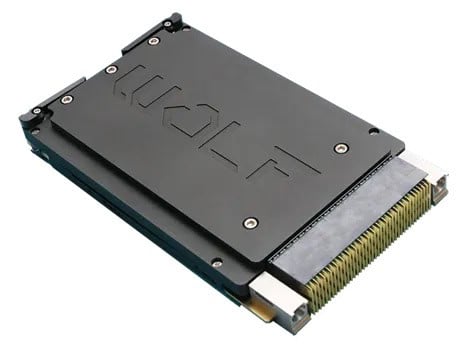
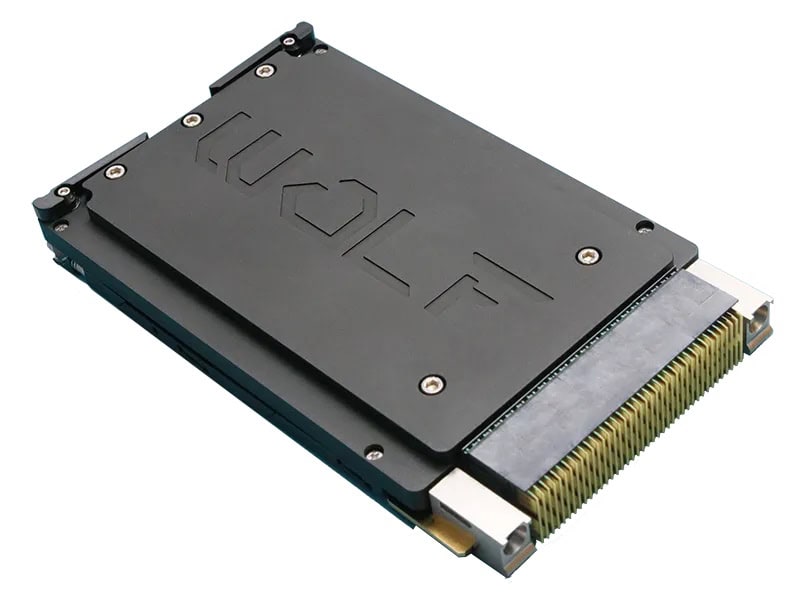
WOLF technologies covered in the whitepaper include the WOLF-3570, which combines an NVIDIA RTX™ 2000 Ada GPU with an integrated FGX2 FPGA and GPUDirect RDMA on a single XMC module; the WOLF-3185 FGX2 for deterministic sensor acquisition and preprocessing; and the WOLF-3476 and WOLF-3576 for GPU-accelerated analytics and visualization.
Maintaining Sensor-Data Integrity
The whitepaper concludes with a discussion of operator trust and sensor-data integrity as generative enhancement, autonomous cueing, and vision-language models enter airborne workflows.
Displays must clearly distinguish original sensor imagery from enhanced, fused, or inferred information. Systems must also preserve an auditable chain of provenance covering original frames, timestamps, calibration state, processing steps, and model versions.
Read the full whitepaper: Eyes in the Sky, Intelligence at the Edge: Hybrid GPU–FPGA Architectures for Real-Time Airborne EO/IR Missions.