

Showcase your capabilities
If you design, build or supply Electric Motor Adhesive, create a profile to showcase your capabilities and connect with visitors who have an active requirement for your solutions.




Electric motor adhesive is used to bond, retain, insulate, seal, and stabilize components within propulsion systems for drones and robotic platforms. These adhesives are used for applications such as magnet bonding, rotor and shaft retention, stator stack assembly, winding impregnation, and insulation fixation.
This category showcases electric motor adhesive manufacturers with solutions for Unmanned Aerial Vehicles (UAVs) and unmanned systems.
Read the Technology Overview
If you design, build or supply Electric Motor Adhesive, create a profile to showcase your capabilities and connect with visitors who have an active requirement for your solutions.

Electric motor adhesive is used to bond, retain, insulate, seal, and stabilize motor components. These materials can help manage vibration, thermal cycling, centrifugal loading, electrical isolation, and tight packaging. In unmanned platforms, adhesive selection can influence motor durability and manufacturing repeatability.
Adhesives in electric motor manufacturing are selected for the specific joint. Substrates, bond-line geometry, operating temperature, glass-transition behavior, stiffness, thermal expansion, cure shrinkage, electrical requirements, chemical exposure, and cure process all influence the choice. Surface preparation and bond-line control are also critical. Application-specific qualification is particularly important for Unmanned Aerial Vehicles (UAVs), Unmanned Ground Vehicles (UGVs), Unmanned Surface Vehicles (USVs), Autonomous Underwater Vehicles (AUVs), and robotic systems.

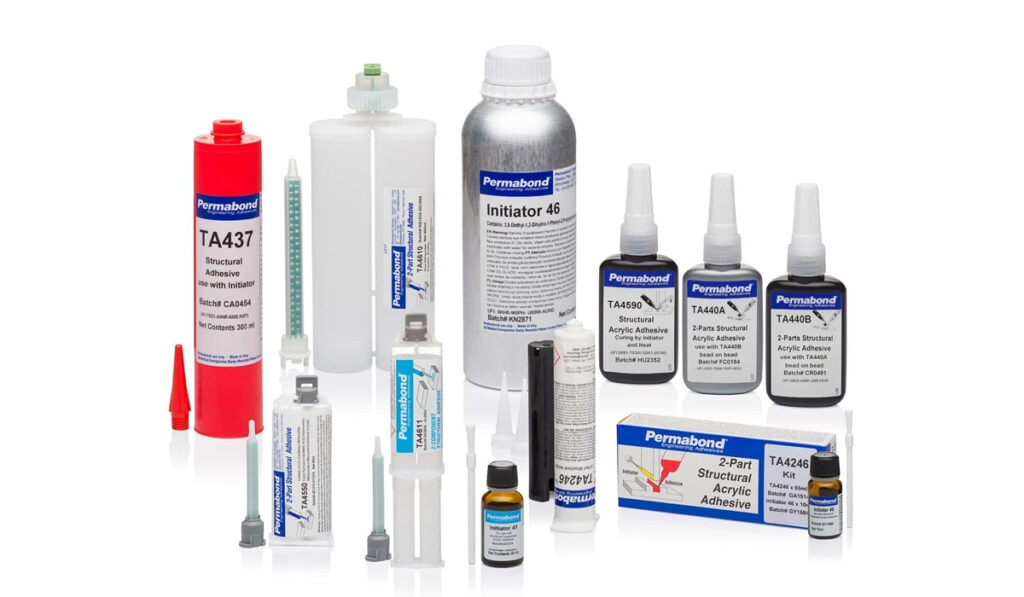
Electric motor adhesive, TA437, from Permabond.
Epoxy adhesives are widely used for structural strength, gap filling, thermal resistance, or electrical insulation. Formulations may be used for magnet bonding, winding impregnation, stator components, and composite-to-metal joints. Searches for high-performance epoxy adhesives for carbon fiber drone motors often relate to composite structures around compact propulsion systems, where the complete joint must be qualified for loads, temperature cycling, and material expansion differences.
Acrylic adhesives can provide strong bonding with relatively rapid cure schedules, making them useful where production speed is important. Their toughness can help accommodate vibration. Selection still depends on temperature capability, surface condition, bond gap, chemical exposure, and the materials present in the assembly.
Anaerobic adhesives cure when confined between suitable metal surfaces with oxygen excluded. Retaining grades suit close-fitting cylindrical joints, including shafts, sleeves, bushings, hubs, and bearing seats. They can supplement press fits, although joint dimensions, metal activity, cure conditions, temperature, and disassembly requirements must be considered.
Silicone adhesives and encapsulants are generally chosen where flexibility, electrical insulation, environmental protection, or temperature cycling matter more than structural stiffness. They can protect sensors, terminals, and electronic interfaces while accommodating movement. Cure chemistry, adhesion, dielectric behavior, outgassing requirements, and material compatibility should be verified.
Polyurethane adhesives can combine bond strength with greater compliance than many rigid structural systems. This can suit assemblies exposed to vibration, impact, or thermal expansion. Performance depends on formulation, particularly where elevated temperatures, moisture, oils, coolants, or fuels are expected.
Cyanoacrylates cure rapidly and can suit small components, closely fitted joints, and production steps requiring fast handling strength. They may also serve as temporary fixturing aids. Because performance can be sensitive to joint gap, substrate, humidity, temperature, and impact loading, they require careful evaluation before use in critical structural motor joints.
Electric motor magnet adhesive is commonly used to secure permanent magnets to rotor or stator structures. High-speed rotors place particular demands on bonded magnets because centrifugal loading, thermal expansion, and acceleration can stress the bond line. Surface preparation, bond-line thickness, magnet coatings, operating temperature, and secondary retention may affect joint reliability.
Rotor and shaft assemblies can use structural adhesives or retaining compounds at sleeves, hubs, laminations, and other cylindrical interfaces. The adhesive may fill controlled clearances and distribute load, but it should not replace rotor-level engineering. Balance, overspeed conditions, fatigue, temperature, fit tolerances, and manufacturing repeatability remain important to qualification.
Adhesive bonding can stabilize laminated stator stacks or reduce mechanical fastening or welding in selected designs. The process must preserve alignment, dimensional accuracy, and required magnetic and electrical behavior. Adhesive placement, squeeze-out, cure shrinkage, cure temperature, thermal expansion, and tolerance control are especially important where the motor uses a small air gap.
Impregnation resins can immobilize stator conductors under electromagnetic and vibratory loading while supporting the insulation system. Vacuum or trickle impregnation may be selected to suit motor geometry and production needs. Penetration, void control, viscosity, cure schedule, thermal class, dielectric performance, and magnet-wire compatibility matter alongside fixation.
Bonding materials can secure slot liners, reinforce end windings, support conductors, and stabilize insulation components. In compact unmanned-system motors, these regions may offer little room for mechanical restraint. The material should provide the required fixation without compromising cooling paths, insulation compatibility, electrical clearances, or assembly tolerances.
Retaining compounds can support bearings, bushings, sleeves, and similar cylindrical components with controlled clearances. Application must avoid contaminating bearing surfaces or obstructing service operations. Designers should also account for cure behavior, thermal expansion, removal procedures, and transmitted axial, radial, and torsional loads.

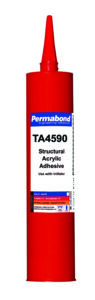
Electric motor adhesive, TA4590, from Permabond.
Electric motor adhesive qualification should combine standardized material or insulation-system tests with representative testing of substrates, joint geometry, surface preparation, cure process, temperature, vibration, and service loads. Depending on the platform, qualification may also need to address humidity, salt exposure, water immersion, pressure, altitude, oils, coolants, or fuels.
These standards provide useful reference points, but industrial electric motor adhesive suppliers and motor manufacturers still need application-specific data reflecting the bonded assembly, aging mechanisms, and production process.
Development increasingly focuses on higher thermal loads, tighter packaging, improved heat transfer, controlled curing, and repeatable production.
These developments reflect a broader shift toward treating adhesive performance, motor architecture, manufacturing process, and operating environment as an integrated design problem.


 Searching Companies & Products