Thermally conductive adhesive provides both structural bonding and a controlled heat-transfer path for electronics, batteries, motors, sensors, and other heat-generating components in drones and unmanned systems. Formulations include thermally conductive epoxy, silicone, acrylic, electrically insulating, and electrically conductive systems.
This category showcases leading thermally conductive adhesive manufacturers, supporting systems such as flight computers, power electronics, RF modules, imaging payloads, and motor controllers.
If you design, build or supply Thermally Conductive Adhesive, create a profile to showcase your capabilities and connect with visitors who have an active requirement for your solutions.
Overview of Thermally Conductive Adhesives for Electronics & Subsystems in Unmanned Platforms
Overview by
William Mackenzie
Updated:
Introduction to Thermally Conductive Adhesives for Drones & Unmanned Systems
Thermally conductive adhesive combines mechanical bonding with a controlled path for moving heat away from electronic components, power devices, batteries, motors, and other heat-generating assemblies. In unmanned systems, these materials can support compact thermal designs where conventional mechanical fasteners or separate thermal interface materials would add weight, complexity, or packaging volume.
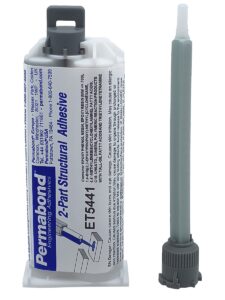
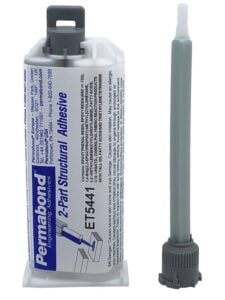
ET5441 by Permabond
Selecting a thermally conductive adhesive requires more than comparing headline thermal conductivity values. Bondline thickness, electrical properties, substrate adhesion, mechanical compliance, cure requirements, viscosity, and environmental exposure all influence real-world performance. Cure shrinkage, thermal expansion mismatch, glass-transition behavior, and long-term thermal aging can also affect bond integrity and heat-transfer performance.
These factors are particularly important for unmanned platforms subject to vibration, temperature cycling, moisture, and restricted size, weight, and power budgets.
Types of Thermally Conductive Adhesive
Thermally Conductive Epoxy Adhesives
A thermally conductive epoxy typically provides strong adhesion, dimensional stability, and good resistance to demanding operating environments. Thermally conductive epoxy adhesives are widely suited to permanent component bonding, heat sink attachment, electronic assemblies, and applications where mechanical strength must accompany effective heat transfer.
Because many epoxy systems cure relatively rigidly, engineers should also consider differential thermal expansion between bonded substrates, particularly where repeated temperature cycling may place the bondline under stress.
Thermally Conductive Silicone Adhesives
Silicone thermal conductive adhesive generally offers greater flexibility than rigid epoxy systems. This compliance can help accommodate vibration and differential thermal expansion between bonded materials, making silicone formulations useful where electronics, housings, or thermal components experience repeated temperature changes or mechanical movement. Their lower stiffness can also be valuable where stress on sensitive components or substrates must be limited.
Thermally Conductive Acrylic Adhesives
Thermally conductive acrylic adhesives can provide relatively rapid processing and strong bonding to suitable substrates. They may be considered for production environments where assembly speed is important, although engineers must evaluate temperature capability, chemical resistance, electrical properties, cure behavior, and long-term environmental durability for the intended platform.
One-Part and Two-Part Adhesive Systems
One-part materials simplify dispensing because no on-site mixing is required, although they may depend on heat, moisture, or another mechanism to cure. Two-part systems cure after resin and hardener are combined, offering engineers different working times, cure schedules, and processing characteristics. Pot life, mix-ratio accuracy, cure temperature, storage requirements, dispensing consistency, and potential cure exotherm should also be considered during manufacturing and qualification.
Electrically Insulating and Electrically Conductive Adhesives
Many thermally conductive adhesives for electronics use electrically insulating fillers so heat can cross an interface without creating an unwanted electrical path. Electrically conductive formulations are also available for applications requiring both functions, but their use demands careful consideration of circuit layout, grounding, and isolation. Where electrical insulation is required, dielectric strength and its retention after environmental exposure should also be evaluated.
Thermal Fillers & Adhesive Material Composition
Thermal conductivity is commonly increased by dispersing conductive particles within a polymer matrix. Filler selection affects not only heat transfer, but also electrical behavior, viscosity, density, mechanical properties, and processing.
Ceramic-filled thermally conductive adhesives: Ceramic fillers can improve thermal transport while retaining electrical insulation, making them useful around power electronics, circuit boards, sensors, and other assemblies where electrical isolation is important.
Metal-filled thermally conductive adhesives: Metallic particles can provide high thermal conductivity and may also make the adhesive electrically conductive. Such materials require careful integration where exposed conductors or electrically isolated interfaces are present.
Carbon-based thermal fillers: Graphitic and other carbon-based materials can provide useful thermal properties, but their electrical characteristics vary with formulation and filler architecture. Suitability should therefore be assessed at the complete material-system level.
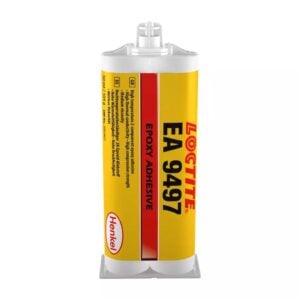
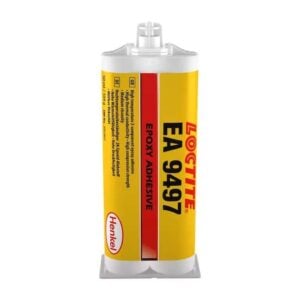
LOCTITE® EA 9497 by Henkel
Increasing filler content can improve heat-transfer capability, but may also increase viscosity, density, brittleness, or difficulty forming a thin and uniform bondline. High viscosity can affect dispensing and wetting, while trapped air or voids can reduce effective thermal performance. Processing behavior should therefore be evaluated alongside thermal data.
Thermally Conductive Adhesive Applications in Unmanned Systems
Autopilots and Flight-Control Electronics
Autopilots and flight-control computers combine processors, power components, and supporting electronics within compact enclosures. A heat conductive adhesive can bond selected components or thermal spreaders to chassis structures, helping establish predictable conduction paths while providing mechanical attachment. Bondline consistency is important because excessive thickness or voiding can increase thermal resistance.
Mission Computers and Embedded Processing Systems
High-performance embedded computers generate concentrated heat within limited packaging space. A suitable processor adhesive or thermal adhesive for heat sink integration can couple processors, heat spreaders, modules, or supporting structures while reducing reliance on separate fastening hardware. Engineers should control bondline thickness and ensure that the surrounding structure provides an effective path for the transferred heat.
Power Electronics and Batteries
Converters, regulators, battery-management electronics, and high-current devices can create significant localized heat. Thermally conductive battery box adhesives may also support thermal coupling between cells, modules, structural elements, or cooling surfaces where the selected chemistry is compatible with the complete battery design. Electrical isolation, cell expansion, chemical compatibility, flame behavior, and the consequences of battery temperature changes should also be considered when selecting the adhesive.
Electric Motors and Motor Controllers
Motors, inverters, and electronic speed controllers require effective thermal paths to maintain operating temperatures within equipment limits. Thermally conductive adhesive may be used to bond electronic devices, housings, heat spreaders, or other interfaces exposed to vibration and repeated thermal cycling. The selected adhesive must retain suitable mechanical and thermal properties over the expected operating temperature range.
Communications and RF Electronics
Radios, data links, amplifiers, and Radio Frequency (RF) modules can produce localized thermal loads while operating inside tightly packaged avionics assemblies. Thermal conductive adhesive can help transfer this heat toward enclosures or dedicated heat sinks without requiring a separate mechanical attachment at every interface. Electrical properties are particularly important where the adhesive is positioned close to RF circuitry or conductive structures.
Sensors, Cameras and Imaging Payloads
Electro-optical payloads, cameras, and sensor electronics often require stable component positioning as well as controlled temperature. Adhesive selection must balance thermal transfer with stiffness, dimensional stability, electrical insulation, cure shrinkage, and the possibility that thermal expansion could affect alignment-sensitive assemblies.
Navigation and Positioning Electronics
Navigation computers, inertial systems, and positioning electronics can benefit from controlled heat removal where internal temperatures influence component performance or reliability. Adhesive integration should preserve electrical isolation and mechanical stability while directing heat toward an appropriate structural or thermal sink.
Selecting Thermally Conductive Adhesive for Unmanned Systems
The appropriate thermal conductive adhesive depends on the complete thermal, electrical, mechanical, manufacturing, and environmental design. Key selection factors include:
Required heat-transfer performance: Consider the complete conduction path, including adhesive conductivity, bonded area, bondline thickness, substrate properties, interface quality, and the destination for transferred heat.
Electrical properties: Determine whether the interface must remain electrically insulating or provide conductivity. This distinction is particularly important for conductive glue for circuit boards and power-electronic assemblies.
Substrate materials: Verify adhesion to the actual metals, composites, ceramics, plastics, coatings, or Printed Circuit Board (PCB) materials used in the assembly, including the proposed surface preparation.
Mechanical loading: Account for vibration, shock, shear, peel forces, cure shrinkage, and differential thermal expansion. More compliant adhesive systems may reduce stresses between materials with different expansion characteristics.
Operating environment: Match the formulation to anticipated temperature, humidity, water, chemicals, and pressure conditions. A high temperature thermal adhesive must also retain suitable thermal, mechanical, and electrical properties throughout the required service range.
Weight and packaging constraints: Evaluate the quantity of adhesive, required bondline, dispensing process, cure method, and any hardware it may replace. These considerations are particularly relevant to Size, Weight, and Power (SWaP)-sensitive airborne and mobile unmanned systems.
A suitable thermally conductive adhesive is therefore selected as part of the complete thermal architecture, not simply as thermal glue for a heat sink. Matching material properties, processing requirements, bond geometry, and qualification conditions to the actual interface helps produce a more predictable thermal and mechanical design.
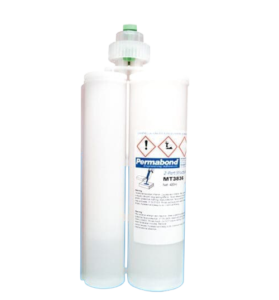
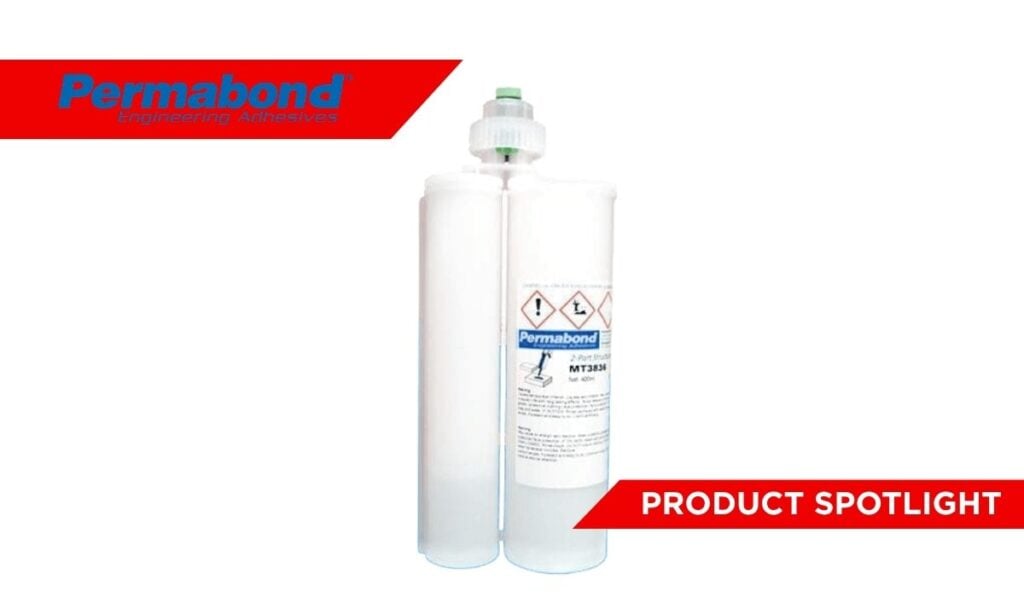
Permabond MT3836 combines thermal conductivity, flexible bonding and fire-retardant properties for UAV battery assemblies, motor controllers and high-power electronics requiring thermal management and vibration tolerance
The latest unmanned systems news, straight to your inbox.
Get our weekly roundup of technology developments, new products and industry news.
THANK YOU FOR SIGNING UP
Thanks for joining us. Check your inbox.
We've sent you an email. Click the confirmation link to complete your subscription to the weekly eBrief. In the meantime, explore the latest news, suppliers and technologies on UST.
Advancing Unmanned Systems Through Strategic Collaboration
UST works with major OEMs to foster collaboration and increase engagement with SMEs, to accelerate innovation and drive unmanned systems capabilities forward.