Showcase your capabilities
If you design, build or supply Drone Fuselages, create a profile to showcase your capabilities and connect with visitors who have an active requirement for your solutions.




Drone fuselages form the central structural body of UAVs, supporting avionics, power systems, payloads, communications equipment, and propulsion components. Fuselage architectures include monocoque, semi-monocoque, truss, modular, pod-and-boom, and blended structures.
This page features leading UAV fuselage manufacturers for fixed-wing, multirotor, and hybrid VTOL platforms.
Read the Technology Overview

Custom Composite Manufacturing & High-Rate Snap-Cure Production for UAVs

If you design, build or supply Drone Fuselages, create a profile to showcase your capabilities and connect with visitors who have an active requirement for your solutions.

Drone fuselages form the central structural body of many Unmanned Aerial Vehicles (UAVs), carrying avionics, power systems, payloads, communications equipment, and, where applicable, propulsion or fuel components. Their geometry and construction influence aerodynamic efficiency, structural integrity, internal packaging, environmental protection, and maintainability.
The right UAV fuselage therefore depends on far more than external shape. Designers must balance stiffness, strength, weight, manufacturing method, payload access, thermal behavior, electromagnetic requirements, load concentrations, vibration, and the operating environment. These trade-offs vary considerably between compact multirotors, fixed-wing aircraft, hybrid VTOL platforms, and larger long-endurance systems.
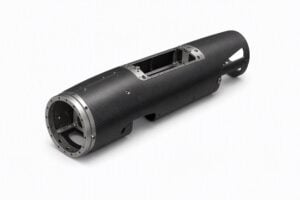
Fuselages, lightweight composite aerostructures, from Fibreworks Composites
A drone fuselage provides the structural and functional backbone around which major aircraft systems are integrated. Its design must support flight and ground loads while creating a practical internal volume for equipment and mission payloads.
These functions are interconnected, so changes intended to reduce weight or drag can affect access, cooling, RF performance, vibration behavior, or load paths elsewhere in the airframe.
Monocoque fuselages carry most structural loads through the outer skin rather than a substantial internal frame. Composite shells are particularly suited to stressed-skin construction because complex aerodynamic forms can be produced with high stiffness at relatively low mass. A monocoque fixed-wing drone fuselage can also provide a smooth exterior, although concentrated loads typically require local reinforcement around attachment points and openings.
Semi-monocoque construction combines a load-bearing skin with internal frames, bulkheads, longerons, or stringers. This distributes loads across several structural elements and provides defined locations for attaching wings, landing gear, propulsion systems, and payload equipment. The architecture is widely applicable where durability, access, buckling resistance, and structural efficiency must be balanced.
Truss and space-frame fuselages use interconnected members to create the primary load-bearing structure. Electronics and payloads may be mounted directly to the frame, with lightweight covers or fairings added as required. This approach can simplify inspection and modification, but exposed or non-structural coverings may provide less aerodynamic refinement than integrated shell structures.
Modular fuselages divide the airframe into replaceable or reconfigurable sections. Nose modules, payload bays, battery compartments, or mission equipment can be changed without redesigning the complete aircraft. A customized drone fuselage based on modular interfaces can support multiple mission configurations, provided connections retain the required stiffness, alignment, electrical continuity, and aerodynamic fit.
Pod-and-boom designs concentrate avionics, payloads, and power systems within a central pod while using one or more slender booms to support tail surfaces, rotors, or other components. This arrangement can reduce unnecessary enclosed volume and provide clear fields of view for sensors. Structural joints between the pod and booms must accommodate bending, torsion, fatigue, and vibration loads.
Blended fuselages merge the body more closely with wings or lifting surfaces, reducing the distinction between the central fuselage and surrounding aerodynamic structure. Such designs can improve packaging efficiency and distribute structural loads over broad surfaces. They can also increase manufacturing and maintenance complexity because aerodynamic, structural, and systems-integration requirements become more tightly coupled.
Material selection affects structural mass, stiffness, impact behavior, environmental resistance, RF transmission, manufacturing cost, and repair options. Composite fuselage manufacturing is especially common where designers need complex geometry or high specific stiffness, while metals and engineering polymers remain useful for local structures and secondary parts. Manufacturing choices such as laminate layup, core construction, bonding, fastening, curing, and dimensional control also affect structural consistency and durability.
| Material | Typical fuselage characteristics |
| Carbon fiber-reinforced polymer | High stiffness-to-weight ratio and low structural mass, well suited to performance-focused shells and primary structures, but electrically conductive laminates can attenuate or shield RF signals. |
| Glass fiber-reinforced polymer | Useful impact tolerance, lower material cost than many carbon systems, and good RF transparency where laminate construction permits. |
| Aluminum alloys | Predictable mechanical properties, machinability, and suitability for frames, brackets, hardpoints, and load-bearing interfaces, with suitable isolation where galvanic interaction with carbon composites is possible. |
| Titanium alloys | High strength and corrosion resistance for demanding fittings, fasteners, and localized structural interfaces where cost is justified. |
| Engineering thermoplastics | Suitable for fairings, housings, access panels, ducts, and some low-volume or additively manufactured structures. |
| Sandwich composites | Thin structural skins bonded to foam or honeycomb cores can provide high bending stiffness at low mass. |
| Hybrid material structures | Composites, metals, and polymers can be combined so each material is used where its mechanical, thermal, RF, or manufacturing properties are most valuable. |
The optimum material system depends on both global airframe requirements and localized demands around joints, payload mounts, access points, antennas, propulsion interfaces, and areas exposed to repeated handling or impact.
Payload integration influences fuselage volume, center of gravity, mass distribution, structural reinforcement, vibration isolation, and external aerodynamics. EO/IR gimbals, mapping cameras, LiDAR, radar, and communications payloads may require apertures, transparent windows, dedicated cooling, or unobstructed fields of view. Designers must also account for rapid payload replacement where mission flexibility is required.
Avionics packaging must provide secure mounting, suitable thermal paths, maintainable wiring routes, and adequate separation between power and signal systems. Conductive composite structures can affect antenna placement, grounding, bonding, shielding, and electromagnetic behavior, while non-conductive sections may be selected for radomes or RF-transparent windows. Access panels should allow maintenance without unnecessarily weakening primary load paths.
Propulsion integration depends on whether the aircraft uses electric motors, combustion engines, hybrid systems, or distributed propulsion. Motor mounts, engine interfaces, batteries, fuel tanks, controllers, cooling paths, and vibration isolation can all impose structural and packaging requirements on the UAV fuselage. Designers must also preserve center-of-gravity limits as fuel is depleted or removable batteries, payloads, and other equipment are changed.
Applicable standards depend on aircraft category, intended operation, jurisdiction, procurement program, and certification or approval pathway. Relevant references may include the following:
These documents should be applied according to the platform, equipment, authority, and acquisition requirements rather than treated as interchangeable fuselage design specifications.
Selecting a drone fuselage requires a whole-aircraft view because structural, aerodynamic, payload, and maintenance requirements are closely linked. Key evaluation factors include:
A suitable drone fuselage is therefore one that supports the required flight envelope and mission systems without creating avoidable penalties in weight, drag, integration complexity, structural durability, or serviceability.


 Searching Companies & Products