

As UAV missions become increasingly complex, operators must manage growing volumes of information while maintaining situational awareness and responding to critical events. Read more >>
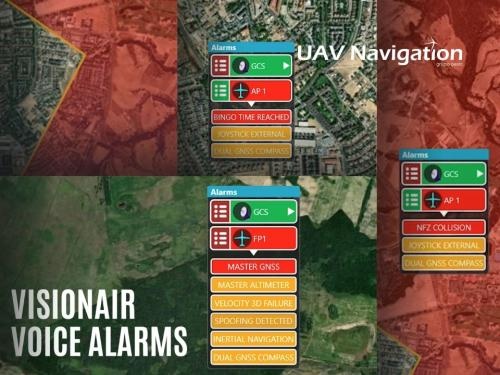
UAV Navigation-Grupo Oesía addresses these human-machine interaction challenges through configurable voice alarms integrated into its Visionair Command and Control Station, complementing visual notifications to support operator decision-making during demanding flight operations.
The voice alarm capability provides an additional channel for communicating operational information, reducing reliance on continuous visual monitoring. Rather than replacing conventional visual warnings, voice alarms complement the existing alarm system, contributing to a more robust and redundant Human-Machine Interface (HMI).
According to UAV Navigation-Grupo Oesía, this multimodal approach increases overall system reliability and helps make complex Unmanned Aircraft System (UAS) operations, including multi-UAV scenarios, simpler and more intuitive for operators.
Configurable Voice Alerts for Different Mission Requirements
Visionair allows operators to configure voice alarms according to specific operational requirements. Custom alerts can be associated with individual events, with operators able to determine the flight modes in which each alarm remains active.
The system also supports personalized audio files, including messages generated using AI text-to-speech technology. This enables generic notification tones to be replaced with spoken messages that communicate the nature of an event directly.
Operators can define different voice alerts based on parameters such as fuel levels, sensor states, and speed thresholds, adapting notifications to the requirements of individual missions. By combining event-specific configuration with audible notifications, Visionair provides operators with an additional means of identifying relevant changes in aircraft or system status without relying exclusively on information displayed on screen.
Reducing Cognitive Load During Multi-UAV Operations
Visual alarm systems have traditionally been the primary method of communicating warnings in mission planning software. However, as the volume of displayed information increases, operators face a greater risk of overlooking important notifications.
This challenge is particularly relevant during multi-UAV operations, where several aircraft may require simultaneous supervision and the operator must divide attention between multiple sources of information.
Voice alarms provide an alternative means of receiving relevant notifications without requiring operators to divert their gaze from the primary area of operation.
By reducing dependence on visual stimuli and the need for continuous scanning of alarm panels, audible notifications can help reduce cognitive load, allowing operators to maintain greater focus on mission supervision and decision-making.
The combination of visual and spoken warnings also supports situational awareness in operational environments characterized by high information density and demanding workloads.
Supporting Faster Responses to Critical Events
The ability to communicate the nature of an alert through speech is particularly relevant when operators must respond to time-critical situations.
Events such as loss of communications, dangerous fuel levels, or exceeded operational thresholds require timely recognition and appropriate action. Spoken notifications can draw attention to these conditions even when an operator is not directly observing the alarm panel.
Unlike generic tones, verbal alerts can explicitly identify the event that has occurred, reducing ambiguity and helping operators prioritize their response.
This approach supports faster reaction times while limiting the need to repeatedly shift visual attention away from the primary task.
During high-workload mission phases, clearly communicating the nature of critical events can also help operators prioritize their responses, reduce stress, and improve overall operational resilience during time-critical situations.
Alarm Management and Operational Safety Objectives
Alarm presentation is an important consideration in professional and mission-critical UAV operations, particularly where operational approval and certification requirements must be addressed.
Beyond notifying an operator that an event has occurred, an alarm system must account for how warnings are generated, presented, prioritized, and subsequently acted upon. These factors influence operator behavior during abnormal and emergency situations.
Visionair combines visual and audible notifications within a structured HMI to support timely awareness and reduce ambiguity when operators are working under pressure.
Visionair provides operators with real-time visual and audible alerts through its Command and Control Station, supported by well-defined emergency procedures (OSO 6).
This safety-oriented approach is intended to contribute to consistent operator decision-making across normal, degraded, and emergency operating conditions.
By retaining visual notifications alongside configurable spoken alerts, the system provides complementary methods of communicating operational information rather than depending on a single notification channel.
Supporting Scalable UAV Mission Supervision
As UAV operations evolve toward greater automation and the simultaneous supervision of multiple aircraft, the presentation of operational information remains an important factor in managing operator workload.
Visionair’s configurable voice alarm capability provides flexibility in how warnings are communicated, allowing notifications and spoken messages to be tailored to different mission requirements.
The integration of audible and visual information also supports an operator-centered approach to HMI design, in which relevant events can be communicated without requiring continuous attention to individual display elements.
For increasingly complex UAS operations, this multimodal approach provides a foundation for adapting alarm management to changing operational requirements while supporting situational awareness, helping reduce human error, and maintaining effective human-machine interaction.