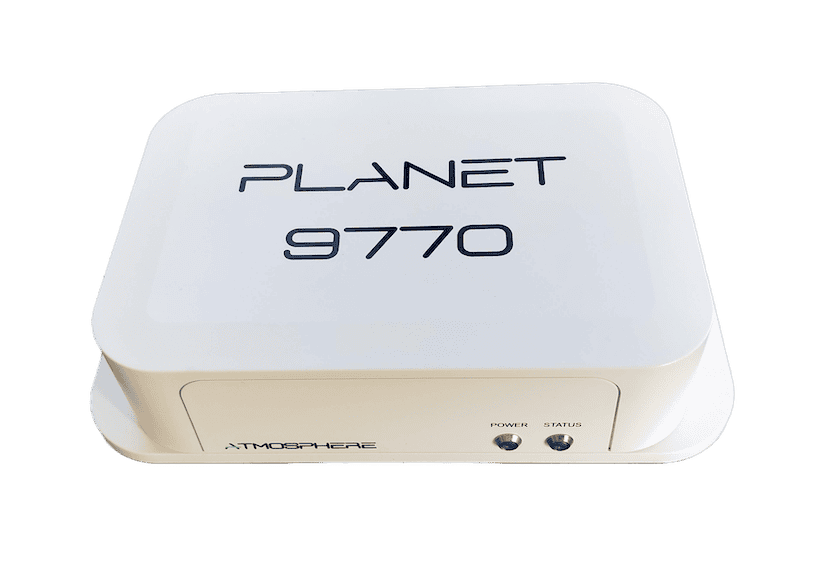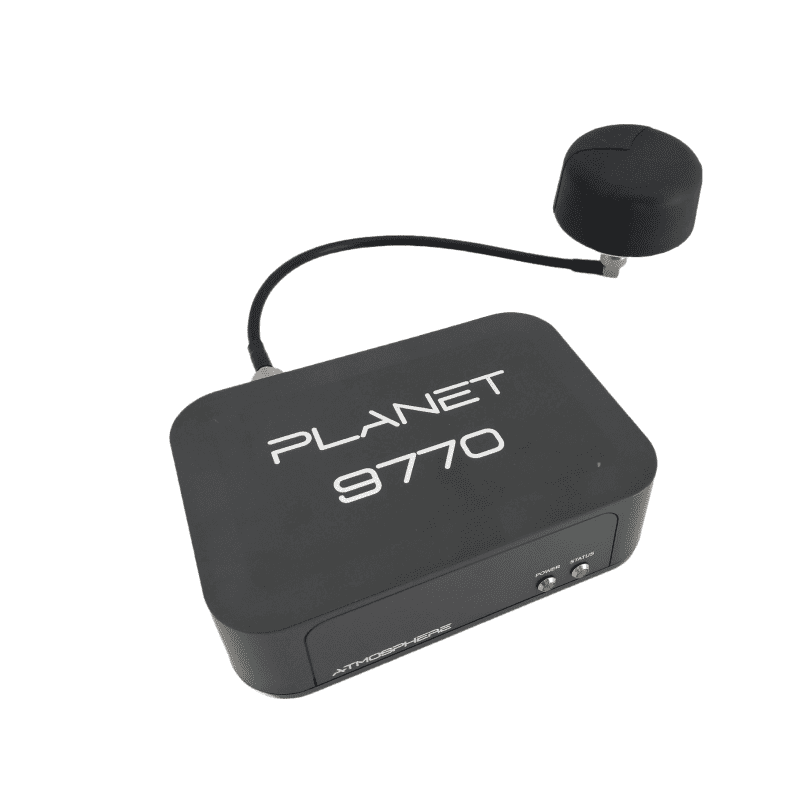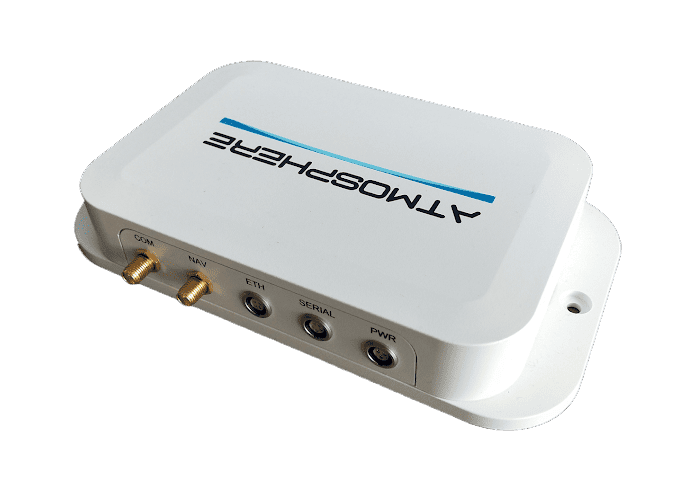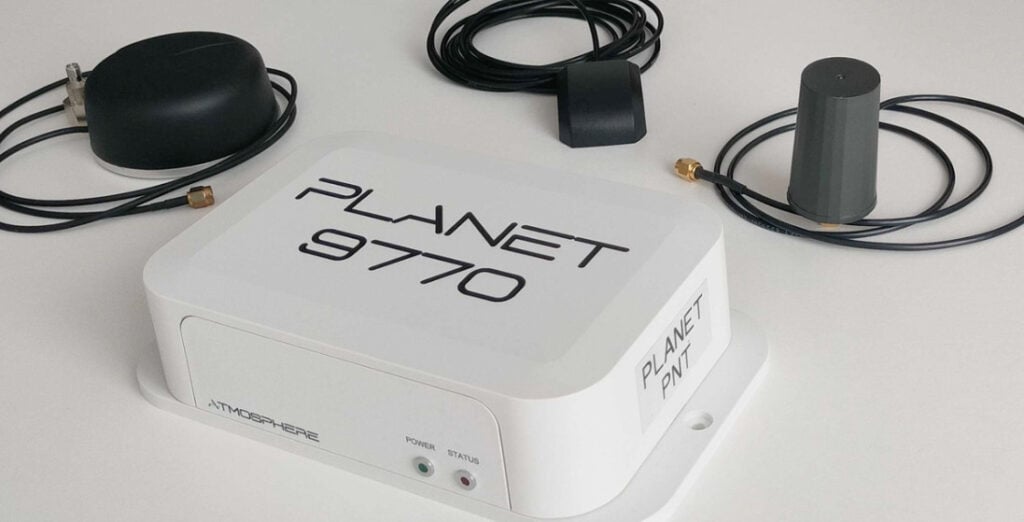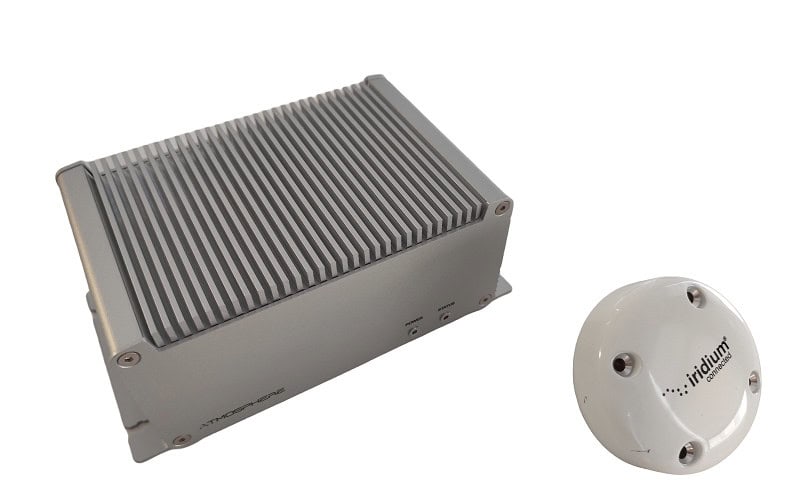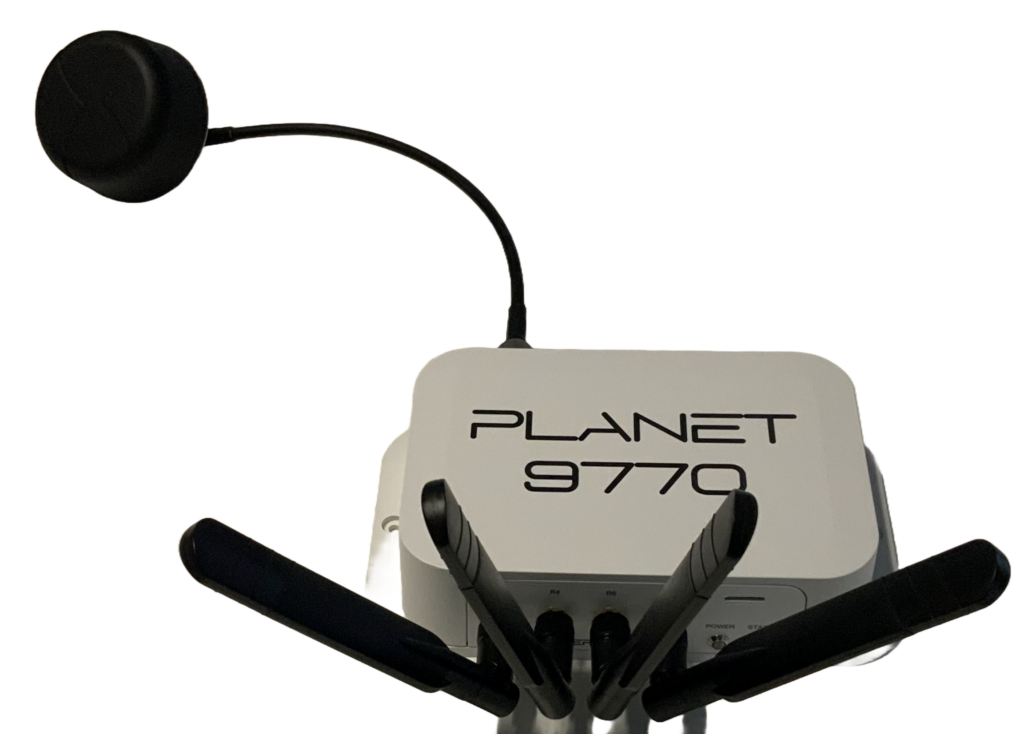




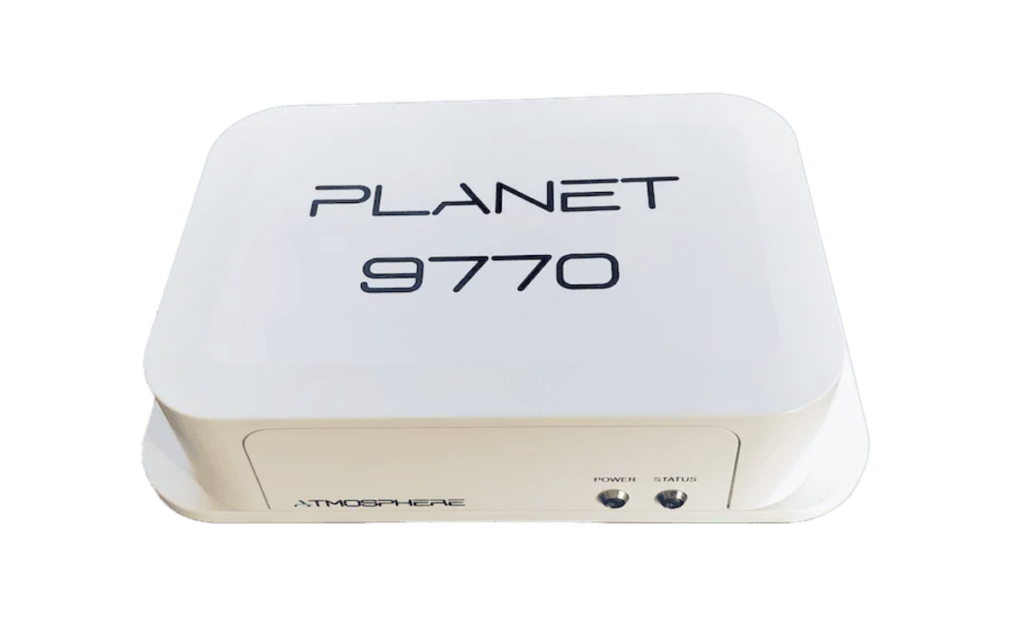
ATMOSPHERE‘s PLANET 9770 terminal range supports airborne communications through Iridium Certus 100 satellite service, with configurations addressing UAV operations and flight test applications.
The terminals combine IP connectivity with local interfaces, GNSS functionality, and application-based tools for exchanging operational information, while the PLANET 9770 UAV-F adds cellular 4/5G connectivity.
PLANET 9770 UAV-L and UAV-L-HP for Satellite-Based UAV Communications
The PLANET 9770 UAV-L Terminal supports mobile communications for unmanned aerial vehicle systems using Iridium Certus 100 service. 
The terminal incorporates local Power, Ethernet, and Serial interfaces, alongside mSata storage and an integrated GNSS receiver providing timing and location information.
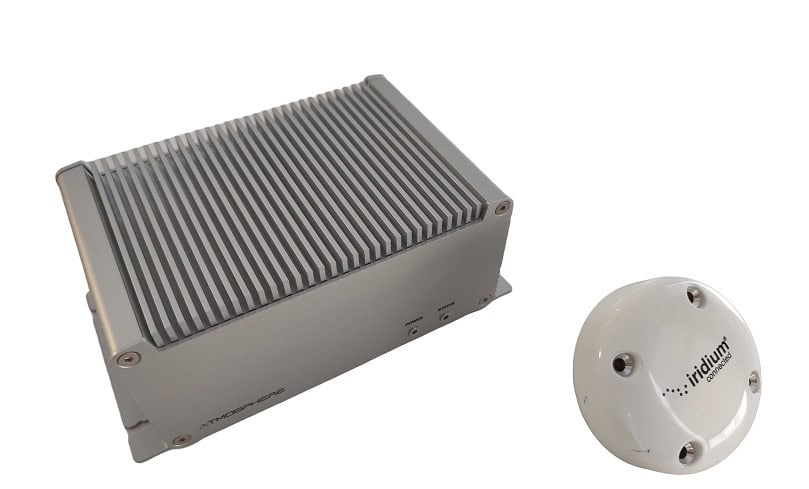
Satellite connectivity is provided through a low-profile passive antenna, with Iridium Certus 100 supporting native IP communications at data rates of up to 88 kbps. The antenna weighs 134 g, measures 38 mm in height, and has a diameter of 80 mm.
Beyond its communications interfaces, the terminal incorporates an embedded PLANET application that can be accessed through an additional user tablet or PC terminal. This provides tracking, messaging, and weather data exchange functions alongside the terminal’s IP connectivity.
The PLANET 9770 UAV-L-HP is also identified within the product range, although separate technical specifications for this variant are not detailed in the supplied information.
PLANET 9770 UAV-F Combines Satellite and Cellular Connectivity
The PLANET 9770 UAV-F Terminal extends the available communications options by integrating cellular 4/5G connectivity with Iridium Certus™ 100 satellite service.
This combination provides two communications technologies within a single terminal, supporting UAV connectivity across cellular and satellite networks.
The UAV-F incorporates Power, Ethernet, Serial, and WiFi interfaces, together with a GNSS receiver and a lightweight antenna. Its hardware configuration also includes a fanless processor, extensive storage capacity, and a compact, robust casing.
A web-based PLANET application provides access to operational information and communication functions. These include real-time tracking, collaboration, telemetry, weather updates, and live video streaming.
The combination of satellite and cellular connectivity, local interfaces, and web-based application functions allows the UAV-F to address a broader set of UAV communication requirements than a satellite-only configuration.
PLANET 9770 FTI for Airborne Flight Test Communications
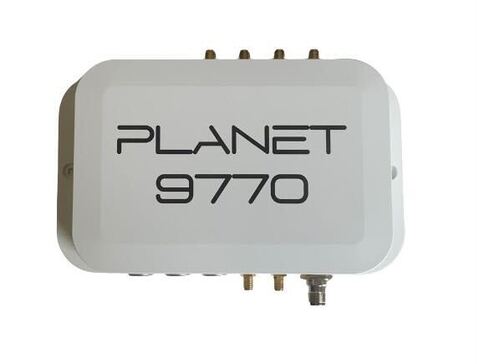
The PLANET 9770 Flight Test Instrument (FTI) Terminal addresses mobile communications requirements during airborne flight testing, using Iridium Certus satellite service.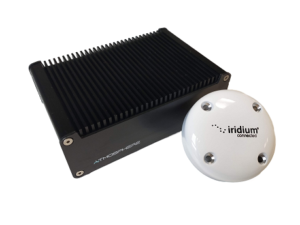
The terminal provides Power, two Ethernet, and two Serial interfaces, together with Iridium connectivity and mSata storage capacity. An integrated GNSS receiver supplies timing and location information.
As with the UAV-L, the FTI configuration uses a low-profile passive antenna to access Iridium Certus 100, delivering native IP connectivity at rates of up to 88 kbps.
In addition to its IP routing capabilities, the FTI terminal incorporates the embedded PLANET application. Accessible through an additional user tablet or PC terminal, the application supports tracking, messaging, and weather data exchange.
Communications Configurations for Different Airborne Requirements
The PLANET 9770 UAV-L, UAV-F, and FTI terminals provide different hardware and connectivity configurations for unmanned aviation and airborne testing.
While the UAV-L and FTI models use Iridium Certus 100 for satellite IP communications, the UAV-F combines this service with cellular 4/5G connectivity and additional web-based application functions.
Across the specified configurations, local data interfaces, GNSS functionality, storage, and PLANET application capabilities support the exchange and management of information during airborne operations.