

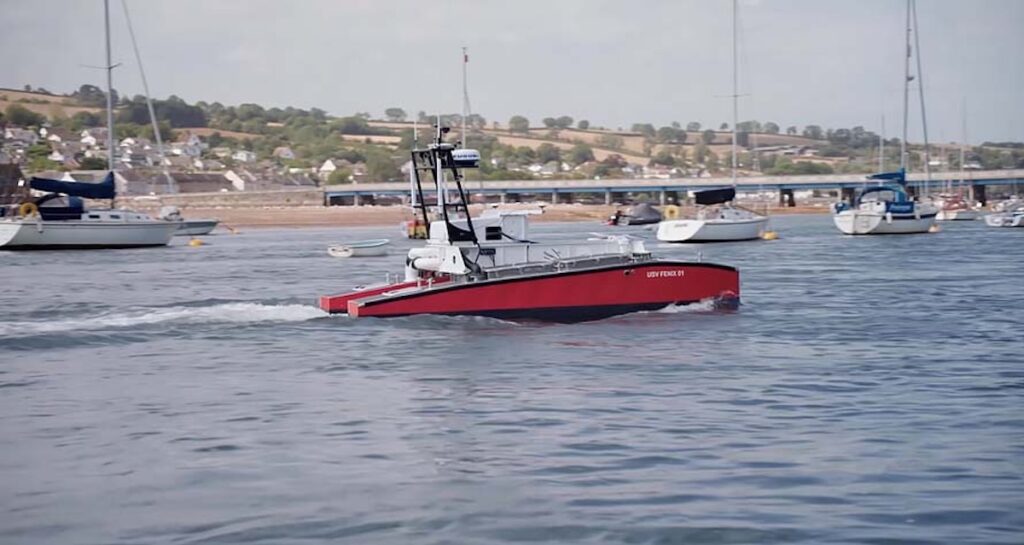
Teledyne Marine highlights how HydroSurv, Subsea Fenix and Teledyne Marine brought together vessel design, operational expertise and multibeam technology in the development of USV FENIX 01.
The 5.7 m battery-hybrid vessel combines HydroSurv’s REAV-60 platform with a modular payload architecture and Teledyne RESON’s SeaBat T51-ASV multibeam echosounder, with the platform developed around Subsea Fenix’s operational requirements.
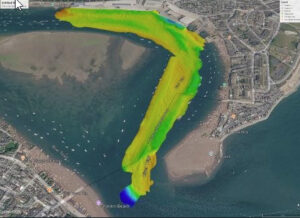
Now undergoing its first operational phase in Italy, USV FENIX 01 has collected its first bathymetric data.
Integrating Multibeam Technology
Subsea Fenix has worked with Teledyne BlueView sonars since 2013 and was introduced to the Teledyne RESON SeaBat range by Codevintec Italiana Srl in 2018. This gave its team experience with the equipment, acquisition and processing workflow, calibration and patch-test procedures.
For USV FENIX 01, Teledyne worked with HydroSurv to integrate the SeaBat T51-ASV into the vessel’s survey configuration.
Stefano Mancini, CEO of Subsea Fenix, commented, “There was no hesitation over the multibeam.”
Operating in the 700–800 kHz range, the SeaBat T51-ASV provides high-resolution data while maintaining coverage of up to seven times the water depth. Its autonomous sonar controls also reduce the number of interventions required at the sensor when the vessel is being controlled from shore.
Stefano Mancini, CEO of Subsea Fenix, stated, “The SeaBat T51 delivers the resolution we were after while maintaining coverage of up to seven times water depth, so the detail does not cost you mission hours. On top of that, the T51-ASV’s autonomous sonar controls reduce the number of interventions required on the sensor – a real advantage when you are operating from shore.”
Expanding Survey and Subsea Capabilities
USV FENIX 01 completed its initial commissioning phase in August 2026, reaching Category A under the IMCA M257 framework and collecting its first bathymetric data using the SeaBat T51-ASV.
The vessel is starting with environmental monitoring to demonstrate its operational reliability, while Subsea Fenix’s broader market strategy focuses on pipeline integrity and pre-survey applications for offshore energy and infrastructure projects.
Work is underway to integrate a launch and recovery system for towed equipment, allowing the vessel to progress to Category B under IMCA M257 by the end of 2026. Category C is planned for early 2027, when USV FENIX 01 will be capable of active Remotely Operated Vehicle (ROV) and Remotely Operated Towed Vehicle (ROTV) deployment.
For hydrographic and geophysical surveys, a survey skid can incorporate the Teledyne SeaBat T51 multibeam echosounder alongside a sub-bottom profiler, towed side-scan sonar and USBL, depending on project requirements.
For subsea inspection, an ROV skid can incorporate a Saab Seaeye Falcon inspection-class ROV. The launch and recovery system will also allow equipment such as Teledyne Marine’s HydroPACT 660 pipe tracker to be deployed.
Combining Vessel, Operator and Sonar Expertise
The project combines Subsea Fenix’s USV operating experience, HydroSurv’s vessel design and adaptation, and Teledyne Marine’s hydrographic technology. HydroSurv developed the REAV-60 around the principle that an uncrewed vessel should be able to evolve as operational requirements change, with USV FENIX 01 using integrated, interchangeable payload skids.
David Hull of HydroSurv, said, “For HydroSurv, the project demonstrates what is possible when flexibility is considered at the platform level. The result is not simply a USV carrying different equipment, but a common offshore platform that can be reconfigured for substantially different types of work.”
For Teledyne Marine, the project demonstrates how established hydrographic technology can be incorporated into an uncrewed platform developed around an operator’s requirements.
 Pim Kuus, Senior Hydrographer and Product Manager at Teledyne Marine, added, “This project is a great example of how proven hydrographic technology can be brought into a new generation of uncrewed platforms. Working closely with HydroSurv, we were able to integrate the SeaBat T51-A into a vessel designed around the operational requirements of Subsea Fenix, while maintaining the data quality, coverage and efficiency that surveyors expect from the SeaBat range.”
“What makes this project particularly interesting is the combination of HydroSurv’s expertise in designing and adapting the USV platforms with Subsea Fenix’s experience of operating uncrewed systems and Teledyne’s long-established hydrographic technology. It’s a great example of how close collaboration between the vessel manufacturer, technology provider and end user can turn new ideas around uncrewed surveying into practical operational solutions.”
With its first bathymetric data collected, USV FENIX 01 is moving into further stages of development, with towed-equipment capabilities followed by active ROV and ROTV deployment planned as the platform progresses through the IMCA M257 framework.