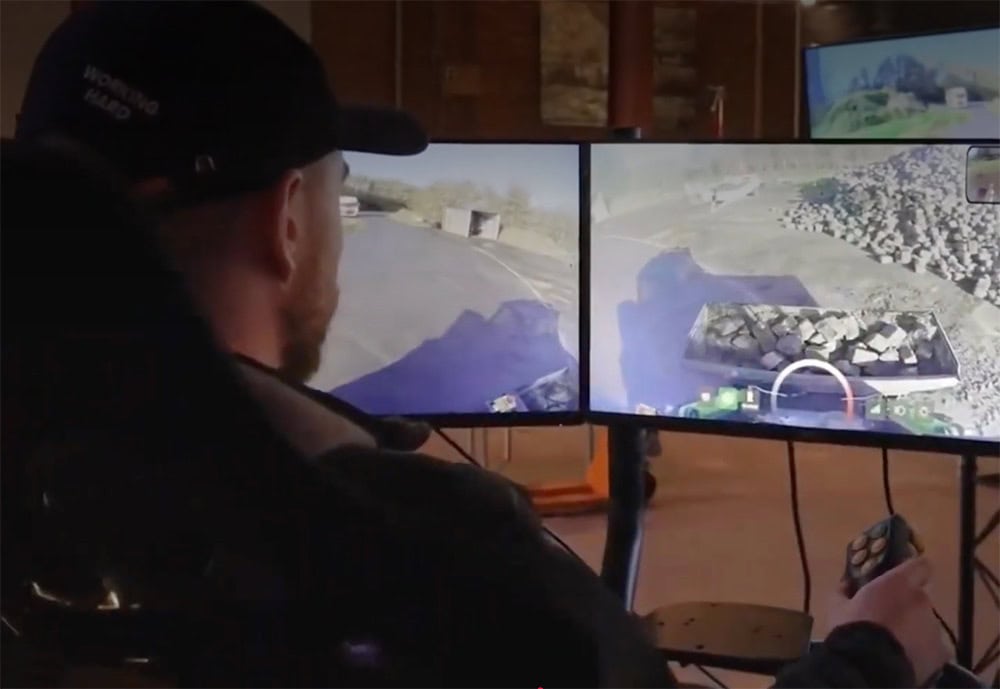
GESAR develops robotic technologies supporting the remote operation of industrial and heavy equipment, including the conversion of existing machinery into teleoperated Unmanned Ground Vehicles (UGVs).
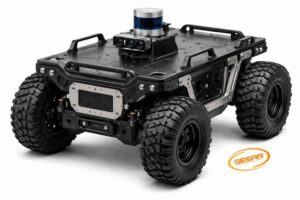
In this Q&A, Unmanned Systems Technology spoke with Cash Willis, President and Robotics/SLAM Engineer at GESAR, about the company’s Custom Four-Wheel UGV Chassis, including its mobility, customization, autonomy integration, GPS-denied operation, and future platform development.
What requirements drove the development of GESAR’s Custom Four-Wheel UGV Chassis, and what are the platform’s key mobility, payload and operational capabilities?
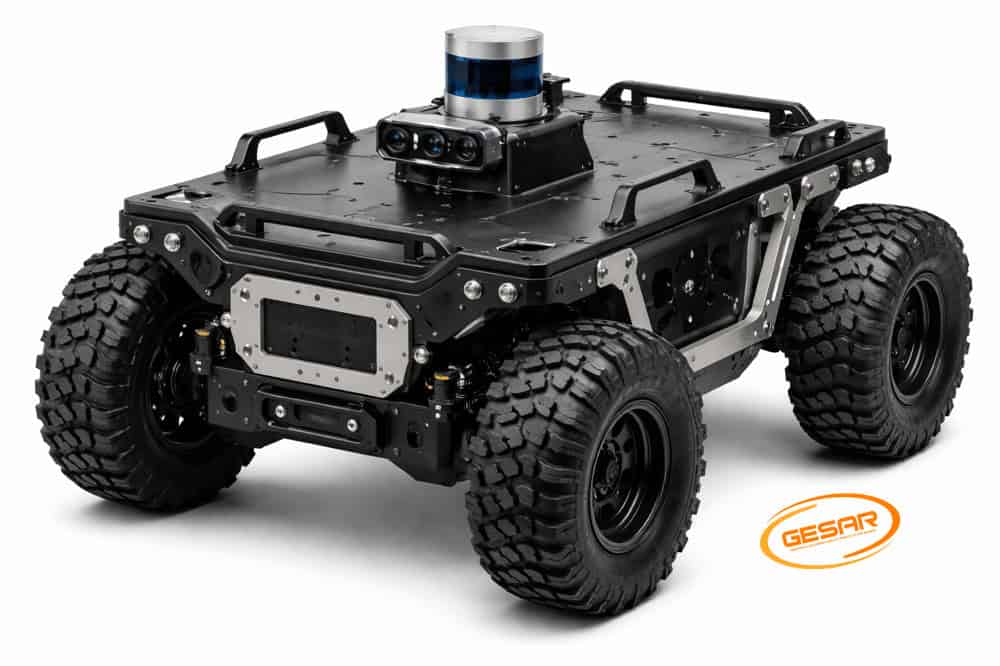
The chassis was developed in response to commercial and defense requirements for a rugged, medium-weight, dependable platform capable of operating in unstructured and high-risk environments. Key requirements included all-terrain mobility, dense onboard battery configurations, and universal payload integration. The platform provides high-torque zero-turn capability, a high payload-to-weight ratio, extended continuous operating runtimes, and a minimum IP54 ingress protection rating for resistance to dust, water, and debris.
How can the chassis be customized to meet different mission and operating requirements, and which aspects of the platform can be adapted for individual customers?
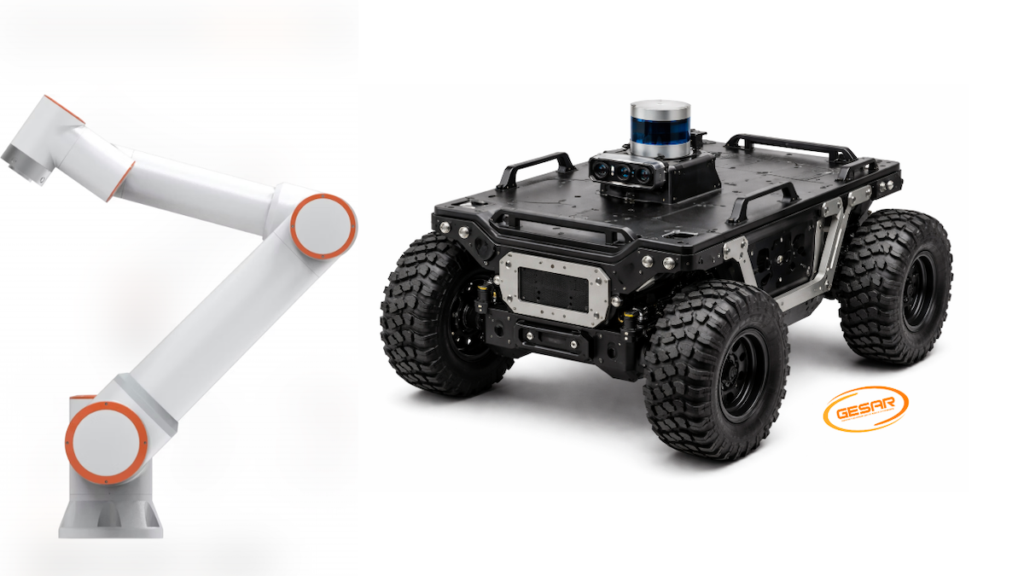
GESAR’s architecture is inherently modular. For individual customers, the company can adapt physical dimensions, ground clearance, suspension stiffness, and battery capacity, with options extending beyond 500 Wh. On the mechanical and electrical side, GESAR can customize mounting top-plates and power distribution boards to supply dedicated, clean power, including 150 W+ lines for high-draw peripherals such as robotic arms, specialized sensor rigs, or communication relays.
What considerations are involved when integrating technologies such as LiDAR, cameras, onboard computing and autonomous navigation systems onto the chassis?
The primary considerations are electromagnetic interference shielding, robust power conditioning, and vibration isolation. When integrating high-performance computing, LiDAR, and optical cameras for autonomous navigation, GESAR ensures the chassis isolates the sensor stack from drivetrain vibration. The platform provides standardized payload interfaces, including Ethernet, CAN bus, and USB, alongside regulated power buses to support plug-and-play integration with advanced autonomy stacks such as ROS/ROS2.
Which industrial and defense applications do you see as the strongest fit for the platform, including operations in GPS-denied or otherwise challenging environments?
The strongest applications include perimeter security, tactical defense logistics, industrial facility inspection, and autonomous infrastructure maintenance. The chassis is also well suited to GPS-denied operations due to its rigidity and precise encoder feedback. When paired with visual-inertial odometry and simultaneous localization and mapping, it can navigate tunnels, dense urban canyons, underpasses, and areas near heavy infrastructure such as highway guardrails and medians.
Can you discuss a customer project, test program or real-world application that demonstrates how a custom GESAR chassis has been configured to solve a particular operational challenge?
GESAR engineered a specialized configuration of its four-wheel chassis to meet a technical requirement for a ruggedized, portable ground-based Intelligence, Surveillance and Reconnaissance (ISR) mobility platform operating in high-abrasion, GPS-denied environments. The application required an all-terrain, high-payload mechanical platform capable of protecting sensitive customer electronics from severe environmental debris. The resulting configuration featured a proprietary armored monocoque enclosure with advanced barrier sealing to isolate the internal electronics bay from desert sand and high-velocity gravel impacts.
The system was configured with a high-torque synchronous 4WD drivetrain using a custom gear reduction architecture to optimize low-end torque and prevent stalling on loose, shifting terrain. To stabilize future optical payloads, the platform incorporated military-grade all-terrain tire assemblies acting as a passive kinetic dampening system, together with a reinforced universal payload interface on the top deck for securing custom sensor masts without altering the core structure.
How do you expect GESAR’s four-wheel UGV chassis to evolve as autonomous ground systems mature, and what capabilities or platform developments are you currently exploring?
GESAR expects its platforms to evolve toward higher levels of edge-AI processing and multi-agent orchestration. The company is currently exploring advanced battery chemistries to increase energy density, smarter power-management systems supporting hot-swappable configurations, and more deeply integrated drive-by-wire architectures. The goal is to ensure that, as autonomy software advances, the underlying GESAR chassis continues to provide a reliable, adaptable, and rugged hardware foundation.
Thank you for your time. It has been a pleasure speaking with GESAR, and we look forward to following the continued development of its UGV platforms and autonomous ground systems.