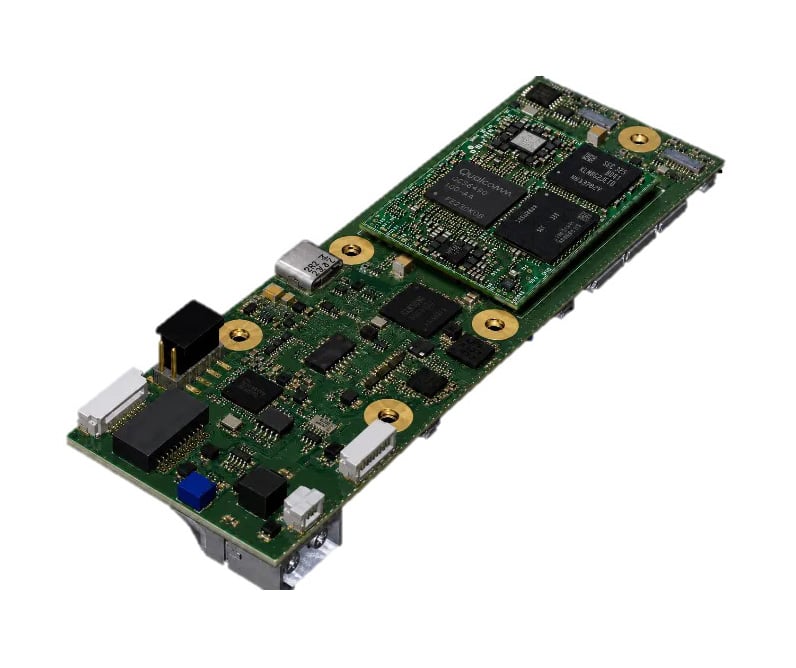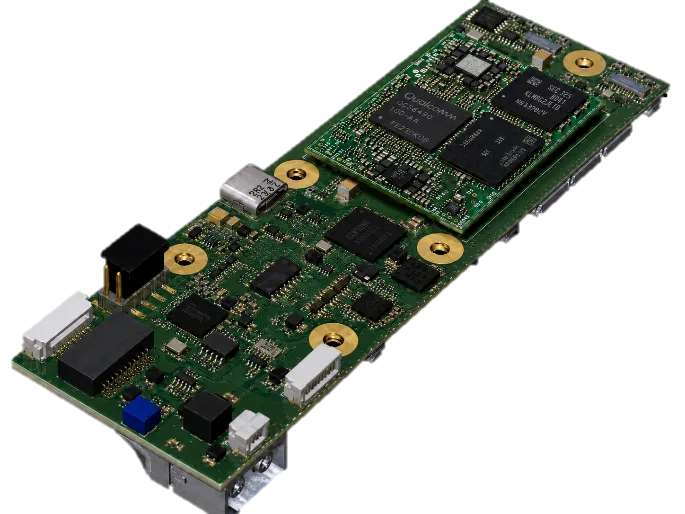



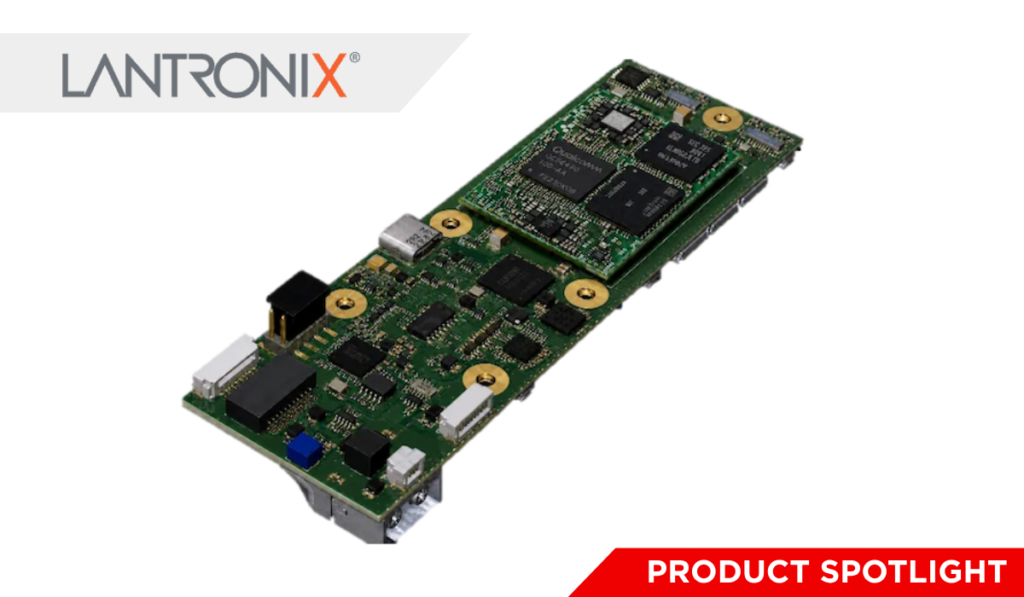
Lantronix‘s Spotter is an edge Artificial Intelligence (AI) computing platform developed to support autonomous drones, robotic vehicles and other unmanned systems.
Designed to integrate onboard processing, sensing and control capabilities, the platform provides a hardware foundation for developing AI-enabled autonomous systems.
Powered by Lantronix’s Open-Q™ 6490CS System-On-Module (SOM), based on the Qualcomm Dragonwing QCS6490 chipset, Spotter combines vision processing, sensor integration, vehicle-control interfaces and high-speed connectivity in a compact 42 × 120 mm form factor.
The platform offers up to 12.5 Trillion Operations Per Second (TOPS) of AI processing performance, with up to 8 GB of LPDDR5 RAM and 64 GB of eMMC storage. Its compact design and typical power consumption of less than 7 W are intended to support integration into mobile robotic and unmanned platforms.
Integrated Vision, Sensing and Vehicle Control
Spotter incorporates two four-lane MIPI CSI D-PHY 1.2 camera interfaces, alongside analog video input and output capabilities. Its video processing specifications include decoding at up to 4K resolution at 60 frames per second and encoding at up to 4K at 30 frames per second.
Display connectivity includes USB 3.1 Type-C with DisplayPort v1.4 support, alongside analog video output.
For navigation and motion sensing, the platform integrates dual six-axis Inertial Measurement Units (IMUs), a precision barometer and a three-axis magnetometer. An optional STM32H7-class microcontroller provides interfaces for real-time vehicle and flight control.
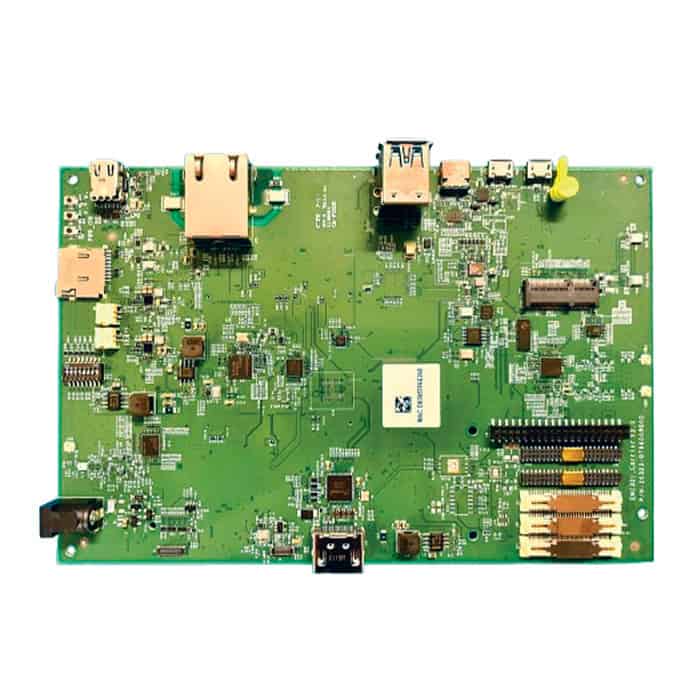
Connectivity and peripheral interfaces include Gigabit Ethernet, USB 3.1, UART, SPI, I²C, configurable General-Purpose Input/Output (GPIO) and Pulse-Width Modulation (PWM). Spotter also provides a dedicated configurable ExpressLRS (ELRS) interface for radio control integration.
The platform lists support for Qualcomm Linux, Betaflight, PX4, MAVLink and ArduPilot.
Applications Across Unmanned Systems
Spotter is designed for use in AI-enabled unmanned aerial, ground and maritime vehicles, with intended applications including vision-based detection and tracking, multi-drone coordination and teaming, short-range reconnaissance-class systems, and autonomous and assisted navigation.
Lantronix also identifies RGB and thermal imaging payloads among Spotter’s intended applications, alongside unmanned ground vehicles, maritime surface platforms and subsea autonomy.
Spotter is compliant with the National Defense Authorization Act (NDAA) and Trade Agreements Act (TAA). Its Open-Q SOM technology is supported by supply-chain measures including verified component traceability and controlled sourcing. Lantronix also highlights a product lifecycle of more than 10 years to support long-term deployments and reduce redesign requirements.
By integrating computing, camera connectivity, navigation sensing and vehicle-control interfaces into a single platform, Spotter is designed to help original equipment manufacturers reduce system-integration effort and accelerate proof-of-concept development for autonomous systems.
To learn more about Spotter AI Platform, visit the Lantronix website.