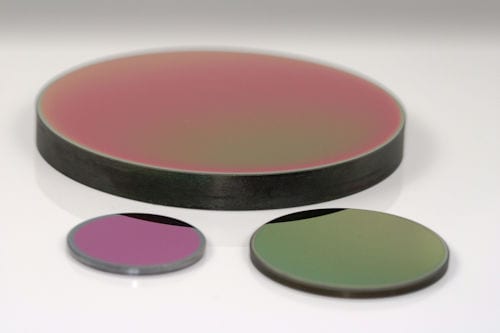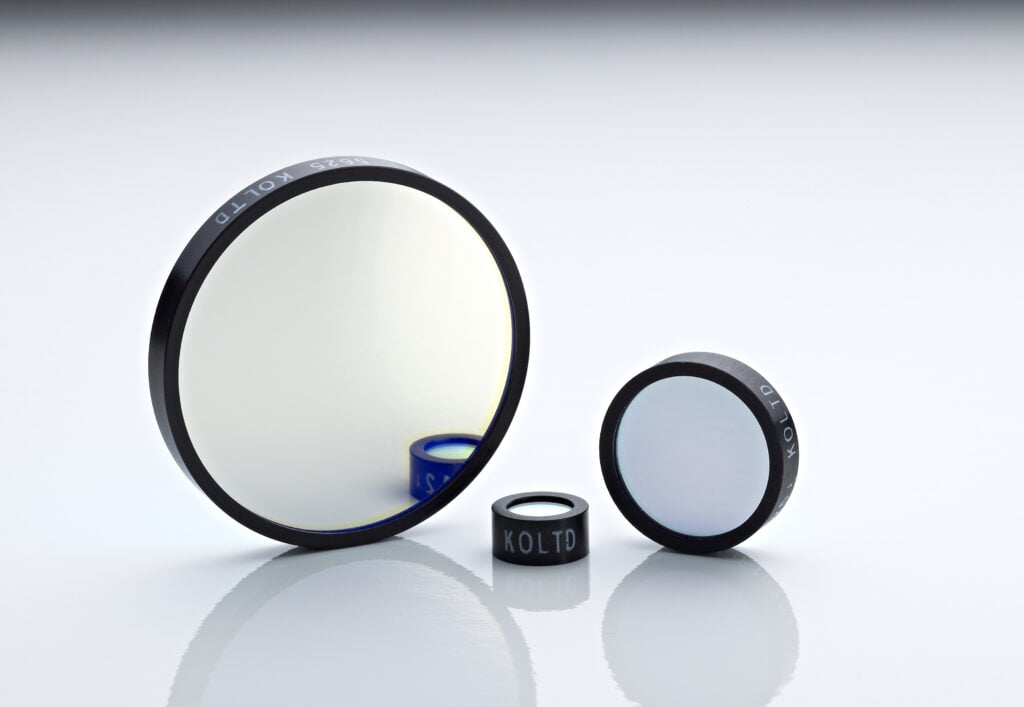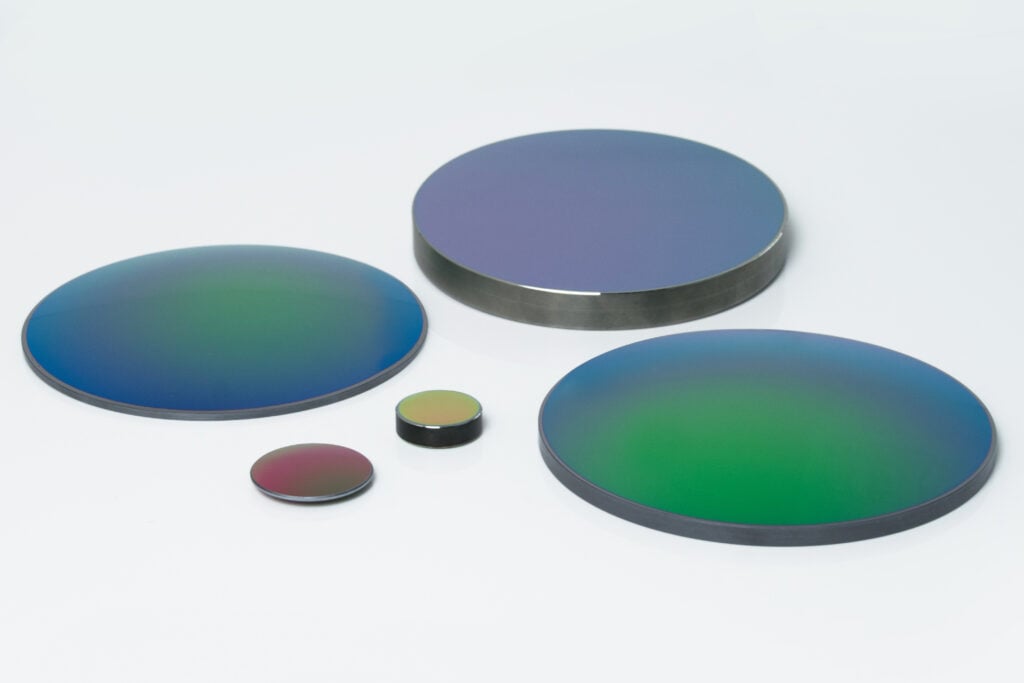
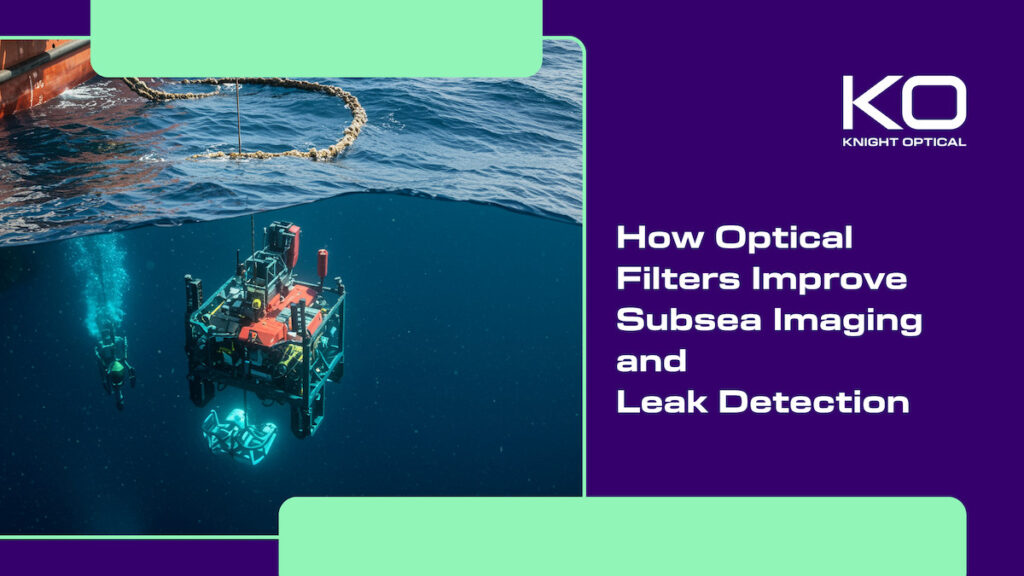
Knight Optical has outlined how optical filters can support subsea 3D imaging, surveying and hydrocarbon leak detection by controlling the wavelengths reaching an imaging sensor or detector.
Underwater imaging systems must contend with absorption, scattering, salinity and pressure, all of which can affect image quality and measurement performance.
Improving Subsea Image Quality
Water absorbs wavelengths at different rates, with red light attenuated relatively quickly and blue-green light travelling farther through the water column. Suspended particles can also scatter light back toward the camera, reducing contrast and creating haze, particularly when artificial illumination is used.
Optical filters can limit unwanted spectral content before it reaches the sensor, improving signal-to-noise ratio and image contrast.
Supporting Accurate 3D Imaging
In 3D imaging and surveying, scattering and refractive effects can reduce reconstruction fidelity and measurement accuracy.
Knight Optical notes that narrow bandpass filters can be matched to the illumination wavelength, helping reject ambient and backscattered light in laser-based 3D imaging systems.
Bandpass filters can support applications including laser line scanning, structured-light imaging and subsea LiDAR.
Matching Filters to Optical Requirements
Different filter types perform specific roles within subsea imaging systems.
Bandpass filters transmit a selected wavelength range, longpass filters pass wavelengths above a defined cut-on point, and shortpass filters transmit wavelengths below a defined cut-off.
Neutral density filters reduce light intensity without shifting color, while hot and cold mirrors can help manage infrared and visible radiation within illuminated optical systems.
Enhancing Hydrocarbon Leak Detection
Hydrocarbons can exhibit characteristic spectral signatures at specific infrared wavelengths, including within the SWIR and MWIR regions.
Optical filters can isolate these bands to improve differentiation from the surrounding underwater environment. Multi-band systems can also compare separate wavelength regions to help reduce false positives.
Specifying Filters for Subsea Environments
Knight Optical highlights that filter selection must account for wavelength, transmission, spectral bandwidth, substrate and coating materials, pressure resistance, environmental durability and angle of incidence.
Knight Optical supplies stock and custom bandpass, longpass, shortpass, neutral density, hot mirror and cold mirror filters, with substrate and coating options tailored to demanding subsea environments.