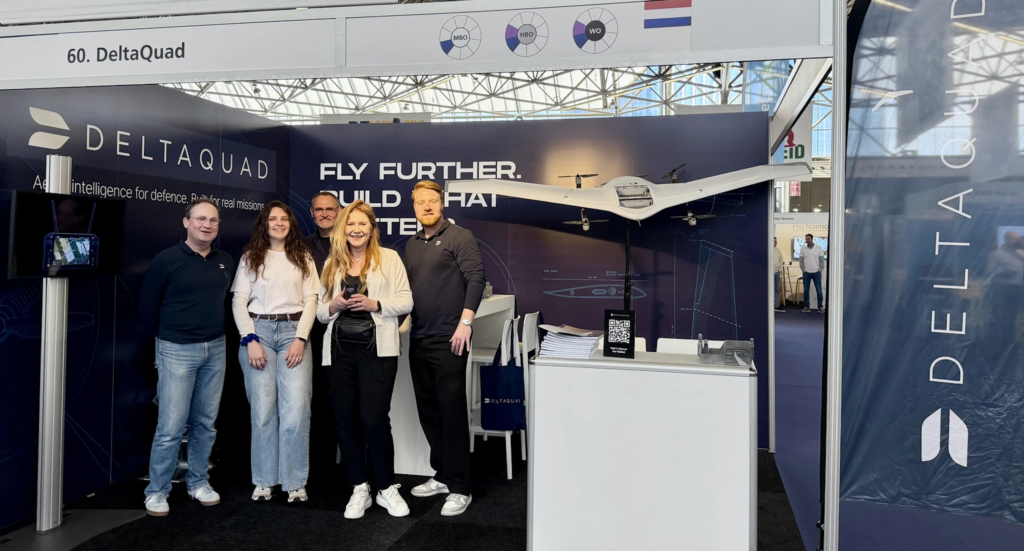



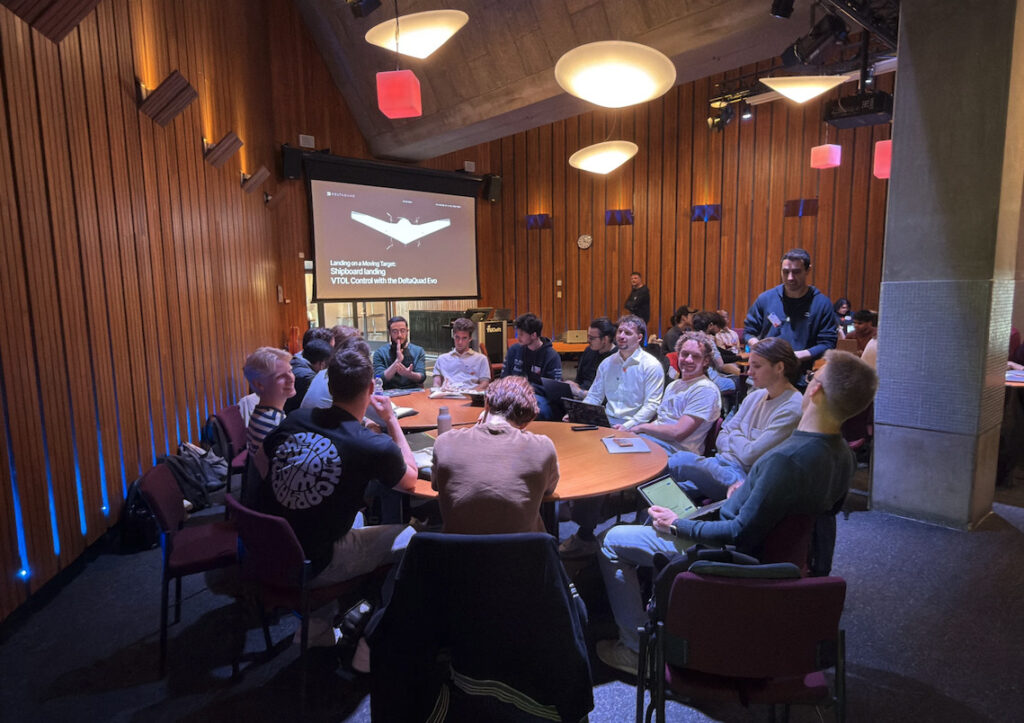
DeltaQuad recently presented a real-world maritime autonomy challenge to students at the Control Robotics Fair at TU Delft.
During a workshop titled “Landing on a Moving Target: Shipboard Landing VTOL Control with the DeltaQuad Evo,” academic participants were invited to analyze the complex engineering problems associated with landing a vertical take-off and landing (VTOL) aircraft onto a moving ship deck under unpredictable environmental conditions.
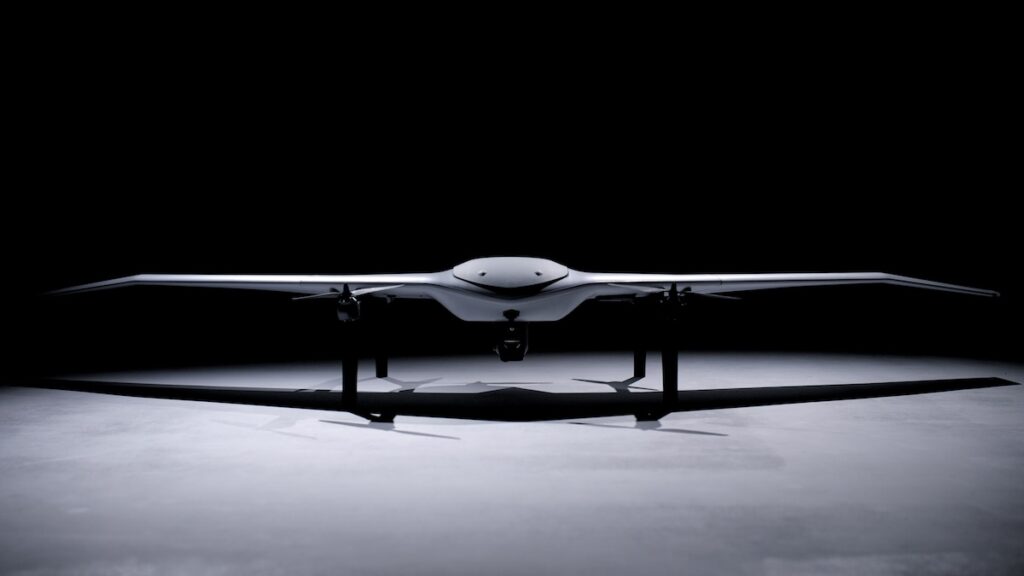
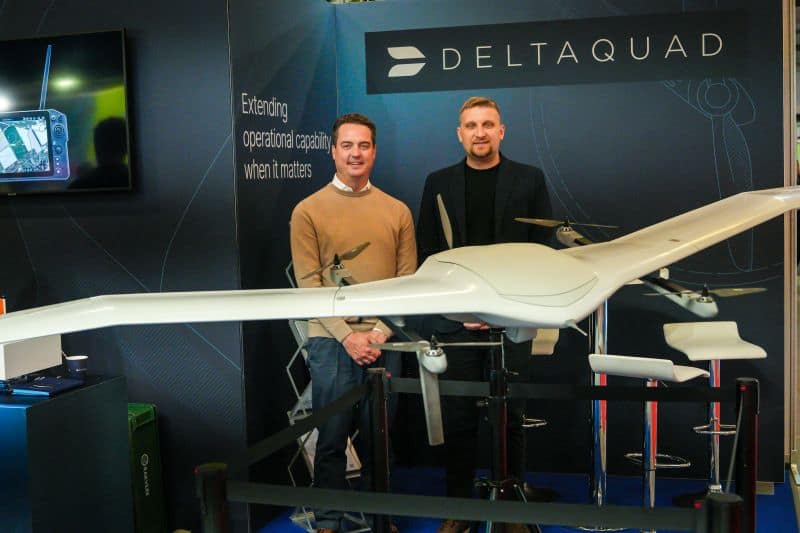
The session commenced with an introductory overview of the DeltaQuad Evo reference platform, outlining the engineering principles behind its VTOL architecture, fixed-wing flight capabilities, transition behavior, aerodynamic trade-offs, and control considerations. DeltaQuad highlighted that maritime targets are subject to continuous horizontal movement, deck pitch from waves, shifting wind velocities, and localized sensor interference.
To address these engineering problems, students were divided into specific focus groups targeting distinct technical components of the landing process:
- Gust Rejection and Wind Stability: One group analyzed aircraft stability during the transition from fixed-wing flight to multicopter mode. The team explored wind-velocity estimation, relative positioning, camera-based target locking, inertial measurements, and specialized control strategies.
- Vertical Deck Movement: The second group investigated methods for counteracting wave-induced vertical movement during descent. The proposed approach involved maintaining a reference altitude above the vessel, estimating ship motion, and utilizing LiDAR, optical flow, IMU data, adaptive modeling, and sensor fusion to improve accuracy.
- Trajectory Planning: The final group mapped out path-planning strategies for a moving landing target. The resulting solution broke the problem down into sensing, mapping, and planning by evaluating IMU and GPS data, cameras, fault diagnosis, no-fly zones, ship location prediction, and waypoint planning adapted to aircraft movement constraints.
DeltaQuad noted that the final student presentations reflected advanced systems-level thinking, covering critical technical areas such as Kalman filtering, model predictive control, adaptive control, A* pathfinding, and safety logic like recovery nets. The company stated that maritime unmanned aerial vehicle (UAV) operations demand the intersection of multiple disciplines, making this real-world problem a strong fit for future engineers interested in systems that operate beyond controlled laboratory environments.
Read more about the shipboard landing challenge at TU Delft on the DeltaQuad website.