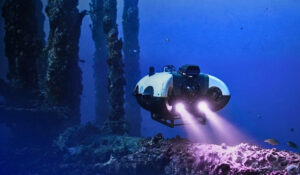
Underwater inspection services use ROVs, AUVs, and other unmanned underwater vehicles to assess submerged assets, infrastructure, and environments using cameras, sonar, laser scanners, NDT instruments, and other inspection payloads.
This page features AUV and ROV inspection services for structural inspection, pipeline and cable surveys, offshore infrastructure assessment, port inspection, and ship hull examination.
If you design, build or supply AUV & ROV Inspection Services, create a profile to showcase your capabilities and connect with visitors who have an active requirement for your solutions.
The Complete Guide to AUV, ROV & UUV Inspection Services
Overview by
William Mackenzie
Updated:
Introduction to AUV & ROV Inspection Services
Underwater inspection services use Remotely Operated Vehicles (ROVs), Autonomous Underwater Vehicles (AUVs), and other Unmanned Underwater Vehicles (UUVs) to assess submerged assets, infrastructure, and environments without relying solely on divers. These systems can carry cameras, sonar, laser scanners, Non-Destructive Testing (NDT) instruments, and other inspection payloads to collect visual, acoustic, dimensional, and condition-monitoring data.
Unmanned underwater inspection is used across offshore energy, marine infrastructure, shipping, ports, subsea construction, and pipeline and cable operations. Depending on the mission, ROV inspection services can provide live operator-controlled examination of individual components, while AUV inspection services are better suited to longer-range autonomous operations, repeated routes, and wider-area coverage.
Key Types of ROV & AUV Inspection Services
Underwater Structural Inspection
Underwater structural inspection assesses submerged components for corrosion, deformation, cracking, coating degradation, marine growth, damaged connections, and other signs of deterioration. Subsea structure inspection may combine visual imaging with sonar, laser measurement, ultrasonic testing, or other sensing methods where more detailed dimensional or material-condition data is required.
Pipeline and Subsea Cable Inspection
Pipeline inspection services and cable inspection services are used to examine long linear assets and their surrounding routes for exposure, burial condition, free spans, displacement, external damage, seabed interaction, and nearby hazards. ROV pipeline inspection is particularly well suited to close examination of specific sections, while AUV pipeline inspection and AUV cable inspection can provide more efficient coverage of longer routes.
Offshore Infrastructure Inspection
Offshore inspection services cover subsea and partially submerged infrastructure including platform jackets, risers, flowlines, umbilicals, mooring systems, subsea equipment, and offshore wind foundations. Offshore platform inspection and subsea riser inspection may combine close-range imaging with sonar, cathodic protection measurement, or underwater thickness measurement to document asset condition and identify areas requiring further assessment.
Marine and Port Infrastructure Inspection
Marine inspection services can be used to inspect bridge foundations, piles, piers, jetties, seawalls, dams, intake structures, and other underwater infrastructure. Robotic underwater inspection is particularly useful where access is restricted, water depth or conditions increase risk, or repeated inspections are required to monitor changes in structural condition over time.
Ship Hull and Vessel Inspection
Ship hull inspection uses underwater cameras, sonar, and other sensors to examine hull plating, propellers, rudders, thrusters, intakes, and associated structures. For selected inspection tasks, ROV hull inspection can support underwater hull assessment without dry docking, while imaging and sonar data can document fouling, damage, corrosion, and other visible conditions.
Unmanned Platforms Used for Underwater Inspection
Remotely Operated Vehicles
ROVs remain widely used for subsea inspection services because they provide live control, continuous communications, and real-time video or sensor feedback through a tether. This makes ROV inspection particularly effective for close visual inspection, ROV sonar inspection, ROV NDT inspection, contact measurements, and detailed examination of complex structures where precise positioning is important.
Autonomous Underwater Vehicles
AUVs conduct pre-programmed or adaptive missions without continuous tethered control, allowing them to inspect larger areas or long routes more efficiently. AUV inspection services are therefore well suited to pipeline corridors, cable routes, offshore assets, seabed infrastructure, and other missions where autonomous coverage, repeatable navigation, and wider-area data collection are important.
Underwater Crawlers
Underwater crawlers operate in direct contact with surfaces such as ship hulls, storage tanks, pipelines, or other submerged structures, giving them a stable platform for close inspection. This contact can support detailed imaging, ultrasonic inspection, thickness measurement, and other NDT tasks where consistent sensor positioning against the inspected surface is important.
Hybrid and Reconfigurable UUVs
Hybrid UUVs combine characteristics of autonomous and remotely operated platforms, allowing a single vehicle to support different phases of an inspection mission. Some systems can perform autonomous transit or survey before switching to direct operator control for detailed inspection, combining broad-area data collection with close-range subsea robotic inspection.
Underwater Inspection Sensors & Payloads
The payload selected for an underwater inspection depends on the asset being assessed, the measurement required, visibility, operating depth, and the level of detail needed from the resulting data.
Sensor or Payload
Primary Inspection Role
Typical Outputs
Subsea cameras and lighting systems
Visual inspection of surfaces, components, and damage
Images and video
Sonar
Imaging and detection in poor visibility
Acoustic imagery and maps
Laser scanners and profilers
Dimensional measurement and surface mapping
Profiles, point clouds, and 3D data
Ultrasonic thickness measurement
Measuring remaining material thickness
Thickness readings
Cathodic protection measurement
Assessing corrosion protection systems
Electrical potential measurements
Magnetic and electromagnetic NDT sensors
Detecting selected defects, corrosion, or material anomalies in suitable components
Sensor responses and anomaly data
Environmental and water-quality sensors
Measuring local water conditions that may support inspection and asset monitoring
Temperature, conductivity, turbidity, and other parameters
Acoustic positioning and monitoring systems
Supporting vehicle positioning, ranging, tracking, or asset monitoring
Range, position, tracking, and acoustic measurement data
These sensors may be deployed individually or combined into integrated payload suites where underwater inspection services require multiple complementary data types from the same mission.
Inspection Data & Deliverables
AUV and ROV inspection services can produce a range of outputs depending on the sensors, positioning systems, and processing methods used during the mission.
Georeferenced Images and Video: Camera data can be linked to vehicle position and mission records so that observations can be associated with specific points on the inspected asset.
Sonar Imagery and Acoustic Maps: Sonar provides structural and seabed imagery where optical visibility is restricted, supporting inspection in turbid or low-light environments.
3D Models and Point Clouds: Laser scanning, photogrammetry, and selected sonar systems can create measurable digital representations of underwater assets for dimensional assessment and comparison.
Defect and Anomaly Records: Identified damage, corrosion, deformation, or other features can be logged with their location and supporting imagery, measurements, or sensor data.
Asset Condition Reports: Inspection findings can be compiled into structured reports for maintenance, engineering, and integrity-management workflows.
Repeat Inspection and Change Detection: Comparable datasets from repeated missions can help identify movement, deterioration, seabed change, or progressive damage over time.
Positioning accuracy and consistent data acquisition are particularly important when inspection results are intended to be compared across multiple survey cycles.
Selecting an AUV/ROV Inspection Service
The appropriate platform, sensors, and operational approach depend on the asset, inspection objective, environment, and type of data that must be collected.
Required Inspection Method: Visual, sonar, dimensional, electromagnetic, or NDT inspection requirements influence both vehicle and payload selection.
Operating Depth and Mission Range: Depth rating, endurance, tether length, and autonomous range must be suitable for the target asset and the wider operating area.
Sensor and Payload Availability: The selected vehicle must support the cameras, sonar, NDT tools, or measurement systems required for the inspection task.
Navigation and Positioning Capability: Accurate subsea navigation is particularly important for georeferenced inspection, repeat surveys, and long pipeline or cable routes.
Data Processing and Reporting Capability: Service providers may need to deliver processed imagery, mapped defects, 3D models, measurements, or structured asset-condition reports rather than raw sensor data alone.
Inspection Frequency and Repeatability: Recurrent asset monitoring benefits from repeatable routes, consistent sensor geometry, and comparable data products that allow changes to be identified over time.
ROVs are generally strongest where close operator control and detailed examination are required, while AUVs are often advantageous for autonomous coverage of larger areas and long linear infrastructure.
Emerging Developments in Unmanned Underwater Inspection
Unmanned inspection services are increasingly incorporating greater autonomy, persistent deployment, and automated data analysis to support more frequent and repeatable assessment of subsea assets.
Resident Subsea Inspection Vehicles: UUVs designed to remain subsea between missions can support repeated inspections without requiring recovery to a surface vessel after every deployment.
Automated Docking and Recharging: Subsea docking stations can extend vehicle availability by supporting autonomous recovery, data transfer, and energy replenishment between missions.
Artificial Intelligence (AI)-Assisted Defect Detection: Automated analysis can help identify potential corrosion, cracks, marine growth, structural anomalies, or other features within large imaging and sonar datasets, reducing the amount of data that must be reviewed manually.
Persistent and Repeatable Asset Monitoring: Improved autonomy and integration with subsea infrastructure are enabling more frequent inspection of pipelines, offshore structures, and other critical marine assets using consistent routes and sensor configurations.
Together, these developments are expanding the role of ROVs, AUVs, and other UUVs from periodic underwater inspection tools toward more persistent subsea inspection and asset-monitoring systems.
The latest unmanned systems news, straight to your inbox.
Get our weekly roundup of technology developments, new products and industry news.
THANK YOU FOR SIGNING UP
Thanks for joining us. Check your inbox.
We've sent you an email. Click the confirmation link to complete your subscription to the weekly eBrief. In the meantime, explore the latest news, suppliers and technologies on UST.
Advancing Unmanned Systems Through Strategic Collaboration
UST works with major OEMs to foster collaboration and increase engagement with SMEs, to accelerate innovation and drive unmanned systems capabilities forward.