
Showcase your capabilities
If you design, build or supply Swarm Software, create a profile to showcase your capabilities and connect with visitors who have an active requirement for your solutions.




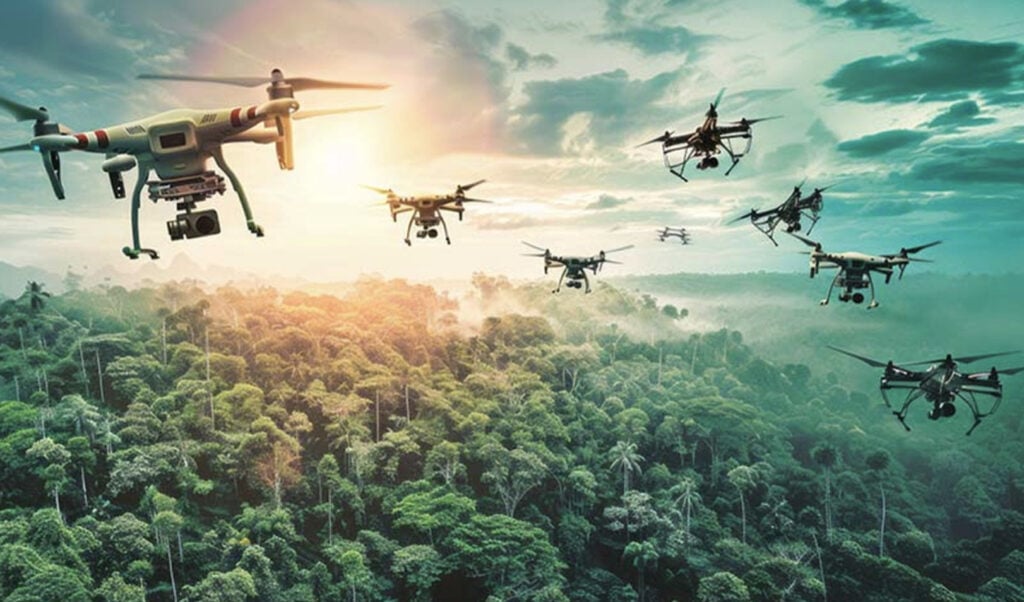
Swarm software enables multiple autonomous systems to coordinate as intelligent, distributed networks across air, ground, surface, and subsea domains. Supporting UAVs, UGVs, USVs, and AUVs, modern swarm architectures manage decentralized navigation, formation control, dynamic task allocation, collision avoidance, and distributed sensor fusion for ISR, electronic warfare, logistics, maritime operations, and infrastructure inspection.
This page showcases leading developers of drone swarm software featuring AI-driven autonomy, mesh networking, and edge computing technologies for intelligent multi-platform coordination.
Read the Technology Overview
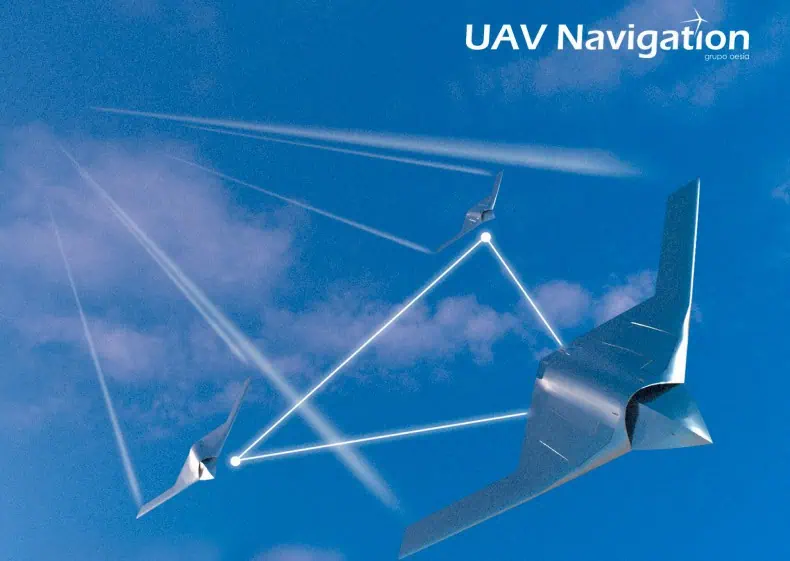
Guidance, Navigation & Control Solutions (GNC) for Drones & UAVs


Innovative Wireless Mesh Networking Technology: Ultra-Reliable & Low-Latency Connectivity for Drones & Mobile Robotics

If you design, build or supply Swarm Software, create a profile to showcase your capabilities and connect with visitors who have an active requirement for your solutions.

Drone swarm software enables multiple autonomous systems to operate cooperatively as a coordinated network rather than as individually piloted platforms. The advanced autonomy software manages complex inter-node communications, decentralized navigation, dynamic task allocation, formation control, collision avoidance, and distributed decision-making across groups of unmanned systems operating simultaneously.
While historically associated with Unmanned Aerial Vehicles (UAVs), modern swarm software increasingly supports collaborative cross-domain autonomy. This approach integrates Unmanned Ground Vehicles (UGVs), Unmanned Surface Vessels (USVs), and Autonomous Underwater Vehicles (AUVs) into a unified network. In military, defense, and advanced industrial environments, swarm architectures provide scalability, system resilience, operational flexibility, and expanded sensing coverage that conventional single-platform autonomy cannot match.

Meshmerize, resilient & low-latency mesh networking for drones & robotics, from Meshmerize
Swarm-enabled Intelligence, Surveillance, and Reconnaissance (ISR) operations allow multiple autonomous drones to maintain persistent coverage across expansive or highly contested operational areas. Distributed sensing improves redundancy, survivability, and target tracking compared to legacy single-platform ISR systems. UAV swarm software continuously coordinates flight paths, sensor tasking, and target tracking behaviors across the network, allowing the swarm to dynamically reposition assets in response to evolving operational priorities or detected threats.
Drone swarms are increasingly deployed for distributed Electronic Warfare (EW) missions, including coordinated jamming, emitter geolocation, signals intelligence (SIGINT), and electronic attack. Swarm drone software coordinates these activities across multiple autonomous nodes simultaneously, creating a virtual large-aperture array from smaller, low-cost assets. This distributed EW approach provides greater operational flexibility while reducing dependence on vulnerable, high-value manned aircraft or centralized EW systems.
Autonomous swarms can overwhelm Integrated Air Defense Systems (IADS) by presenting large numbers of coordinated targets simultaneously. Within a single swarm architecture, some drones function as active radio-frequency decoys, while others perform specialized ISR, EW, or kinetic strike roles. Drone swarming software coordinates the precise timing, routing, and autonomous behaviors across the attack package, complicating adversary defensive targeting and increasing the survivability of higher-value assets.
Swarm software allows groups of drones to rapidly map and search vast operational areas using collaborative navigation and distributed sensing. Shared Electro-Optical/Infrared (EO/IR) and thermal imaging data significantly improve situational awareness during rescue operations. Autonomous coordination allows drones to divide search zones dynamically while avoiding redundant coverage, maximizing efficiency in disaster response, maritime rescue, and remote-area search missions.
Drone swarm management software supports autonomous logistics missions by coordinating the movement of cargo, medical equipment, or critical supplies across multiple unmanned platforms operating collaboratively. Distributed logistics swarms reduce dependence on vulnerable supply lines and allow autonomous systems to adapt delivery paths in real time in response to terrain, weather, or changing threat environments.
Maritime swarms combine UAVs, USVs, and subsea assets into coordinated naval networks. Applications include mine countermeasures (MCM), maritime ISR, harbor protection, and distributed anti-submarine warfare. Swarm software manages communications, navigation, and sensor coordination across highly dynamic maritime environments, enabling distributed autonomous operations over large ocean areas with reduced human operator workload.
Commercial and industrial drone swarms are increasingly used for asset inspection, industrial monitoring, and high-fidelity urban mapping. Multiple drones inspect critical infrastructure simultaneously while autonomously coordinating routes and avoiding collisions. This approach drastically reduces operational downtime and manpower requirements, proving particularly valuable for large-scale industrial sites, transportation networks, and energy facilities.
Swarming autonomous systems provide scalable solutions for border surveillance and perimeter monitoring missions. Distributed drones maintain persistent situational awareness across large geographic frontiers. Autonomous coordination allows the swarm to dynamically reposition individual assets in response to detected activity or changing surveillance priorities, improving coverage continuity and operational responsiveness.
Scientific organizations leverage swarm-enabled autonomous systems for environmental sensing, agricultural analysis, oceanographic research, and wildlife monitoring. Collaborative sensing allows synchronized data collection with improved spatial and temporal resolution, reducing the operational complexity and time associated with large-scale scientific data gathering.

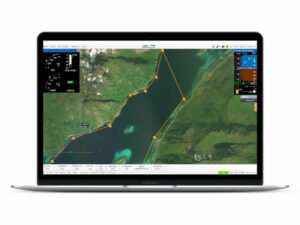
Visionair, GCS Software for mission planning & analysis, from UAV Navigation
Implementing reliable drone swarm control software requires a combination of algorithmic frameworks to manage the collective behavior of the fleet.
Artificial intelligence software and machine learning are central to modern drone swarm autonomy software. AI-driven software enables autonomous systems to recognize patterns, optimize behaviors, adapt to environmental conditions, and coordinate actions with minimal human-in-the-loop intervention.
Mesh networking allows each autonomous node within the swarm to function as both a communications endpoint and a router relay. This creates resilient, distributed networks capable of dynamically adapting as platforms move or network conditions change. Because communications pathways can reroute automatically, mesh architectures improve survivability and eliminate reliance on centralized ground control infrastructure.
MANET architectures are widely used in military swarm operations where fixed infrastructure is unavailable, degraded, or denied. These self-forming, self-healing networks continuously adapt their topology to maintain communications between autonomous systems, allowing drones to enter or leave the network dynamically during missions without disrupting wider swarm operations.
Swarm operations require low-latency communications to support synchronized maneuvering, distributed sensing, and collaborative autonomy across multiple platforms simultaneously. Sensor data, positional updates, and mission-critical commands must be exchanged in near real time to preserve coordinated swarm behaviors.
Large drone swarms place significant demands on RF spectrum usage. Swarm software dynamically allocates bandwidth, prioritizes critical traffic, and mitigates congestion across the network. Efficient spectrum management is vital in dense urban environments and military operations where electromagnetic interference is common.
Beyond-line-of-sight swarm operations increasingly rely on hybrid communications architectures combining terrestrial RF links, airborne relays, and satellite communications. SATCOM connectivity allows autonomous swarms to maintain operational reach over large geographic areas while supporting remote mission management.
Military swarms must continue operating under hostile electronic warfare conditions, including jamming and signal disruption. Modern swarm software incorporates adaptive routing, frequency agility, and low-probability-of-intercept/low-probability-of-detection (LPI/LPD) waveforms to preserve connectivity.
Self-healing networking architectures automatically reroute communications when nodes fail or links are disrupted, improving survivability and operational resilience by reducing single points of failure within the communications architecture.
Advanced encryption and authentication frameworks protect autonomous swarms against interception, spoofing, and unauthorized access. Modern swarm software incorporates secure key management, trusted device authentication, and encrypted communications protocols designed for contested operational environments.
Drone swarms present a large, distributed cyber attack surface. Swarm software must protect against jamming, GNSS spoofing, malicious intrusion, node compromise, and unauthorized control attempts. Because autonomous swarms rely heavily on distributed communications and decentralized decision-making, cyber resilience must be embedded throughout the software architecture.
Modern swarm architectures are built around modularity, open standards, and edge computing to ensure scalability. Rather than relying on a centralized control system, processing and decision-making are distributed across individual autonomous nodes operating collaboratively.
Most architectures separate mission management, communications, sensor fusion, autonomy logic, and flight control into modular software layers aligned with Modular Open Systems Approaches (MOSA). Middleware frameworks like ROS 2 (Robot Operating System 2) and Data Distribution Service (DDS) increasingly support interoperability between heterogeneous autonomous systems. For flight control and vehicle-level communication, protocols such as MAVLink and UAVCAN/Cyphal form the backbone of both proprietary and open source drone swarm software platforms.
| Software Framework / Protocol | Primary Role in Swarm Architecture |
| ROS 2 / Micro-ROS | Multi-agent robotics middleware providing distributed nodes, pub/sub communication, and lifecycle management at the edge. |
| DDS (Data Distribution Service) | Low-latency, deterministic data-sharing middleware standard used for dependable, secure swarm communications. |
| MAVLink | Lightweight message-marshalling protocol used for vehicle-to-ground and inter-vehicle telemetry/command distribution. |
| UXAS (Unmanned Systems Autonomy Services) | An open-source framework developed by AFRL to enable cooperative, autonomous task assignment and path planning. |
| OpenCV / TensorFlow Lite | Edge-optimized libraries for computer vision, object classification, and distributed perception on swarm nodes. |
Containerized software environments (e.g., lightweight Docker or Podman) and edge computing architectures are standard, enabling rapid deployment of AI applications, mission updates, and distributed processing capabilities across large autonomous fleets.
AI-native swarm architectures are driving the next generation of autonomous operations. Future systems will rely increasingly on adaptive machine intelligence and decentralized decision-making rather than predefined behavioral logic.


 Searching Companies & Products


 Subscribe to the Weekly eBrief
The latest engineering and technical developments straight to your inbox - join thousands of engineers who receive it.
Subscribe to the Weekly eBrief
The latest engineering and technical developments straight to your inbox - join thousands of engineers who receive it.