Honeywell Aerospace has validated a lightweight satellite communications antenna designed to enable safe, continuous command-and-control for unmanned aircraft operating beyond visual line of sight.
Developed at Honeywell Aerospace’s European R&D center in Brno, Czechia, as part of the European Space Agency’s Iris Global program, the breakthrough technology provides resilient connectivity required for real-time flight control, airspace awareness, and conflict avoidance. Integrated with the company’s VersaWave satcom system, the antenna enables seamless switching between satellite and terrestrial networks to maintain uninterrupted command-and-control during critical missions such as infrastructure inspection, logistics, and emergency response.
Martin Mlaskač, Senior Technical Manager at Honeywell Aerospace, commented, “As regulators and operators prepare for scaled BVLOS operations, resilient command-and-control connectivity is foundational. Flight testing at Budkovice Airport confirmed that combining satellite and terrestrial communication links ensures operators maintain positive control of the aircraft even in demanding or complex scenarios.”
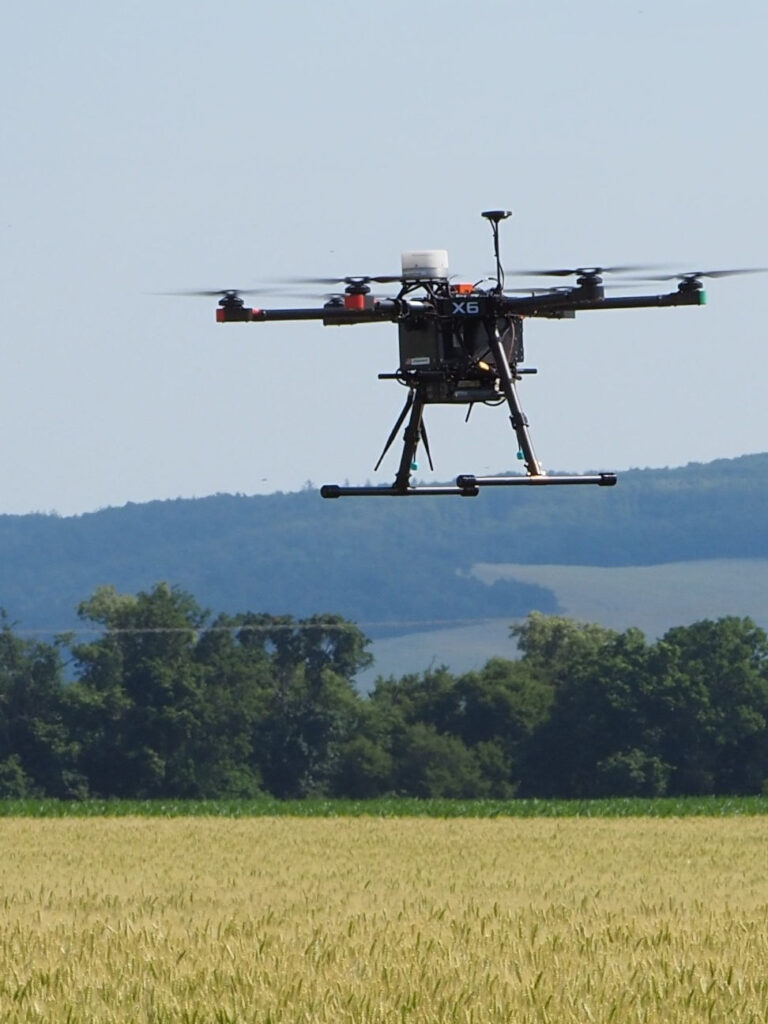
The validation flights were conducted under real operating conditions at Budkovice Airport in partnership with Viasat, demonstrating how resilient connectivity supports safe drone integration into airspace shared with crewed aircraft. During testing, operators adjusted flight trajectories and maintained safe separation when potential conflicts were detected, including scenarios where another drone crossed a planned flight path.
Several test missions took place within a U-space environment, Europe’s digital, automated, and regulated airspace framework for unmanned aircraft. Frequentis supplied its Uncrewed Traffic Management suite for secure data exchange regarding operator registration, flight authorizations, and geo-awareness. Simultaneously, a Honeywell Aerospace Ground Control Station equipped with a ground-based Detect-and-Avoid system processed telemetry from both the drone and an actual crewed intruder aircraft to alert the operator and recommend safe route adjustments. Once approved, updated flight plans were uploaded and executed automatically.
Bernhard Kirschner, Solution Architect for Integrated Lower Airspace at Frequentis, added, “The successful demonstration underlines the importance of strong industry collaboration. Together with our partners, we’re building the digital infrastructure required for safe and efficient unmanned aviation.”
Viasat provided the satellite network infrastructure supporting the live flight demonstrations.
Joel Klooster, SVP Aircraft Operations and Safety at Viasat, said, “UTM integration and resilient network capabilities are core pillars of BVLOS, not just nice add-ons. Our ongoing collaboration in the ESA Iris program shows how advanced multilink networks can enable real-time interaction, airspace awareness, and continuity of control in live operating conditions. These are all critical elements for scalable unmanned operations.”
Czech industrial partners contributed to prototype production, while Brno University of Technology supported radio-frequency validation. Honeywell Aerospace is now preparing the antenna for industrial production and evaluating regional suppliers for inclusion in its manufacturing supply chain. The initiative is co-funded by the European Space Agency, with additional support from the Ministry of Transport of the Czech Republic and the Ministry of Industry and Trade of the Czech Republic.