

Reactive Drone examines how operating Unmanned Aerial Vehicle (UAV) motors near maximum thrust can increase energy consumption, generate additional heat, and reduce flight endurance.
The company highlights the importance of propulsion power margins in balancing efficiency, component reliability, and maneuvering capability.
Understanding Propulsion Efficiency Losses
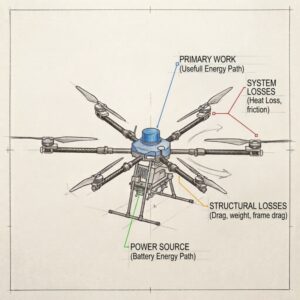 Brushless DC (BLDC) motors are widely used in multirotor UAVs, from compact First-Person View (FPV) drones to heavy cargo platforms. However, operating these motors near their maximum output can introduce significant electrical and aerodynamic inefficiencies.
Under Joule’s Law, resistive heating increases with the square of electrical current (I²R). Reactive Drone explains that extracting the final 20% of available thrust requires substantially more current, increasing thermal losses.
Aerodynamic resistance also increases at higher propeller speeds. Under comparable operating conditions, propeller drag generally scales with the square of rotational speed, while the power required to overcome it scales with the cube. These effects can contribute to declining specific thrust, measured in grams per watt (g/W).
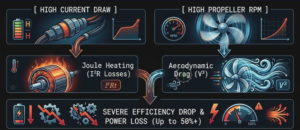
Higher current demand also places additional stress on batteries, contributing to voltage sag, increased temperatures, reduced usable capacity, and a potential risk of mid-air power cutouts.
Identifying an Efficient Operating Range
Reactive Drone reports that propulsion bench testing and field trials indicate an efficiency peak at approximately 60% to 65% of maximum thrust, with motor temperatures remaining within nominal operating limits.
The company describes an inverted-parabolic efficiency curve and reports that efficiency can decline by more than 50% when motors operate at 90% to 100% of maximum thrust, compared with their most efficient operating point.
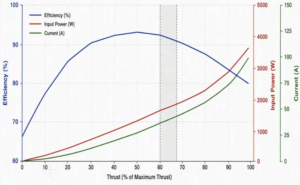
These figures reflect the company’s reported findings rather than a universal operating range for all UAV propulsion systems.
Applying Power Margins to UAV Design
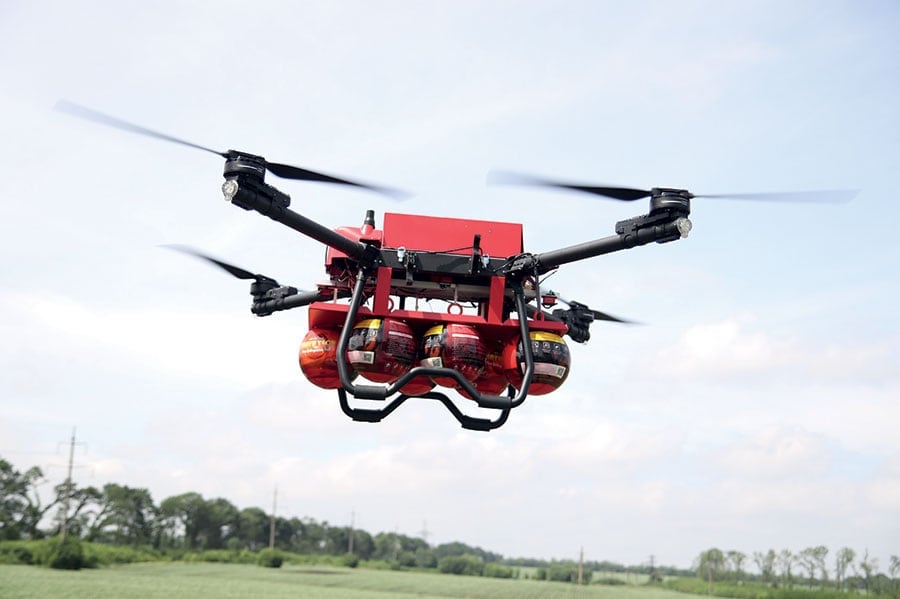
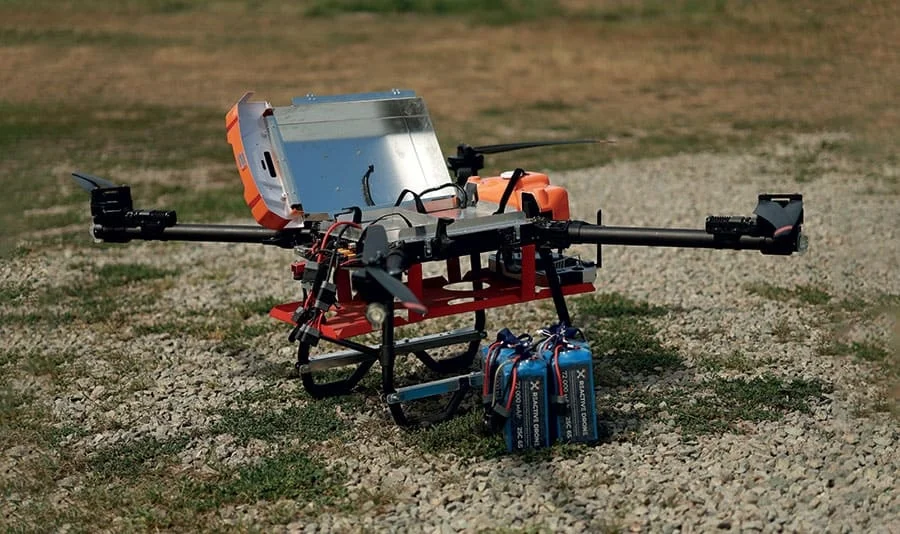
Reactive Drone incorporates intentional propulsion power margins across its KAZHAN 620 (BAT 620), KAZHAN 630 (BAT 630), and SHMAVIK UAV platforms.
The company sizes propulsion systems so that cruise flight with a full payload takes place within its identified 60% to 65% efficiency range, rather than requiring sustained operation near maximum motor output.
Three principal benefits of this approach:
- Extended flight endurance: Reduced electrical loading helps limit battery overheating and premature degradation.
- Component reliability: Maintaining motors within nominal thermal limits helps mitigate overheating-related failures, including inter-turn short circuits and neodymium magnet demagnetization.
- Maneuvering reserve: Additional thrust remains available for brief use during high-wind conditions or emergency evasive maneuvers.
By incorporating propulsion power margins into UAV design, Reactive Drone emphasizes sustained operating efficiency, thermal management, and available maneuvering capacity rather than maximum thrust figures alone.