




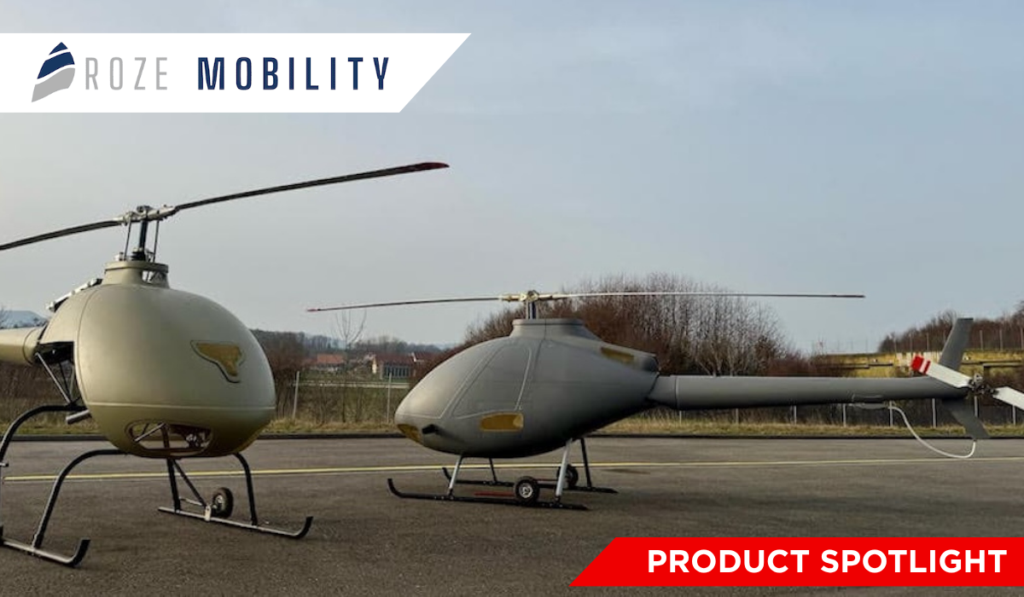
The SH-917 Unmanned Helicopter, an autonomous-capable Vertical Take-Off and Landing (VTOL) platform from Roze Mobility, is designed for civilian and defense applications requiring high payload capacity and extended flight endurance.
Purpose-built as an Unmanned Aerial Vehicle (UAV), the Swiss-engineered SH-917 combines a patented lightweight composite airframe, gasoline-powered propulsion and modular payload architecture. It offers a maximum payload capacity of 250 kg, a Maximum Take-Off Weight (MTOW) of 550 kg and configuration-dependent endurance of up to eight hours, with a published range of up to 1,200 km.
Airframe and Autonomous Capabilities
The SH-917 incorporates a carbon fiber main body and tail boom, a two-bladed composite main rotor and a fail-safe tail design. Its helicopter configuration enables vertical take-off, landing and hovering without requiring a conventional runway.
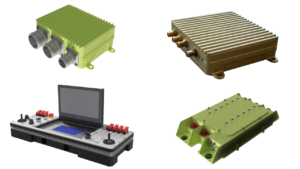
Powered by Kepstronic — (Switzerland)
Developed in collaboration with Swiss technology partner Kepstronic, the aircraft’s automation architecture incorporates deterministic control, fault handling, redundant flight computers and safe-mode fallback capabilities. A Field-Programmable Gate Array (FPGA) real-time core supports time-critical control operations, complemented by secure telemetry and video communications.
Propulsion and Payload Integration
The SH-917 features a gasoline-powered propulsion system based on a 160 hp Rotax 912 engine configuration. Its standard fuel arrangement comprises four 40-liter tanks, providing a total capacity of 160 liters, with optional additional fuel tanks available to extend endurance.
Roze Mobility reports average fuel consumption of around 22–22.5 liters per hour, depending on configuration.
Its modular architecture supports a range of mission-specific payloads, including Electro-Optical/Infrared (EO/IR) camera gimbals, LiDAR scanners, laser rangefinders, cargo delivery mechanisms, and water-dispensing, spraying or fire-retardant equipment.
These payload options allow the aircraft to be configured for applications including surveillance, mapping, cargo transportation and firefighting-related operations.
Technical Specifications and Flight Performance
The SH-917 has an empty weight of 300 kg and a maximum gross weight of 550 kg. Its published cruise speed is 90 knots at 85% power, increasing to 100 knots at 100% power, with a never-exceed speed (VNE) of 120 knots.
The aircraft’s In-Ground-Effect (IGE) hover ceiling under International Standard Atmosphere (ISA) conditions is specified at 5,000 ft at maximum weight, increasing to 7,500 ft with a 50 kg cargo load.
Range and Endurance
The SH-917’s operating range and endurance vary according to payload configuration. Roze Mobility provides the following example performance figures without optional additional fuel tanks:
Payload: 230 kg | Endurance: 1 hour | Range: Up to 150 km
Payload: 190 kg | Endurance: 3 hours | Range: Up to 450 km
Payload: 130 kg | Endurance: 6 hours | Range: Up to 900 km
Payload: 90 kg | Endurance: 8 hours | Range: Up to 1,200 km
These configurations allow operators to balance carrying capacity against flight duration, with the aircraft’s maximum published range and endurance corresponding to its 90 kg payload configuration.
The SH-917 combines an autonomous control architecture, configurable payload integration and gasoline-powered propulsion in a modular helicopter UAV designed for civilian and defense applications.
To find out more about the SH-917, visit the Roze Mobility website.







