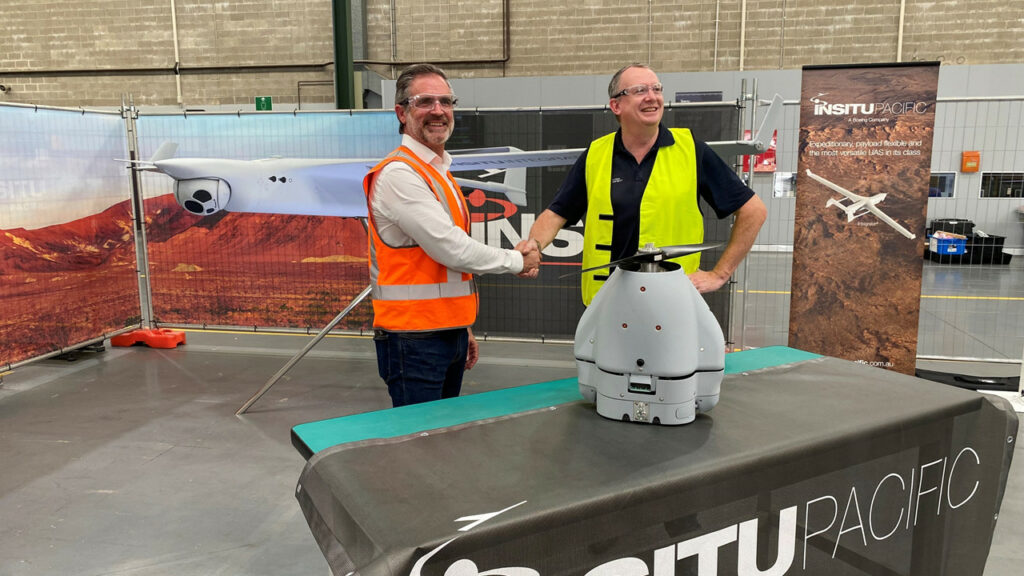
Orbital UAV, a developer of integrated heavy fuel engine systems for military and commercial unmanned aircraft, discusses the role of metrology in the manufacture of its engine crankcases, where dimensional accuracy underpins propulsion reliability.
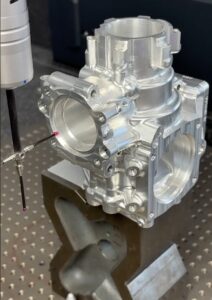 Within these propulsion systems, the crankcase serves as a primary structural component rather than a simple enclosure. It provides the mechanical foundation for the crankshaft, bearings, and internal engine assemblies, all of which must remain precisely aligned while operating under sustained loads, temperature variation, and vibration.
In unmanned aviation, system dependability is established well before an aircraft leaves the ground. For propulsion assemblies, this assurance begins with the dimensional and geometric accuracy of the crankcase.
Metrology forms the link between design intent and manufactured outcome. Each crankcase produced by Orbital UAV is machined from a single solid billet and undergoes complete dimensional verification within the company’s in-house metrology laboratory, ensuring the specified geometry is consistently achieved throughout production.
The inspection methodology applied to every crankcase is based on clearly defined and controlled parameters:
- 62 critical characteristics and 11 significant characteristics are defined, controlled and inspected.
- Geometric toleracnes, including squareness, flatness, and parallelism, are held to ≤10 µm.
- Feature-of-size dimensions, such as compressor bore diameters, are maintained to ±7 µm.
- Inspection coverage is comprehensive, with every crankcase verified and no reliance on statistical sampling.
Even minimal dimensional deviation can have measurable consequences. Sub-micron misalignment within the crankcase structure can influence bearing preload, affect crankshaft balance, and degrade combustion efficiency. Through precise measurement and closed-loop verification, each crankcase is confirmed to meet its specified geometry and dimensional accuracy.
This application of metrology supports consistent power delivery, long service life, and reliable engine performance. For unmanned platforms operating in demanding environments, precise crankcase verification contributes to propulsion system integrity and mission reliability.