


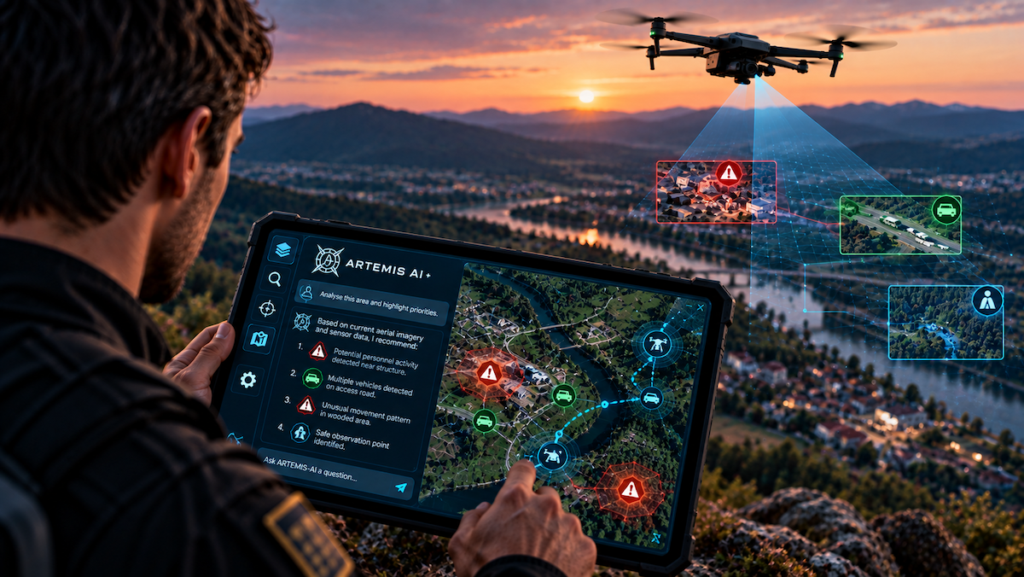
In a recent discussion with UST, Andrew Munro, Managing Director at Smith Myers, outlined how ARTEMIS-AI is being developed to support uncrewed missions by reducing operator workload, improving situational understanding and accelerating decision-making.
Andrew also explained how the capability operates entirely offline, adapts within closed environments, supports human-led decision-making and is being designed for both existing and future ARTEMIS users.
What kinds of uncrewed missions or unmanned system operators will benefit most from integrating ARTEMIS AI into their payload setups?
The benefits apply to any uncrewed mission where operators need to understand and act on the cellular environment. This includes search and rescue, border security, defense, law enforcement and disaster response, although the principle applies much more broadly.
ARTEMIS-AI is designed to become increasingly valuable over time. As it is used, it can build a deeper understanding of the operating environment, recurring mission sets, and what is normal or significant within that context. This allows it to help operators interpret increasingly complex data, identify activity that warrants attention, and reduce the amount of information they need to assess manually.
Ultimately, the objective is to reduce operator workload and accelerate decision-making. The more ARTEMIS-AI understands about the mission and operating environment, the more effectively it can help operators focus on what matters.
Can you give a real-world uncrewed mission scenario where ARTEMIS AI significantly improves an operator’s performance or decision-making?
A compelling example is a fast-moving natural disaster, such as a major wildfire, flood or landslide, where conditions are changing by the minute and an uncrewed aircraft may need to search a large area quickly.
ARTEMIS-AI could simplify that mission by assisting with search management, analyzing the cellular environment as the aircraft moves through the affected area, and presenting the operator with clear, prioritised information. It could identify areas of interest, help locate people who may be trapped or isolated, and support the communication of evacuation instructions, warnings or escape routes directly to cellular devices.
Looking further ahead, ARTEMIS-AI could also work with the aircraft itself, directing or recommending its flight path to ensure the affected area is systematically searched and revisiting locations that require further investigation.
The key advantage is speed and reduced workload. Rather than spending valuable time configuring systems, interpreting multiple data streams and deciding where to search next, the operator can focus on the decisions that matter.
ARTEMIS AI runs entirely offline. How have you managed to deploy a Large Language Model without relying on cloud connectivity, and what edge-processing or SWaP considerations did you address for uncrewed platforms?
A fundamental design principle of ARTEMIS-AI is that it does not depend on the cloud. Its sovereign AI capability is hosted locally, either within the ARTEMIS system or, depending on the platform, on processing hardware in the associated ground control station.
This removes the need to send operational data to an external cloud service or rely on internet connectivity, which is particularly important where connectivity, security and data sovereignty are critical.
Running a Large Language Model locally requires careful optimisation around processing efficiency and SWaP. Where appropriate, processing can instead be hosted at the ground station while remaining within the user’s controlled environment.
ARTEMIS-AI therefore remains self-contained, with the operator retaining control of the system, processing and data.
How does ARTEMIS AI ensure that remote operators can trust the recommendations it provides during mission-critical uncrewed operations?
Trust is fundamental in any mission-critical environment. ARTEMIS-AI is designed to support the operator, not replace them, and the human remains firmly in the decision-making loop.
Rather than simply presenting an instruction or conclusion, ARTEMIS-AI can provide recommendations in the context of the current mission data, previous missions and other relevant information available to the system. This allows the operator to understand why a particular course of action is being suggested, interrogate the information if required, and make the final decision with greater confidence.
As the system develops greater understanding of recurring missions and operating environments, it can increasingly help identify patterns, highlight anomalies and bring the most relevant information to the operator’s attention. But responsibility for mission-critical decisions remains with the operator.
The objective is not to automate human judgement; it is to give the operator better situational awareness, reduce unnecessary cognitive workload and help them make informed decisions more quickly.
How does the system learn or adapt over time if it operates in a fully closed environment with no internet connectivity on autonomous or air-gapped platforms?
Operating in a closed environment does not mean ARTEMIS-AI is static. In fact, one of its key advantages is that it can become increasingly useful the more it is used, building a richer understanding of previous missions, recurring patterns and the specific operating environment in which it is deployed.
Users can also enrich that environment with their own information. For example, they could incorporate operating procedures, mission protocols, areas of responsibility, geographic information and other organisation-specific knowledge. ARTEMIS-AI can then use that information alongside the ARTEMIS mission database and its previous mission experience to provide increasingly relevant and context-specific assistance.
Importantly, all of this can remain entirely within the user’s controlled environment. There is no requirement for that operational knowledge or mission data to be shared with Smith Myers, uploaded to the internet or transferred to a third-party cloud provider. The customer retains control of both the information and the environment in which it is used.
Separately, improvements to the underlying AI capability and validated model updates can be developed and tested under controlled conditions before being introduced to the deployed system. This provides the benefits of an evolving AI capability while maintaining the security, sovereignty and configuration control required for autonomous and air-gapped platforms.
Will ARTEMIS AI be available as an upgrade for existing ARTEMIS users, or is it tied to new hardware processing and future platform configurations, such as Modular Payload compliant UAV integrations?
Yes. ARTEMIS-AI is being designed to be available as an upgrade for existing ARTEMIS users, with the add on of additional hardware and will be incorporated as a standard feature on future system configurations.
This is important to us because there is already a significant installed base of ARTEMIS systems operating around the world, and we want those users to be able to benefit from ARTEMIS-AI without having to replace their existing systems. The additional AI processing capability can be introduced into a deployed ARTEMIS architecture, with a number of options for where that processing is hosted depending on the platform and operational requirement.
So ARTEMIS-AI is not tied to a particular future platform or new generation of ARTEMIS hardware. It is an evolution of the ARTEMIS capability that we intend to make available to both existing and future users.
Thank you for your time Andrew. We look forward to following the continued development of ARTEMIS-AI and seeing how the capability is applied across uncrewed operations.