Artificial Intelligence (AI) Technology
Discover cutting-edge solutions from 7 leading global suppliers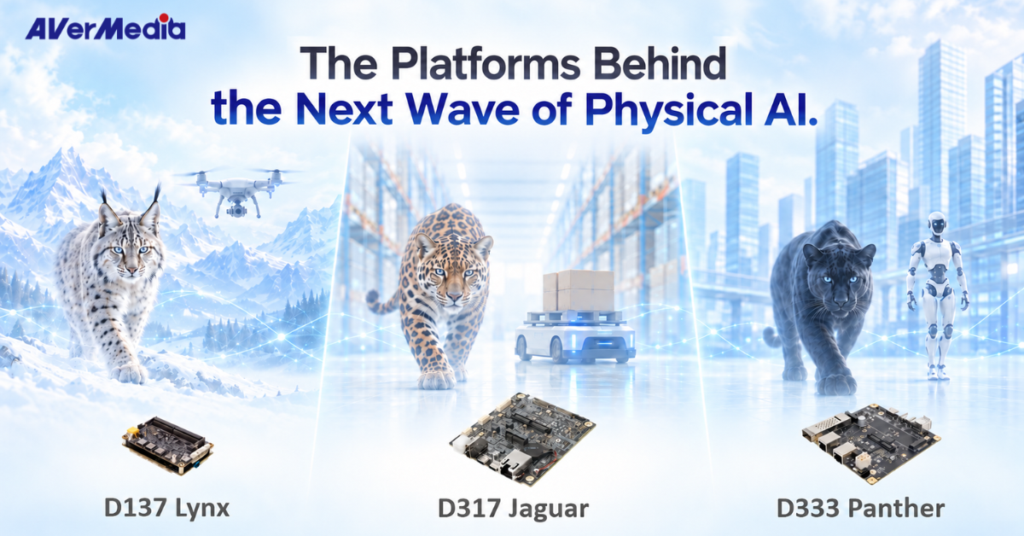
To address the growing integration complexity in advanced robotics, AVerMedia Technologies has introduced a new hardware and software platform portfolio tailored specifically for drones, autonomous mobile robots (AMRs), and humanoid systems.
As physical artificial intelligence advances, autonomous machines are increasingly required to process multi-sensor inputs, manage complex control loops, and run heavier AI workloads simultaneously. This evolution often creates integration bottlenecks for engineering teams attempting to incorporate additional cameras, sensors, and expansion modules without compromising physical footprint, power efficiency, or payload capacity.
The new portfolio addresses these challenges through three application-focused hardware foundations. For aerial applications, the D137 Lynx carrier board integrates NVIDIA Jetson Orin Nano or Orin NX modules into a 90 × 60 mm, 50 g frame. Featuring built-in control I/O alongside support for MIPI, gimbal, and GMSL camera architectures, the board reduces external wiring and supplementary electronics to preserve onboard weight and power for batteries and mission payloads.
For ground-based systems, the D317 Jaguar pairs the NVIDIA Jetson AGX Orin with high-bandwidth expansion options, including GMSL and Power over Ethernet (PoE) connectivity, to handle demanding perception, localization, navigation, and fleet-management workloads in AMRs. For humanoid robotics, the D333 Panther utilizes NVIDIA Jetson Thor T4000 and T5000 processors within a 120 × 120 mm carrier. The Panther incorporates a modular architecture with an F8G7C daughter board to accommodate evolving I/O requirements across cameras, control systems, USB peripherals, and networking.
To enhance spatial awareness across all three platforms, AVerMedia supports direct integration with RealSense and Stereolabs depth cameras. On the software side, the company offers both Standard and Real-Time Board Support Packages (BSPs) simultaneously, with the Real-Time release incorporating PREEMPT_RT support for low-latency execution. The platforms also leverage NVIDIA memory-optimization technologies to help developers execute workloads efficiently across Jetson modules, reducing memory footprints and allowing teams to right-size hardware configurations.
“Physical AI is creating a new wave of opportunity for robotics developers,” said Alex Liu, Vice President of AVerMedia. “Our robotics platform portfolio gives developers a purpose-built foundation to integrate faster, scale more easily, and move confidently from development toward deployment.”
Leveraging practical experience across real-world drone, AMR, and humanoid deployments, AVerMedia backs the hardware line with BSP customization, peripheral integration, validation, and production support to assist developers throughout the product lifecycle.