Remotely Operated Vehicles (ROV)
Discover cutting-edge solutions from 4 leading global suppliersThe Royal Navy is exploring advanced robotic capabilities to enhance underwater threat response and maritime safety, with VideoRay’s Mission Specialist Defender Remotely Operated Vehicle (ROV) playing a key role in recent trials conducted by the UK’s Defence Science and Technology Laboratory (Dstl).
In collaboration with industry partners, Dstl has integrated a suite of mission-specific technologies into the commercially available VideoRay Mission Specialist Defender ROV.
The enhanced system is designed to counter sabotage threats to subsea infrastructure and safely neutralize legacy unexploded ordnance (UXO), threats that pose significant risks to both vessels and human divers.
The Defender is also the ROV of choice for the MESR program of record for the US Navy following a $92.6 million five-year indefinite-delivery/indefinite-quantity (IDIQ) contract for the family of systems.
Dstl explosives engineer John, said, “This technology would be a valuable toolset for keeping our Armed Forces safe whilst providing the public with value for money.
“This unique capability with its sensors, tools and cameras will give operators a real time ability to deal with these underwater hazards in a safe, effective and efficient way.”
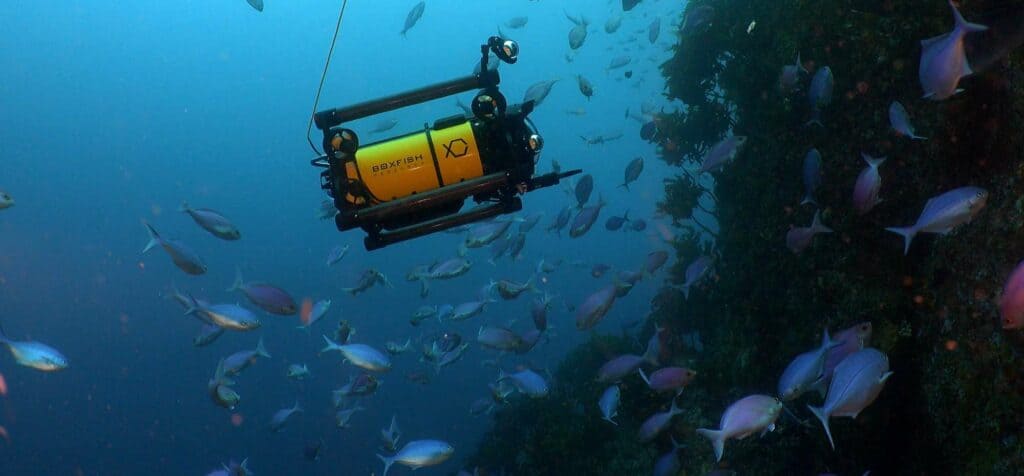
The modified Remotely Operated Vehicle is equipped to detect UXO on the seabed and deploy remotely operated explosive charges to neutralize them. With a compact yet powerful design, the Mission Specialist Defender can operate at depths beyond diver reach and sustain missions far longer, offering extended endurance and reducing the need to place personnel in hazardous environments.
Thanks to its modular architecture and high-definition video and sonar feedback, the Mission Specialist Defender can be deployed rapidly from ships or shorelines and controlled remotely. It provides operators with real-time situational awareness and precision control to investigate and dispose of subsea hazards.
This system is intended to work in conjunction with other robotic platforms to perform seabed surveys, identify underwater threats, and deliver targeted intervention, all without the need to sacrifice the ROV itself, allowing for repeat use and maximizing operational value.
The project is not only advancing underwater defense capabilities but also supporting specialist jobs across the UK’s defense technology sector through ongoing collaboration between Dstl, the Royal Navy, and technology providers such as VideoRay. Tactics, techniques, and technologies have been jointly developed and tested during a series of successful trials at key locations including Horsea Island in Portsmouth, Portland Harbour, South Wales, and Norway.
This Royal Navy-funded initiative continues to push the boundaries of maritime unmanned systems and demonstrates the potential of commercial-off-the-shelf (COTS) platforms like the VideoRay Mission Specialist Defender to deliver cutting-edge military capability with enhanced cost-efficiency and operational safety.