Remotely Operated Vehicles (ROV)
Discover cutting-edge solutions from 4 leading global suppliers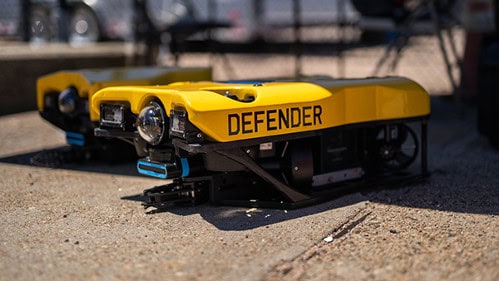
AeroVironment, Inc., through its wholly owned subsidiary VideoRay, has been awarded a $4.8 million contract by the United States Coast Guard for its Mission Specialist Defender Remotely Operated Vehicles (ROVs).
The contract is part of the Coast Guard’s Force Design 2028 modernization initiative. The Defender ROVs are intended to strengthen Coast Guard operations by providing advanced maritime robotics for rapid underwater inspections, pier inspections, hull assessments, subsurface infrastructure surveys, disaster response, and search and rescue operations in challenging environments. This is expected to reduce diver risk while increasing mission safety, operational efficiency, and fleet readiness.
The $4.8 million award is the largest portion of the $11 million executed in fiscal year 2025 for rapid autonomous fleet upgrades.
Chris Gibson, Chief Executive Officer at VideoRay, commented, “The selection of the Mission Specialist Defender reinforces our ability to deliver proven technology to address the most demanding defense and security missions. Customers have come to depend on VideoRay when failure is not an option. As AV’s maritime pillar, we’re proud to contribute to the organization’s all-domain uncrewed systems strategy to ensure the safety and security of our forces.”
The Coast Guard established the Robotics and Autonomous Systems (RAS) Program Executive Office to rapidly integrate unmanned and robotic technologies across all missions as part of the Force Design 2028 plan. This initiative includes investments in robotics and autonomous systems designed to build a more agile, technology-enabled, and globally ready force for the evolving maritime domain.
Anthony Antognoli, the Coast Guard’s first RAS program executive officer, spoke on the program in a separate release in September 2025, “These unmanned systems provide increased domain awareness, mitigating risk and enhancing mission success as the Coast Guard continues to operate in hazardous environments. The Coast Guard’s mission demands agility, awareness and adaptability. Robotics and autonomous systems deliver all three, enabling us to respond faster, operate smarter and extend our reach where it matters most. We are not waiting for the future to arrive. We are delivering it to the fleet today.”
The Mission Specialist Defender is built on a modular, open-architecture design that allows operators to easily integrate advanced sensors, manipulators, and specialized payloads. This flexibility supports adaptability to evolving mission requirements, while field-swappable modules enable on-site maintenance and repairs to minimize downtime and maintain operational tempo.
The selection of the Mission Specialist Defender builds on the company’s expanding track record with U.S. and allied defense customers, including the Navy’s Maritime Expeditionary Standoff Response (MESR) program.