
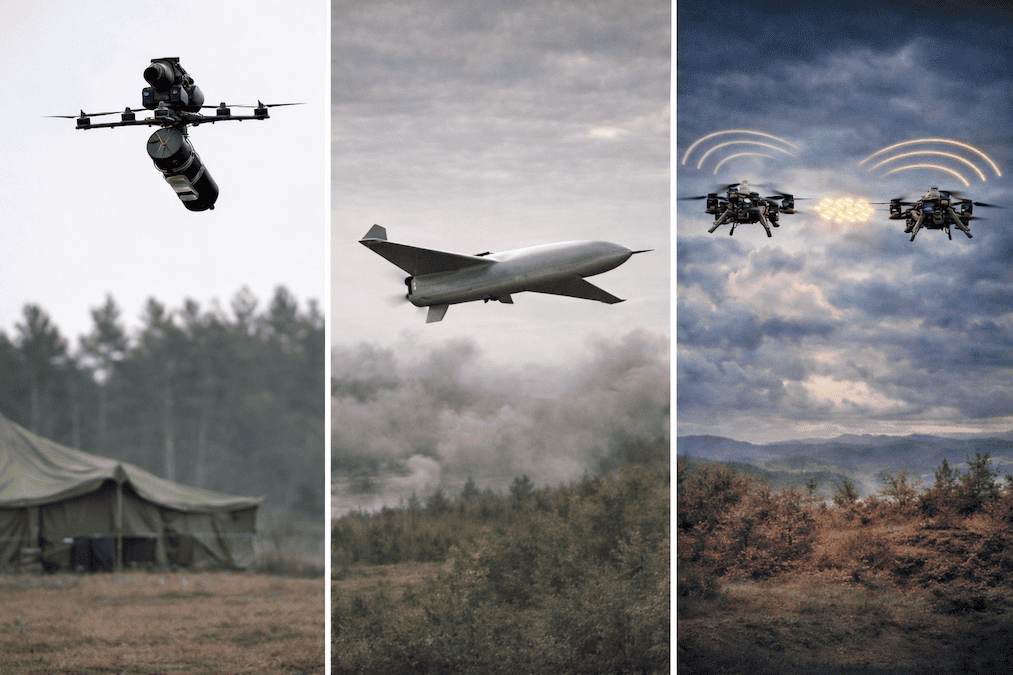
Beechat Network Systems discusses how modern drones are being adapted to operate in environments affected by electronic warfare, where jamming and signal disruption have become major challenges for both military and civilian systems. Read more >>
Electronic warfare techniques can interfere with drone control links and GPS signals, particularly in conflicts such as Ukraine, where platforms ranging from commercial quadcopters to loitering munitions are routinely deployed. In response, anti-jamming technologies are being developed that either avoid radio-frequency communication entirely, reduce reliance on live operator input, or make wireless links more resistant to disruption.
One anti-jamming method uses fibre-optic tethering, where drones remain physically connected to operators through lightweight optical cables that transmit control data and sensor feeds as light signals. Because these systems do not rely on radio communication, they are immune to RF jamming and provide secure, high-bandwidth connections suited to surveillance and overwatch operations in electronic warfare environments.
However, tethered systems also introduce limitations including reduced maneuverability, shorter operating range, added deployment complexity, and the requirement for operators to remain closer to operational areas.
Another approach involves onboard Artificial Intelligence (AI), allowing drones to continue operating even after communication links are lost. AI-enabled systems can use onboard processing for navigation, obstacle avoidance, and autonomous flight functions without relying on continuous operator input.
Experimental FPV systems and modified loitering munitions in Ukraine are described as being capable of continuing missions autonomously under jamming conditions. At the same time, onboard AI increases computing and power requirements, creates challenges for in-flight retasking, and raises ethical considerations surrounding autonomous decision-making.
The article also examines Frequency Hopping Spread Spectrum (FHSS), which continuously changes transmission frequencies to make wireless communication more difficult to jam or intercept. HopSync, Beechat’s adaptive frequency-hopping system, is designed to synchronize multiple radios across tactical mesh networks operating in contested environments.
While fibre-optic tethering, onboard AI, and frequency hopping each address jamming differently, frequency hopping is presented as a practical balance between mobility, range, and resilience for tactical drone operations.
Read ‘How Modern Drones Overcome Jamming: Fibre Optics, AI Autonomy, and Frequency Hopping’ to find out more information.