

Unmanned Helicopters
Discover cutting-edge solutions from 5 leading global suppliers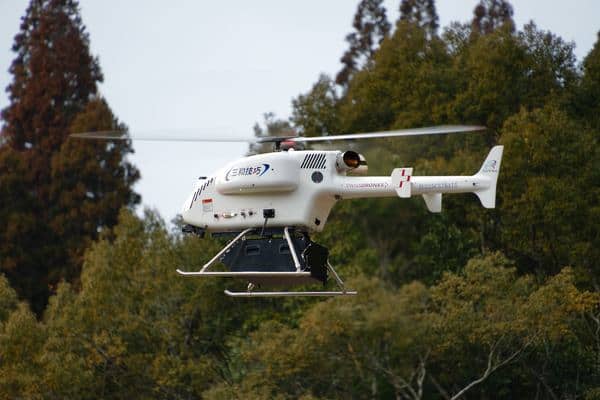
SwissDrones’ heavy-lift unmanned helicopter platform, the SDO 50, is gaining momentum in Japan following recent flight demonstrations and disaster-response training exercises that showcased the aircraft’s operational flexibility, endurance, and cargo capabilities.
Japanese engineering company Sanwa Giko recently confirmed the successful introduction and maiden flight of the SDO 50 in Kitakyushu City, marking an important milestone in the deployment of advanced unmanned helicopter systems for industrial and emergency response applications in the country.
Designed and manufactured by SwissDrones, the SDO 50 is a large-scale unmanned helicopter engineered to meet aviation-grade quality standards. The platform has already been deployed internationally across a range of demanding missions, including infrastructure inspection, surveillance, search operations, and cargo transportation.
A key differentiator of the aircraft is its intermeshing rotor system, which enables efficient vertical lift while reducing operational complexity and lowering emissions compared with conventional crewed helicopters. The design also supports safe operations in challenging environments, including nighttime missions and flights over hazardous or difficult-to-access terrain.
Expanding Operational Capability in Japan
Following the initial flight in Kitakyushu, the SDO 50 was further evaluated during a demonstration program in Kagoshima Prefecture as part of Japan’s regional logistics initiatives. Conducted under a modal shift project supported by the Ministry of Land, Infrastructure, Transport and Tourism, the demonstration highlighted the aircraft’s flight stability and payload transport performance.
With its ability to be transported on vehicles and rapidly deployed by a relatively small operational team, the SDO 50 offers significant mobility advantages for organizations requiring quick-response aerial capability across geographically dispersed locations. These attributes make the platform particularly relevant for disaster relief, infrastructure support, and remote logistics operations.
Sanwa Giko intends to expand domestic support services and operational deployment of the aircraft, focusing on applications such as inspection missions, search and surveillance, emergency response, and cargo transport.
Disaster Response Training Highlights UAV Capabilities
The SDO 50’s potential role in emergency management was further emphasized during a disaster-response exercise held in Amakusa City, where UAVs and drones were integrated into simulated crisis operations.
The training exercise was organized by Drone Move in partnership with the wide-area disaster prevention organization RUSEA, which operates through an extensive network of branches across Japan. Participants reviewed aerial information-gathering procedures and conducted practical flight demonstrations based on a simulated disaster scenario.
Among the highlights was the operation of a helicopter-type UAV capable of transporting payloads of up to 20kg, while supporting mission endurance of up to 3 hours and operational ranges reaching 200km. Such performance characteristics underscore the growing role of large unmanned rotorcraft in supporting logistics and reconnaissance during emergency situations, particularly when access by ground or crewed aircraft may be limited.
The exercise also focused on operational readiness, including pilot procedures and support-team coordination to improve response effectiveness during real-world emergencies.
As Japan continues to explore resilient logistics networks and disaster-response technologies, SwissDrones’ SDO 50 platform is positioning itself as a versatile solution capable of supporting both commercial and public-sector missions through long-endurance autonomous flight and heavy-lift capability.