Unmanned Helicopters
Discover cutting-edge solutions from 5 leading global suppliers
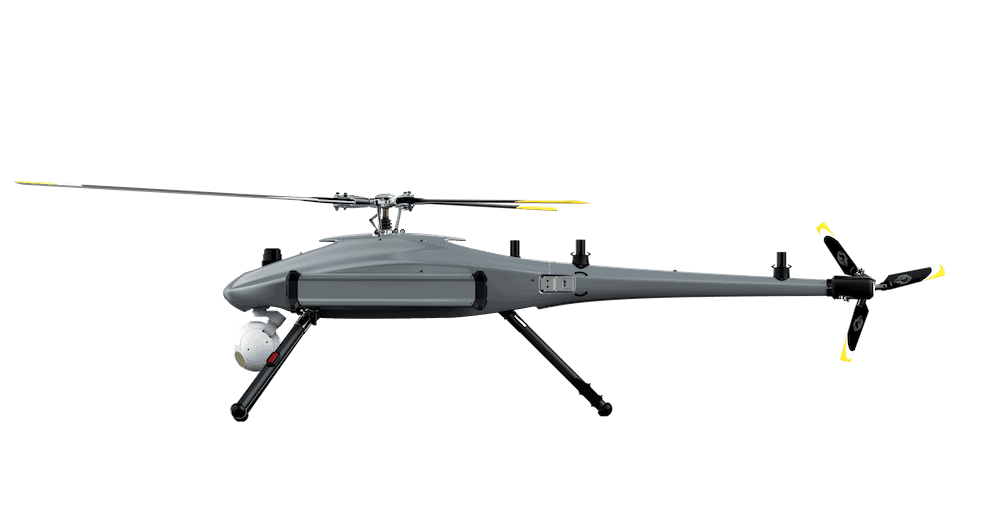
SwissDrones’ SDO 50 UAV, a long-range unmanned helicopter with high payload capacity and VTOL capabilites, was used in a successful Proof-of-Concept trial for a Brazilian energy company, facilitated by OMNI Unmanned.
SwissDrones is an advanced aerial intelligence solutions provider specializing in long-range unmanned helicopter systems, and Omni Unmanned is an air transport leader serving the oil sector and part of OMNI Helicopters International (OHI) Group.
The trial, which included an offshore-to-offshore platform delivery, marks the first Beyond Visual Line of Sight (BVLOS) UAV operation of its kind in Brazil.
The multi-day trials involved testing the UAV under severe weather conditions with high winds. Pilots from OMNI Táxi Aéreo controlled the unmanned helicopter, which successfully flew between offshore platforms off the coast of Rio de Janeiro. The mission required two phases of piloting, involving ground teams on each platform and a seamless mid flight autonomous handover of the aircraft.
During the trials, a real-world operational requirement emerged where an urgent piece of equipment was needed on another platform to prevent downtime. The SDO 50 successfully delivered the part, averting significant additional costs associated with moving the equipment by boat or helicopter, as well as reducing operational downtime.
The use of UAVs for offshore cargo deliveries demonstrates significant value, according to the companies. With a compact physical footprint, UAVs enable easy onboard storage and deployment on offshore platforms where space is limited. Additionally, unmanned helicopters are said to decrease safety risks and carbon emissions compared to conventional counterparts.
Ulrich Amberg, CEO of SwissDrones, said, “It’s great to see energy companies embracing long-range UAV technology that offers faster, safer, greener and more cost-effective air transport between offshore platforms. This project offers a glimpse into the near future of the offshore energy sector, where interaction between platforms is dynamic, convenient and safer than ever before. This future can only be realized, however, with close collaboration between technology developers, piloting and air mobility specialists, and energy companies themselves.”
Roberto Coimbra, Board Director at the OHI Group, added, “Unmanned aircrafts are no longer a next generation solution for the energy industry. They’re a solution that’s applicable, deployable and needed today, as demonstrated by the real-world spare part scenario that arose during the trial. This Proof-of-Concept demonstrates the power of marrying advanced UAVs with offshore air operations experience.”