


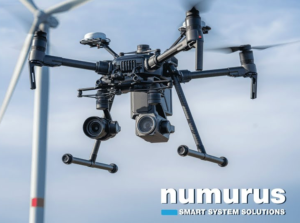
In this Q&A, the NEPI by Numurus team explain what edge AI means for drone operations, why onboard processing matters where connectivity is weak or unavailable, and what teams must address beyond the AI model itself.
 The discussion also examines how having the underlying foundation already in place can help teams prototype more quickly, with an autonomous search and rescue project at Lane Community College providing a practical example.
What does “edge AI” actually mean on a drone?
It means the AI runs on the drone’s own compute, not in the cloud. The model looks at the camera feed, makes a decision, and triggers an action while the drone is still in the air. Nothing has to travel to a server and back first.
Why not just stream the video to the cloud and process it there?
Connectivity. Drones fly where signal is weak, congested, or gone entirely. A cloud round trip adds lag, and in the field that lag is the difference between catching something and missing it. Running the AI at the edge removes the dependency on a connection that may not be there.
So, what is actually hard about building edge AI for a drone today?
It is usually not the AI model. It is everything around it. Sensor integration, model management, the automation logic, data handling, and a way to see what the system is doing. Most teams spend months building that foundation before they get to the capability they actually set out to build.
Can you give a concrete example?
A single student at Lane Community College built an autonomous search and rescue drone as a four-month capstone project. It detected people and vehicles, tasked its own flight path, and sent images and locations to emergency responders in near real time, all onboard. He used NEPI‘s built-in object detection model, a short automation script, and the NEPI ROS API. The point is not that he was an unusually strong programmer. It is that he did not have to be one to get there.
Where is this heading for drone teams?
Onboard AI is becoming standard across inspection, mapping, search and rescue, and agriculture. Because the foundation is already handled, teams can prototype in days instead of spending months on infrastructure, then iterate with real flight data. The teams that move fastest are the ones who stop rebuilding the same foundation for every project and spend their time on the part that makes their product different.