



Replicating natural wind conditions in a controlled laboratory environment requires more than producing steady airflow. Tyto Robotics examines how boundary layer wind tunnel (BLWT) testing can reproduce the wind-speed variations and turbulence found in the atmosphere, supporting investigations into structural wind loads, environmental effects, wind turbine performance, and the aerodynamics of drones and UAVs.
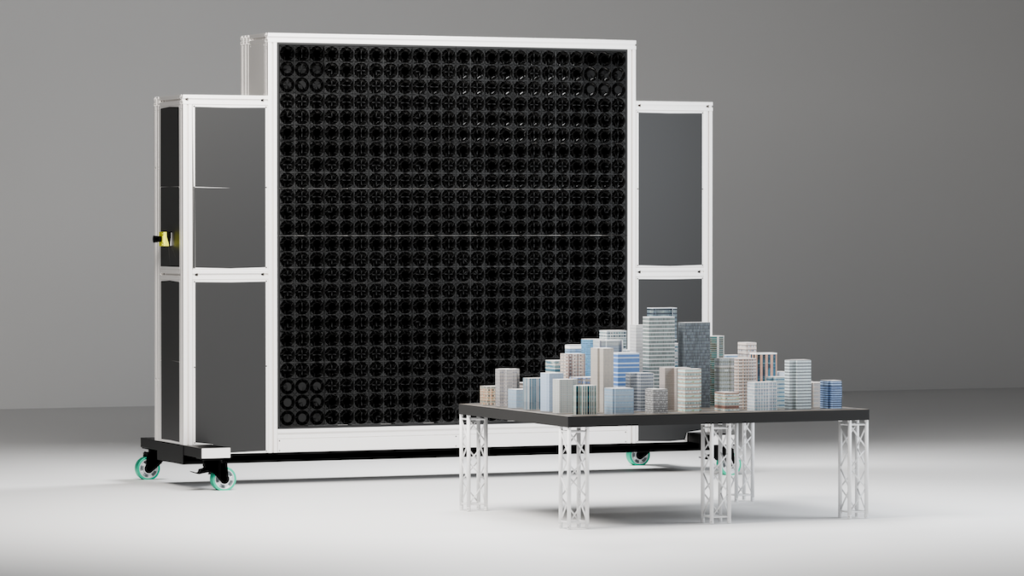
The development of boundary layer testing has enabled engineers to study how structures and other objects respond to atmospheric wind conditions before they are exposed to them in the field. Technologies such as the WindShaper wind wall provide an alternative approach to generating these conditions, using individually controlled fans to produce specified airflow profiles and turbulence within a test area.
The Development of Boundary Layer Wind Tunnel Testing
Wind tunnel experiments have a history extending back to the eighteenth century. Some of the earliest recorded investigations into the effects of airflow on objects took place in 1742 and 1759, when researchers attached test objects to rotating arms and moved them through the air.
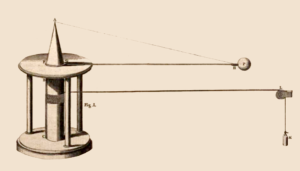
An early diagram of a whirling arm system, driven by a falling weight to test airflow on objects.
Over the following 150 years and beyond, these experimental methods developed into wind tunnel technologies used in aerospace, automotive engineering, and eventually civil engineering.
Early wind tunnels were primarily configured to generate smooth, steady airflow, making them suitable for investigating aircraft and airfoil performance. However, applying the same techniques to buildings and other civil structures presented additional challenges.
Unlike the relatively uniform airflow produced by conventional wind tunnels, natural atmospheric wind contains turbulence, fluctuations in velocity, and variations associated with terrain and surrounding obstacles.
Consequently, engineers needed methods of reproducing the characteristics of the atmospheric boundary layer rather than relying solely on steady airflow.
Understanding the Atmospheric Boundary Layer
In fluid mechanics, a boundary layer is the region adjacent to a surface where fluid motion is affected by interactions with that surface. Depending on the flow conditions, a boundary layer may exhibit laminar or turbulent behavior.
The Reynolds number, a dimensionless parameter describing the relationship between inertial and viscous forces, is one factor influencing these flow characteristics.
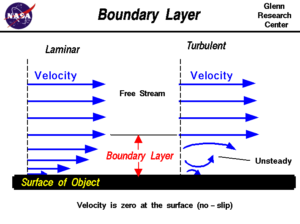
Boundary layer demonstration in laminar and turbulent flow.
Lower Reynolds numbers generally favor laminar flow, while higher values increase the likelihood of transition to turbulence. Surface roughness, disturbances, geometry, and other factors can also affect this transition.
The atmospheric boundary layer is the lowest region of the atmosphere, where airflow is directly influenced by the Earth’s surface.
As wind moves across terrain, buildings, vegetation, and other obstacles, these surface features disrupt the flow and can generate turbulence. Thermal effects also contribute, particularly when solar heating warms the ground and causes air to rise.
Atmospheric convection associated with clouds can introduce additional turbulence.
These interacting processes produce wind conditions that are considerably more complex than the steady airflow typically generated in conventional wind tunnels.
Reproducing the relevant atmospheric characteristics is therefore central to boundary layer wind tunnel experimentation.
Applications include investigating:
- Fluctuating wind loads on tall buildings
- Snow accumulation on building roofs
- Wind flow around industrial structures
- Pedestrian-level airflow in urban environments
- Wake effects and flow velocities within wind farms
- Aerodynamic performance of drones and UAVs
Measuring Wind Loads and Structural Responses
One of the principal applications of BLWT testing in civil engineering is evaluating how buildings and other structures respond to atmospheric wind.
Scale models can be exposed to simulated wind conditions to investigate the forces and movements that may occur under different airflow profiles.
Cameras can be used to monitor wind-induced motion, while load cells installed at the base of a model measure shear forces and moments acting on the structure.
These measurements allow engineers to examine structural responses to wind loading during the design process.
BLWT testing has become an established technique for assessing wind effects on buildings. In Ontario, for example, buildings exceeding 60 meters in height, or with a height greater than four times their minimum effective width, are required to undergo BLWT testing before development.
Boundary layer experiments are also used to investigate aeroelastic behavior, where wind loads produce structural deformation or motion that can increase as loading changes.
Structures particularly relevant to these investigations are often flexible, relatively lightweight, and lightly damped. Examples include chimneys, masts, long-span bridges, and transmission lines.
Investigating Environmental Effects on Buildings and Urban Areas
Beyond structural loading, boundary layer wind tunnels support studies of environmental conditions influenced by wind.
In colder regions, wind-driven snow transport and accumulation are important considerations for buildings with large roof areas.
Testing scaled structures under simulated conditions allows researchers to investigate where snow may collect and how the resulting distribution could affect roof loading.
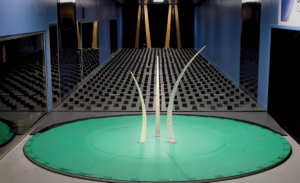
U.S. Air Force Memorial in Arlington, VA with a spire as tall as 270 ft (82 m) being tested in a BLWT.
This information can support structural design decisions and help identify locations where snow removal may be necessary.
Another application concerns pedestrian-level wind conditions in urban environments.
Closely spaced buildings can alter airflow and create areas where wind accelerates near the ground. Measurements of mean wind speeds and peak gusts help assess how proposed developments may affect surrounding pedestrian areas.
Cities including Boston, Toronto, New York, and San Francisco require BLWT data on pedestrian-level wind conditions before approving certain developments. These assessments examine conditions both with and without the proposed structures.
Boundary layer experiments also support studies of atmospheric pollutant dispersion.
Emissions from industrial stacks, building vents, and automobiles can be transported through complex airflow patterns, making their distribution and resulting concentrations difficult to predict.
Physical modeling in a BLWT allows researchers to estimate how pollutants disperse after release and identify locations where concentrations may be elevated.
Generating Atmospheric Boundary Layer Conditions in Wind Tunnels
Producing a representative atmospheric boundary layer within a wind tunnel requires control over both airflow velocity and turbulence.
One established approach involves modifying conventional wind tunnel installations with devices that deliberately disturb the incoming airflow.
These can include spires, vortex generators, and fences positioned within the tunnel to influence the developing flow.
As air passes these devices, turbulent vortices form and promote mixing farther downstream.
The resulting flow develops turbulence and a modified vertical velocity profile, with wind speed generally increasing with height above the simulated ground surface.
This behavior approximates an important characteristic of the atmospheric boundary layer, where friction and surface obstacles influence wind speeds near the ground.
Traditional methods can therefore reproduce relevant atmospheric flow characteristics, although they require sufficient test-section length for the airflow to develop after passing the flow-adjustment devices.
Using a Wind Wall to Reproduce Atmospheric Wind Profiles
An alternative method of generating boundary layer conditions involves controlling airflow directly through an array of fans.
The WindShaper wind wall, used by Tyto Robotics, consists of individually controllable, counter-rotating fan modules that can generate uniform or turbulent wind conditions.
Rather than relying on a long test section containing additional flow-adjustment devices, the system allows the operator to configure wind-speed and turbulence profiles across the test area.
To reproduce the vertical wind-speed distribution associated with an atmospheric boundary layer, the lower rows of fans can operate at reduced speeds while progressively higher rows produce faster airflow.
This arrangement creates a wind-speed profile that increases with height, reflecting a characteristic of atmospheric wind near the Earth’s surface.
The counter-rotating fans within each module also allow turbulent airflow to be generated directly, without requiring the extended test section and additional devices associated with conventional boundary layer generation methods.
Such configurations can be applied to experimental arrangements involving scale models of buildings and urban areas, where the distribution of airflow across different heights is relevant to the investigation.
Simulating and Measuring Wind Shear
Wind shear is another atmospheric characteristic relevant to boundary layer experiments.
It describes a change in wind speed and direction over a given distance and can be an important consideration when investigating airflow around structures or evaluating aerodynamic behavior.
The WindShaper can be configured to simulate wind shear by varying airflow conditions across its fan array.
Tyto Robotics has demonstrated this approach using the WindShaper together with the WindProbe, which is used to measure the resulting airflow conditions.
A demonstration video shows how the equipment can be used to generate and measure simulated wind shear.
The ability to adjust airflow across different sections of a wind wall provides researchers with a means of investigating nonuniform wind conditions under controlled laboratory settings.
Boundary Layer Testing for Wind Turbines and Unmanned Aircraft
Atmospheric boundary layer simulation also has applications beyond conventional civil engineering studies.
At UCLouvain, researchers have installed a WindShaper system to reproduce atmospheric boundary layer conditions for experiments involving wind turbines and wind farm dynamics.
The research uses scale models of wind turbines, allowing data to be collected more quickly and at substantially lower cost than full-scale field trials.
These experiments can support investigations into wind turbine behavior and the flow interactions associated with wind farm configurations.
The university also plans to use the wind wall for research involving drones, helicopters, and biomimetic flight.
Additional planned applications include simulating environmental weather conditions such as rain and snow.
These research activities illustrate how laboratory-generated atmospheric wind conditions can be relevant to both renewable energy investigations and the study of unmanned and other flight systems.
Expanding the Scope of Controlled Atmospheric Wind Testing
Boundary layer wind tunnel experiments provide a means of studying airflow conditions that cannot be adequately represented by steady, uniform wind alone.
In civil engineering, established applications include structural wind-load assessments, aeroelastic investigations, pedestrian wind studies, snow accumulation analysis, and pollutant dispersion modeling.
The same principles are relevant to research involving wind turbines, wind farms, and UAV aerodynamics, where atmospheric turbulence and variations in airflow can affect experimental conditions.
Conventional boundary layer wind tunnels generate these characteristics using devices that modify and mix airflow as it travels through the test section. Fan-array systems such as the WindShaper provide another method by allowing wind-speed distributions and turbulence to be controlled directly.
Both approaches reflect the importance of reproducing relevant atmospheric boundary layer characteristics when conducting laboratory studies of wind-related effects.
Read Boundary Layer Wind Tunnel Experiments – An Introduction on the Tyto Robotics website.