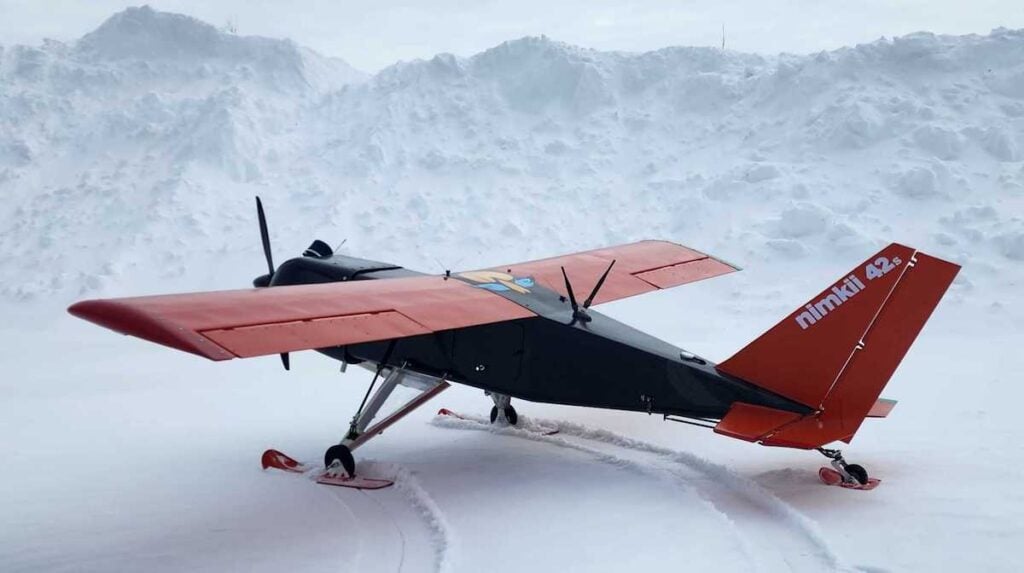
Sky Power International examines how hybrid UAV propulsion systems can extend flight endurance, increase operational range, provide greater payload flexibility and support sustained electrical power availability for advanced onboard systems.
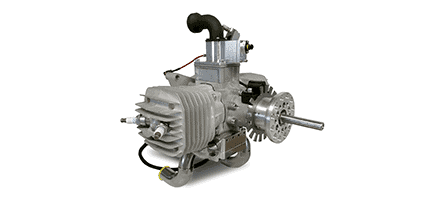
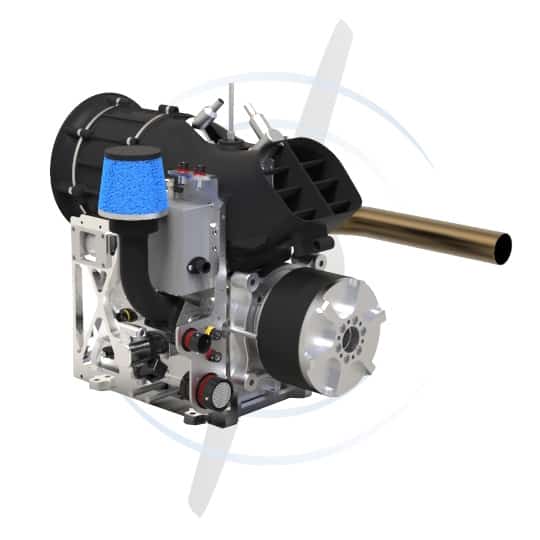
Sky Power International offers the SP-55 FI TS Hybrid for small UAV platforms.
By combining internal combustion engines with generators and electric propulsion, these architectures address the energy-density limitations associated with current battery-powered unmanned aircraft.
The company’s approach integrates an internal combustion engine, generator, control electronics and cooling equipment into a compact power unit for UAV platforms. The systems are particularly suited to applications such as long-range missions, VTOL operations and flights involving energy-intensive sensors or communications equipment.
Longer flight times, greater operational ranges, more capable sensor systems and increased payload capacity remain key development objectives for many UAV manufacturers. While fully electric propulsion systems offer high efficiency and precise control, the limited energy density of current battery technology can restrict performance during missions requiring extended endurance or higher power availability.
Hybrid UAV propulsion systems provide an alternative by combining the energy density of liquid fuels with the control advantages of electric propulsion. This approach enables aircraft to operate for longer periods, carry larger payloads where the overall platform design allows, and supply the electrical requirements of propulsion systems and onboard electronics.
The Operating Principle of a Hybrid UAV Propulsion System
In a serial hybrid propulsion system, the internal combustion engine does not directly drive the propeller. Instead, the engine generates electrical energy through a generator, which then supplies power to the UAV’s electric motors.
The generated electricity can also support flight-control systems, avionics, communication equipment and, where applicable, battery storage.
This architecture separates energy generation from propulsion control. The internal combustion engine can operate continuously within an efficient operating range, while the electric propulsion system manages power delivery to the aircraft.
Because the engine does not directly respond to changing flight requirements, the system can improve overall efficiency while reducing fuel consumption and mechanical loading.
Unlike conventional aircraft engines, the combustion engine in a serial hybrid system does not need to continually adjust to the demands of takeoff, climb, cruise and descent. Instead, it operates largely at a consistent speed within an optimized RPM range.
This reduces load variations, thermal stress and vibration, contributing to the operational life of the overall propulsion system.
Sky Power International’s Integrated Hybrid Technology
Sky Power International takes a fully integrated systems approach to hybrid propulsion solutions. Rather than focusing solely on the engine and generator, the company’s systems combine multiple components into a coordinated architecture designed specifically for UAV applications.
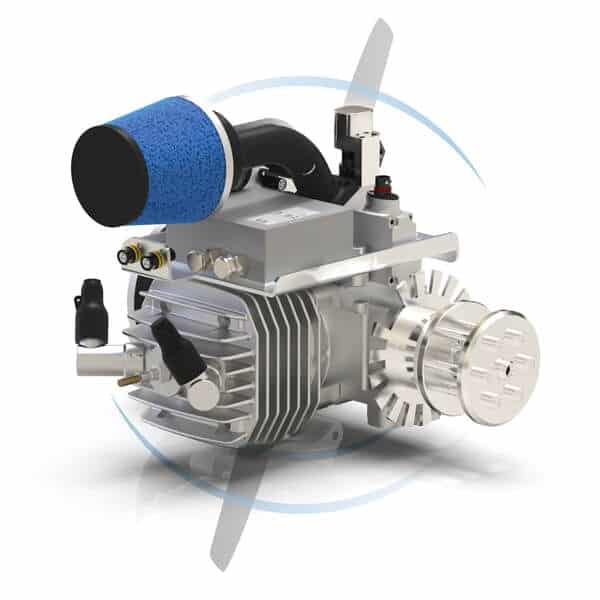
The systems incorporate electronic fuel injection (EFI), a brushless DC generator, a starter-generator control unit, an ignition system and a dedicated cooling and airflow system.
The generator is mounted directly on the engine’s rear output shaft, creating a compact configuration with high power density. Integrating the components within a single aluminum frame reduces installation requirements for UAV manufacturers and supports integration across different platform designs.
For smaller UAV platforms, Sky Power International offers the SP-55 FI TS Hybrid. The company also provides higher-power hybrid solutions based on Wankel engine technology, including the SP-180 SRE Hybrid.
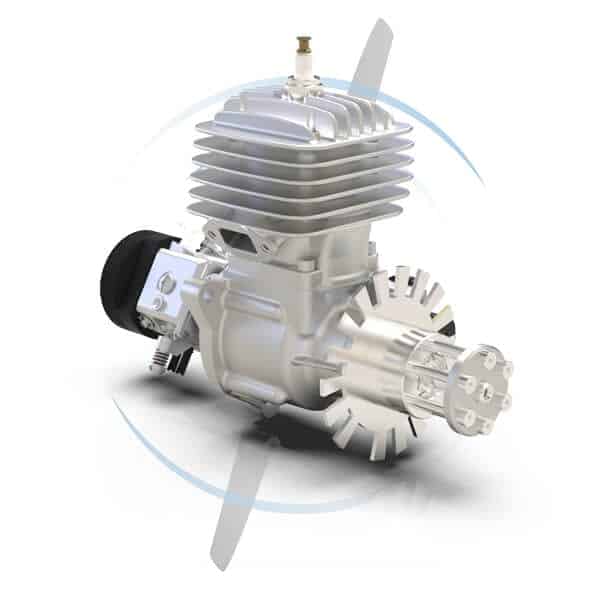
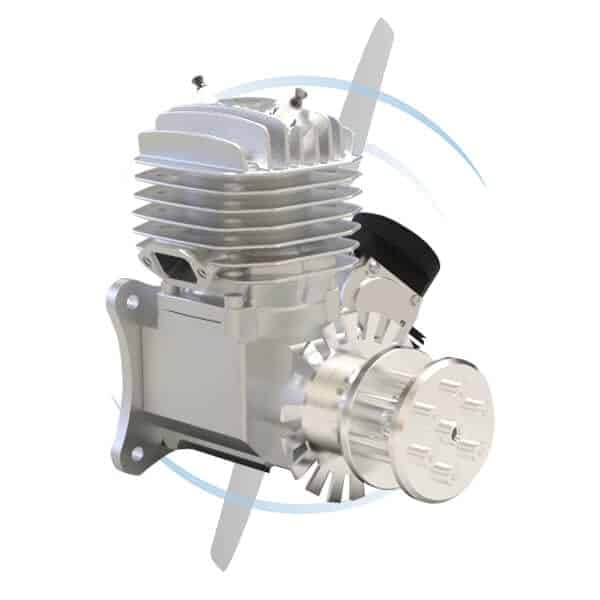
Generator-optimized variants of the Boxer engine families are also available, including the SP-110 FI TS GEN, SP-170 FI TS GEN and SP-210 FI TS GEN models.
Addressing the Energy Challenge of Modern UAV Systems
From a technical perspective, hybrid propulsion systems address one of the central challenges facing modern UAV development: the amount of energy available relative to overall system weight.

Hybrid engine designs are particularly well-suited for use in the monitoring of critical infrastructure.
Electric motors provide high efficiency, but current battery systems remain limited in terms of energy density. Liquid fuels, by comparison, store significantly more energy per kilogram.
Hybrid systems take advantage of this difference by converting fuel energy into electrical power for propulsion and onboard systems.
For UAV designers, this provides greater flexibility when balancing mission range, endurance and payload requirements. Available energy is no longer determined solely by battery capacity but can also be supplied through the aircraft’s fuel system.
As fuel is consumed during flight, the aircraft becomes lighter. A battery that has discharged its stored energy, however, retains its mass and continues to be carried throughout the mission.
This difference becomes increasingly important during longer missions, where fuel mass decreases throughout the flight while battery mass remains constant after energy has been depleted. This can influence payload planning and may allow aircraft designers to use smaller battery systems while maintaining required performance.
Hybrid Propulsion Advantages for VTOL UAVs
The benefits of hybrid propulsion are especially relevant for VTOL platforms, which experience different power requirements during vertical takeoff, transition and cruise flight.
Vertical takeoff requires significant power, while cruise flight generally requires a lower and more consistent energy output.
In an all-electric VTOL system, the battery must be sized to support peak takeoff requirements. This means a large proportion of the battery capacity may be dedicated to providing power during only a short part of the mission.
Hybrid UAVs approach this challenge differently. The battery can provide the temporary power required during takeoff, landing and transition, while the hybrid system supplies electrical energy during cruise and can recharge the battery.
This can increase flight duration and range while maintaining the control characteristics associated with electric VTOL propulsion.
For surveying drones, inspection platforms and military VTOL systems, this capability can extend missions from less than two hours to several hours, depending on aircraft configuration and operating conditions.
Supporting Advanced Sensor and Communication Systems
Another important advantage of hybrid UAV propulsion systems is their ability to supply power for energy-intensive payloads.
Modern UAV platforms increasingly carry high-resolution EO/IR cameras, LiDAR systems, Synthetic Aperture Radar (SAR), satellite communication systems and AI-based onboard processing equipment. These payloads can require several hundred watts of electrical power.
In battery-powered aircraft, additional payload requirements directly reduce available flight time. Hybrid systems supply electricity through the onboard generator, reducing the demand placed on battery systems.
For UAV manufacturers, this creates additional flexibility when integrating advanced sensing, communication and processing technologies.
For ISR missions, mapping operations and complex inspection tasks, the hybrid propulsion system can serve as a sustained power source for the aircraft platform and mission systems.
Long-Range Missions and Persistent Surveillance
Hybrid propulsion systems provide particular advantages for missions requiring extended operational endurance.
Conventional reconnaissance UAVs powered only by batteries may require mission interruptions for battery replacement or multiple aircraft operating in rotation.
Hybrid UAVs can support longer-duration surveillance and observation missions without these limitations. Increased endurance can improve data collection while reducing operational effort and the number of aircraft required.
Potential applications include:
- Border surveillance
- ISR missions
- Coastal protection
- Pipeline monitoring
- Power line inspection
- Early detection of wildfires
- Infrastructure monitoring
- Maritime reconnaissance
For BVLOS (Beyond Visual Line of Sight) missions, endurance is increasingly becoming an important factor in overall system capability.
Heavy-Lift Drones and Logistics Applications
Hybrid propulsion systems can offer advantages for larger UAV platforms where increased payload requirements create higher energy demands.
As payload mass increases, the energy requirements of fully electric systems can rise significantly, often reducing flight duration. Hybrid propulsion addresses this challenge by generating electrical energy throughout the mission.
Potential applications include:
- Logistics drones
- Medical care in remote regions
- Offshore supply operations
- Disaster relief
- Industrial transport tasks
- Military resupply missions
For missions involving long distances and substantial payload requirements, hybrid configurations can offer a practical balance between endurance, energy availability and operational capability.
Redundancy and Increased Mission Reliability
Beyond endurance and payload capability, reliability remains an important consideration for UAV operations.
Hybrid UAV systems generally incorporate two power sources: a fuel-based generating system and a battery system. Depending on the architecture, this can introduce additional redundancy and improve operational reliability.
If the generator experiences a failure, the battery may provide sufficient power for a controlled return or emergency landing.
Conversely, the generator can maintain electrical availability during periods of high demand or when battery capacity has been reduced.
This additional redundancy can offer safety benefits for BVLOS operations, offshore missions, defense applications and critical infrastructure activities.
Bridging Electric and Conventional UAV Propulsion
Hybrid UAV propulsion systems represent more than a combination of an internal combustion engine and a battery. They provide an energy architecture designed for long-range missions, sensor-intensive operations and platforms requiring increased payload capacity.
Sky Power International’s hybrid solutions combine the high energy density of liquid fuels with the control benefits of electric propulsion. This enables UAV platforms to achieve longer flight times, greater ranges, increased payload flexibility and sustained electrical availability for modern onboard systems.
Hybrid propulsion systems are being considered for applications including VTOL, ISR, BVLOS inspection, maritime surveillance, logistics and defense missions.
By combining established combustion-based power generation with electric propulsion, hybrid systems provide an additional pathway for the development of future professional unmanned aerial systems.