




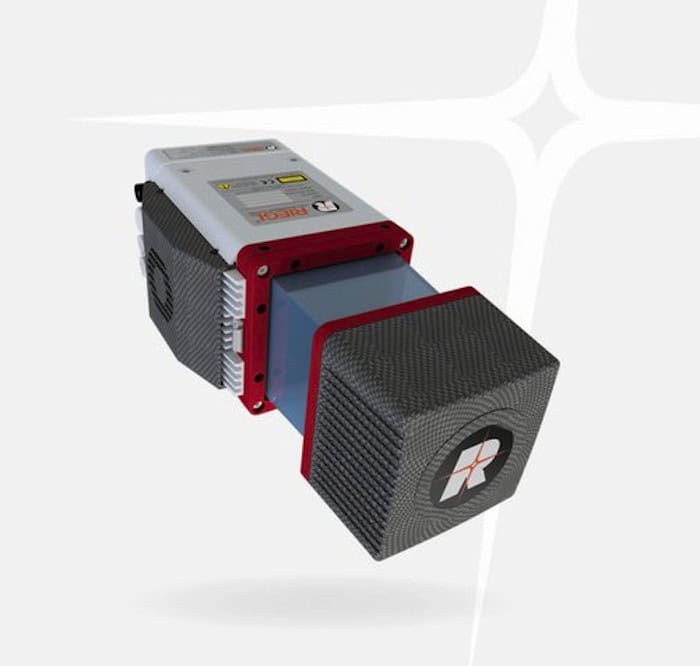
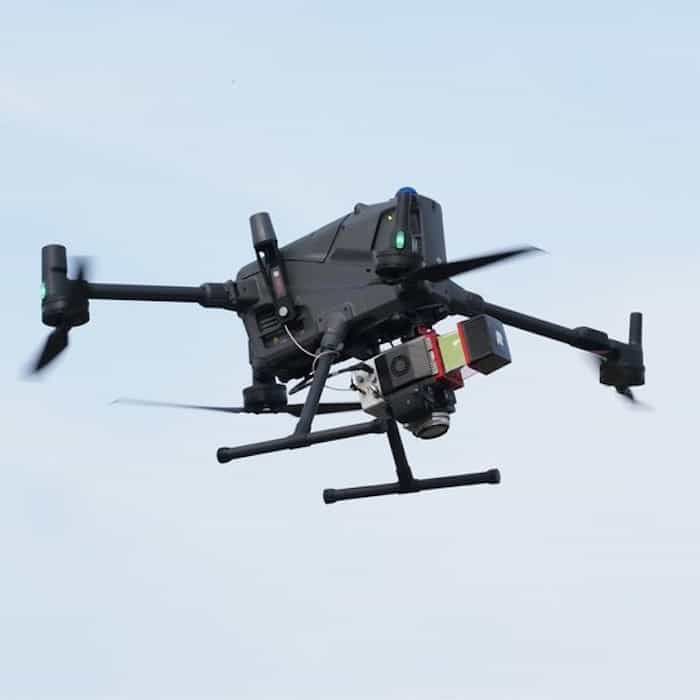
The RIEGL miniVUX-4UAV is an extremely lightweight airborne laser scanner designed for integration with UAS, UAV, and RPAS platforms. It offers selectable laser pulse repetition rates of 100, 200, 300, and 400 kHz, with a maximum effective measurement rate of up to 200,000 measurements per second at 200 kHz reduced power and 360° field of view. At 400 kHz and 120° FoV, it provides up to 133,333 measurements per second, while scan speeds reach up to 150 scans per second. The scanner weighs approximately 1.55 kg without its cooling fan, and its 1.25 × 0.5 mrad beam divergence, 12 mm accuracy, and 8 mm precision support dense, detailed point acquisition.
RIEGL Waveform-LiDAR technology enables echo digitization and online waveform processing, with up to five target echoes per laser shot and multi-target resolution for measurements through dense foliage. The near-infrared wavelength is optimized for surveying snowy and icy terrain. A robust aluminum housing supports mounting on multi-rotor, rotary-wing, and fixed-wing UAVs, while mechanical and electrical interfaces are provided for IMU mounting. The miniVUX-4UAV is available as a stand-alone sensor, with RIEGL RiLOC-E25 and RiLOC-F IMU/GNSS system solutions and optional camera integration also available.
| Laser Pulse Repetition Rate PRR: | 100 kHz / 200 kHz reduced power | 200 kHz | 300 kHz / 400 kHz |
| Field of View: | 360° | 180° | 120° |
| Max. Measuring Range, reflectance ≥ 20%: | 170 m | 150 m | 170 m |
| Max. Measuring Range, reflectance ≥ 60%: | 290 m | 250 m | 290 m |
| Max. Measuring Range, reflectance ≥ 80%: | 330 m | 280 m | 330 m |
| Max. Number of Targets per Pulse: | 5 | 5 | 5 |
| Minimum Range: | 2 m | 2 m | 2 m |
| Accuracy / Precision: | 12 mm / 8 mm | 12 mm / 8 mm | 12 mm / 8 mm |





