


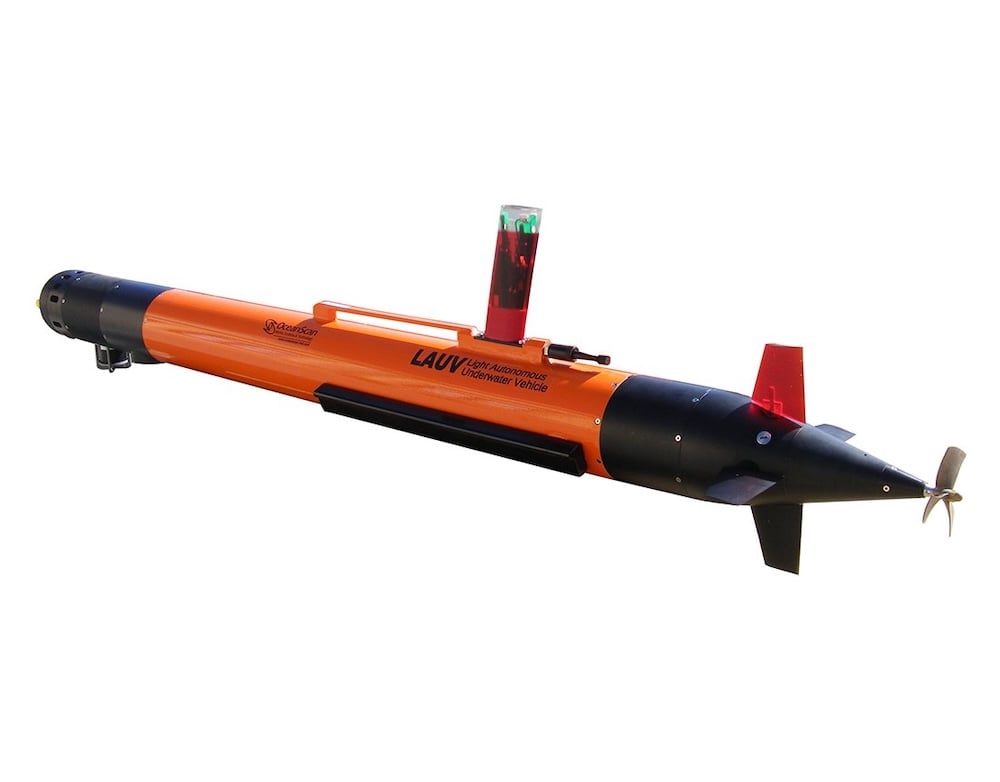
OceanScan-MST’s LAUV is a lightweight autonomous underwater vehicle designed for deployment, operation and recovery by a single person. Easily launched from shore, a pier or a small boat without cranes or specialized tools, it offers a low logistical footprint and 100 m and 400 m depth options. An external ballast rail allows adjustment for fresh or saltwater operations.
Each system can be configured during production with navigation, communications and payload options tailored to the mission. Available instruments include side-scan and multibeam sonar, digital cameras, magnetometers and water-column sensors, as well as specialized turbulence and particle-imaging payloads. Independent modules and open-source software allow users to introduce additional sensors, algorithms and vehicle behaviors.
GPS, AHRS and depth sensing can be complemented by DVL, tactical-grade inertial navigation, LBL, USBL and RTK options. Wi-Fi and 5G cellular connectivity provide surface communications, with optional satellite messaging and acoustic modems for underwater links. The portable, battery-powered Manta gateway connects operators with one or more LAUVs through wireless and acoustic communications, housed in a rugged waterproof enclosure suitable for buoy installation or open-vessel operation.
Neptus command and control software runs on a standard or rugged computer, covering configuration, planning, simulation, mission execution and post-mission analysis. The LAUV Remote smartphone app enables teleoperation and status checks, while a joystick can be connected to the computer running Neptus for physical control.
Applications for the LAUV include:
- Mine countermeasures (MCM)
- Rapid environmental assessment (REA)
- Search and recovery (SAR)
- Anti-submarine warfare (ASW)
- Security and surveillance
- Marine biology
- Hydrography
- Marine archaeology
- Offshore oil and gas exploration
- Renewables
Specifications
| Dimensions | 115–250 cm length; 15 cm hull diameter |
| Weight in Air | 15–35 kg |
| Depth Rating | 100 m and 400 m options |
| Maximum Speed | Up to 6 knots |
| Typical Endurance | 8–12 hours at 3 knots |
| Extended Endurance | Up to 48 hours at 2 knots for specific configurations |





