

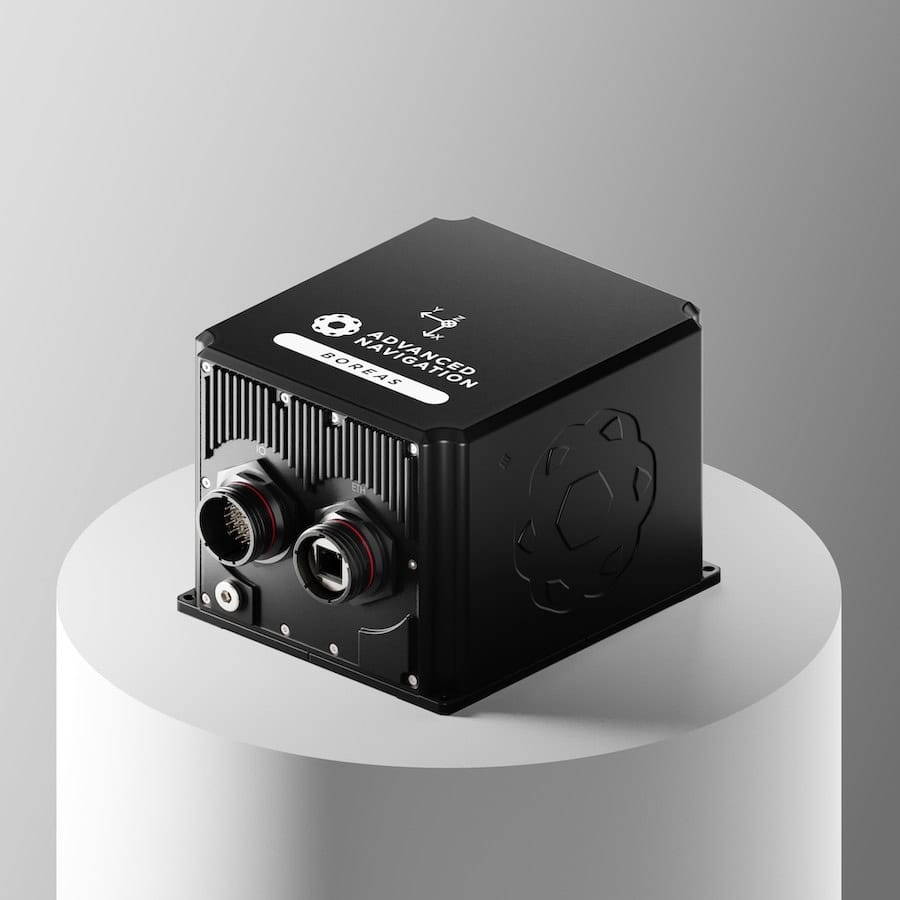
The Boreas A70 and A90 from Advanced Navigation are rugged FOG IMU/AHRS systems designed to maintain precise heading and orientation where GNSS or magnetic heading references are unavailable. Digital fibre optic gyroscope technology, closed-loop accelerometers, and AI-based sensor fusion support rapid north-seeking gyrocompassing without a magnetometer. Both variants provide 2-minute coarse gyrocompassing, output rates up to 1000 Hz, IP67 protection, and operation from -40 °C to 75 °C, while a 9–36 V input range and 12 W typical power consumption support integration into space, weight, power, and cost-sensitive platforms. The systems can also be upgraded for full INS operation with external GNSS aiding.
For unmanned aerial vehicles and autonomous vehicles, the A70 provides 0.01° roll and pitch accuracy, 0.1° heading accuracy, and 0.01°/hr gyroscope bias instability, while the higher-performance A90 tightens these figures to 0.005°, 0.01°, and 0.001°/hr respectively. Ethernet, RS232/RS422, CAN, 1PPS, GPIO, and auxiliary serial connectivity enable integration with vehicle and payload architectures, with support for NMEA, CANopen, AN Packet Protocol, odometer, DVL/USBL, air data, zero-velocity, and external GNSS inputs. The same platform is suitable for gimbal stabilization, high-precision surveying, structural monitoring, tunnelling and mining, subsea navigation, infrastructure monitoring, and hydrography.
| Boreas A70 | Boreas A90 | |
| Roll and pitch accuracy: | 0.01° | 0.005° |
| Heading accuracy: | 0.1° secant latitude RMS | 0.01° secant latitude RMS |
| Gyrocompassing alignment: | 2 min coarse; 10 min fine, typical | 2 min coarse; 10 min fine, typical |
| Horizontal position accuracy, external RTK GNSS aided: | 0.01 m | 0.01 m |
| Vertical position accuracy, external RTK GNSS aided: | 0.015 m | 0.015 m |
| Velocity accuracy, external GNSS aided: | 0.005 m/s | 0.005 m/s |
| Heave accuracy: | 2% or 0.02 m, whichever is greater | 2% or 0.02 m, whichever is greater |
| Output data rate: | 1000 Hz | 1000 Hz |
| Interfaces: | Ethernet, RS232/RS422, CAN, 1PPS | Ethernet, RS232/RS422, CAN, 1PPS |
| Ethernet speed: | 100 Mbit | 100 Mbit |
| Serial speed: | 4800 to 4M baud | 4800 to 4M baud |
| Protocols: | AN Packet Protocol, NMEA, CANopen | AN Packet Protocol, NMEA, CANopen |
| Peripheral interfaces: | 2 × GPIO, 1 × auxiliary RS232 | 2 × GPIO, 1 × auxiliary RS232 |
| GPIO level: | 5 V (RS232), 3.3 V | 5 V (RS232), 3.3 V |
| GPIO functions: | 1PPS input/output, odometer input, DVL/USBL input, air data input, zero-velocity input, NMEA input/output, NovAtel GNSS input, Trimble GNSS input, AN Packet Protocol, CAN/CANopen | 1PPS input/output, odometer input, DVL/USBL input, air data input, zero-velocity input, NMEA input/output, NovAtel GNSS input, Trimble GNSS input, AN Packet Protocol, CAN/CANopen |
| Operating voltage: | 9 to 36 V | 9 to 36 V |
| Input protection: | -200 to 200 V | -200 to 200 V |
| Typical power consumption: | 12 W | 12 W |
| Hot-start standby duration: | — | 48 hrs |
| Operating temperature: | -40 °C to 75 °C | -40 °C to 75 °C |
| Environmental protection: | IP67 | IP67 |
| MTBF: | >70,000 hrs | >70,000 hrs |
| Shock limit: | 50 g, 11 ms, MIL-STD-810H | 50 g, 11 ms, MIL-STD-810H |
| Vibration: | 8 g RMS, 20–2000 Hz random | 8 g RMS, 20–2000 Hz random |
| Dimensions: | 160 × 140 × 115.5 mm | 160 × 140 × 115.5 mm |
| Weight: | 2.7 kg | 2.7 kg |
| Accelerometer range: | ±15 g | ±15 g |
| Gyroscope range: | ±490 °/s | ±490 °/s |
| Pressure sensor range: | 10 to 130 kPa | 10 to 130 kPa |
| Accelerometer bias instability: | 7 µg | 7 µg |
| Gyroscope bias instability: | 0.01 °/hr | 0.001 °/hr |
| Pressure bias instability: | 8 Pa | 8 Pa |
| Accelerometer initial bias: | <100 µg | <100 µg |
| Gyroscope initial bias: | <0.05 °/hr | <0.01 °/hr |
| Pressure initial bias: | <50 Pa | <50 Pa |
| Accelerometer initial scaling error: | 340 ppm | 340 ppm |
| Gyroscope initial scaling error: | 100 ppm | 80 ppm |
| Accelerometer scale factor stability: | 150 ppm | 100 ppm |
| Gyroscope scale factor stability: | 20 ppm | 10 ppm |
| Accelerometer non-linearity: | 150 ppm | 150 ppm |
| Gyroscope non-linearity: | 10 ppm | 10 ppm |
| Cross-axis alignment error: | <0.001° accelerometers; <0.001° gyroscopes | <0.001° accelerometers; <0.001° gyroscopes |
| Accelerometer noise density: | 40 µg/√Hz | 30 µg/√Hz |
| Gyroscope noise density: | 0.3 °/hr/√Hz | 0.06 °/hr/√Hz |
| Pressure noise density: | 0.4 Pa/√Hz | 0.4 Pa/√Hz |
| Accelerometer random walk: | 23 mm/s/√hr VRW | 17 mm/s/√hr VRW |
| Gyroscope random walk: | 0.005 °/√h ARW | 0.001 °/√h ARW |
| Accelerometer bandwidth: | 300 Hz | 300 Hz |
| Gyroscope bandwidth: | 400 Hz | 400 Hz |
| Pressure bandwidth: | 50 Hz | 50 Hz |