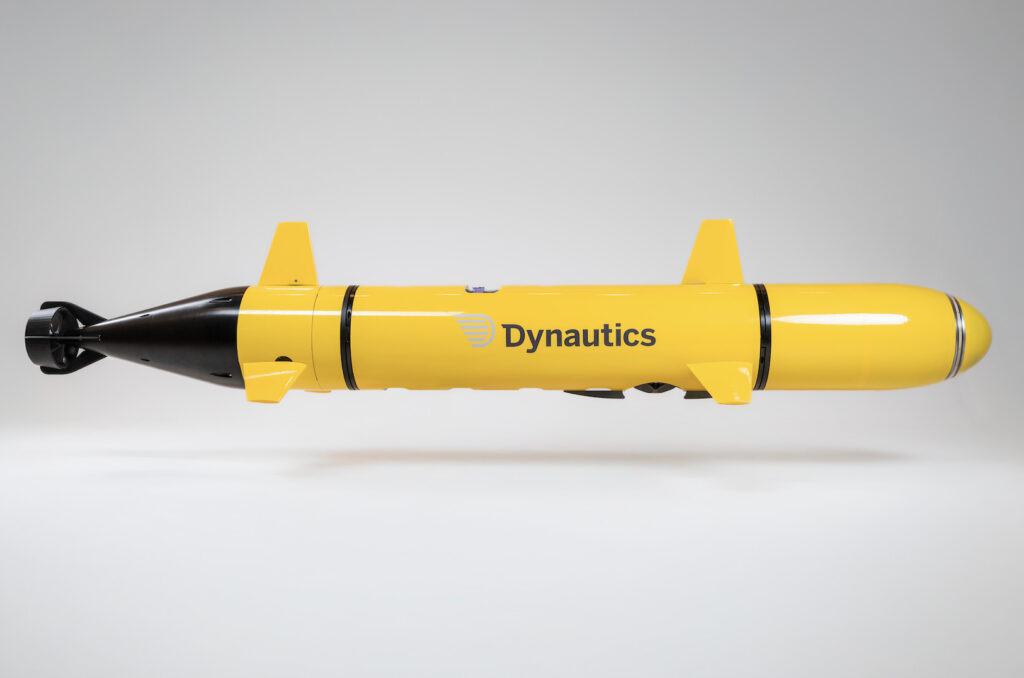
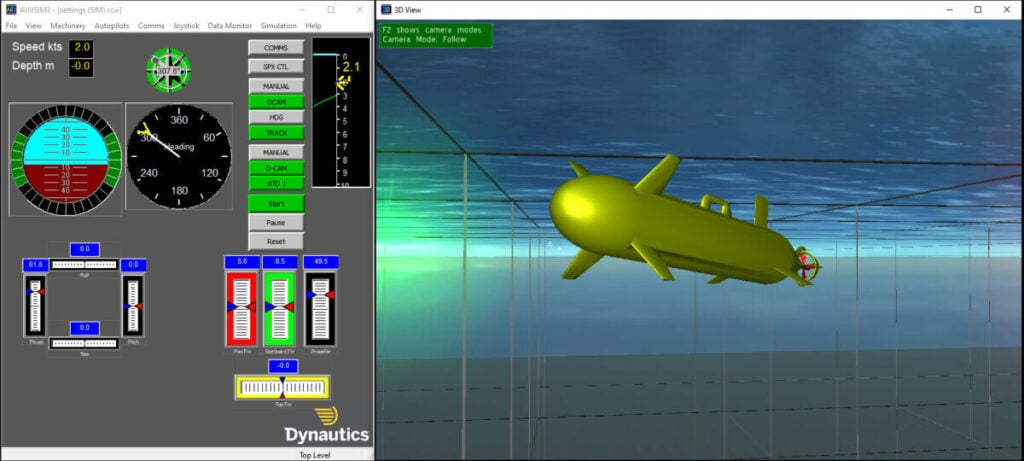
Admiral Makarov National University of Shipbuilding (NUoS) in Ukraine is strengthening its leadership in underwater technology education by integrating Dynautics AUVSim marine simulation software into its teaching and research programmes.
With more than three decades of experience in the research, design, and application of underwater robotic systems, NUoS provides a strong foundation for training the next generation of underwater technology specialists. As autonomous underwater vehicles (AUVs) become increasingly vital across marine science, offshore energy, environmental monitoring, underwater inspection, and defence, higher education institutions face a growing demand for practical tools that simulate vehicle behavior under realistic operating conditions without relying solely on costly physical trials.
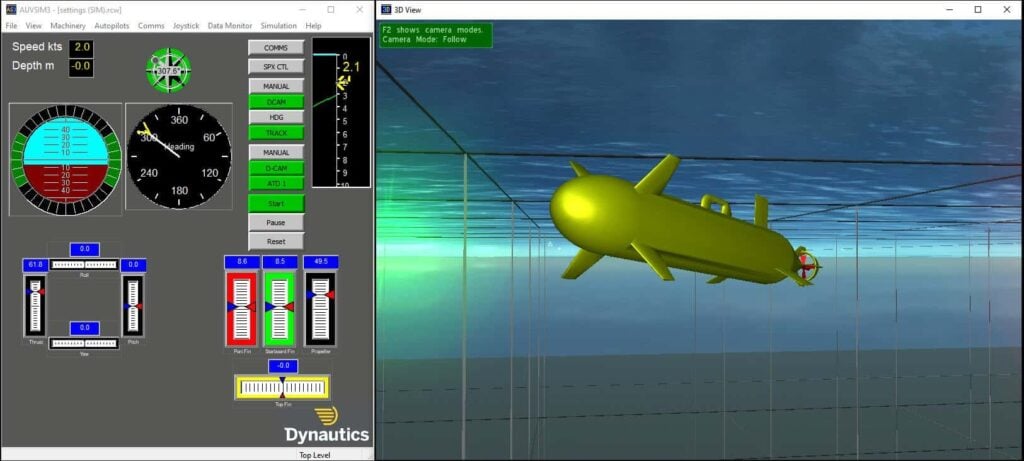
Acquired with financial support from Micron, the Dynautics AUVSim software allows students and researchers to model AUV dynamics, evaluate control system performance, and refine designs in a safe, repeatable laboratory setting. During system testing, the University successfully established a universal communication interface between AUVSim and its custom controller developed in MATLAB/Simulink, enabling direct testing and validation of advanced control algorithms within the simulation environment.
Dr Hanna Hrudinina, Associate Professor at the Kherson Educational and Scientific Institute, said, “AUVSim provides students with practical experience in designing, tuning, and validating autonomous vehicle control systems before deploying them on physical hardware. This improves their understanding of vehicle dynamics while providing a safe, repeatable, and highly flexible laboratory environment that supports both research and practical engineering education.”
To guide the implementation, the Department of Electrical Equipment and Automation at the Kherson Educational and Scientific Institute developed the “Concept of the Educational and Research Project for the Implementation of AUVSim Software,” which was formally approved by the Academic Council of NUoS. Following ongoing preparatory work, practical integration into the curriculum begins in September 2026 across laboratory work, course projects, master’s theses, and doctoral research.
Professor Volodymyr Blintsov, Head of the Educational and Research Project, Programme Director of “Intelligent Marine Robotic Systems,” and Director of the Research Institute of Underwater Technology at NUoS, said, “Obtaining a licence from Dynautics to use the specialised AUVSim software package for autonomous underwater vehicle modelling opens up new opportunities to enhance the education of undergraduate and PhD students at our University. To support the effective introduction of AUVSim into academic research, the Department of Electrical Equipment and Automation of the Kherson Educational and Scientific Institute developed the ‘Concept of the Educational and Research Project for the Implementation of AUVSim Software’. The Concept covers the academic, methodological, and research activities required for its effective integration into teaching and research. It has been approved by the Academic Council of NUoS. Preparatory work is currently under way at the Department of Electrical Equipment and Automation, and the practical use of AUVSim in the University’s educational process will begin in September 2026.”
Dynautics offers discounted licensing options for higher education and research organisations to make vessel simulation and control system development more accessible.
Dr Henry Robinson, Chief Executive Officer of Dynautics, added, “We are delighted that NUoS has adopted our AUV simulation tool, and we look forward to supporting both its researchers and future student cohorts. We were particularly pleased with the thorough and methodical evaluation process they demonstrated, which highlighted the capabilities of the software in a rigorous academic environment. Our discounted licensing programme for universities and research organisations is designed to make the development of advanced vessel simulation and control systems more accessible, enabling higher education institutions to develop, test, and validate complex control systems quickly and cost-effectively.”