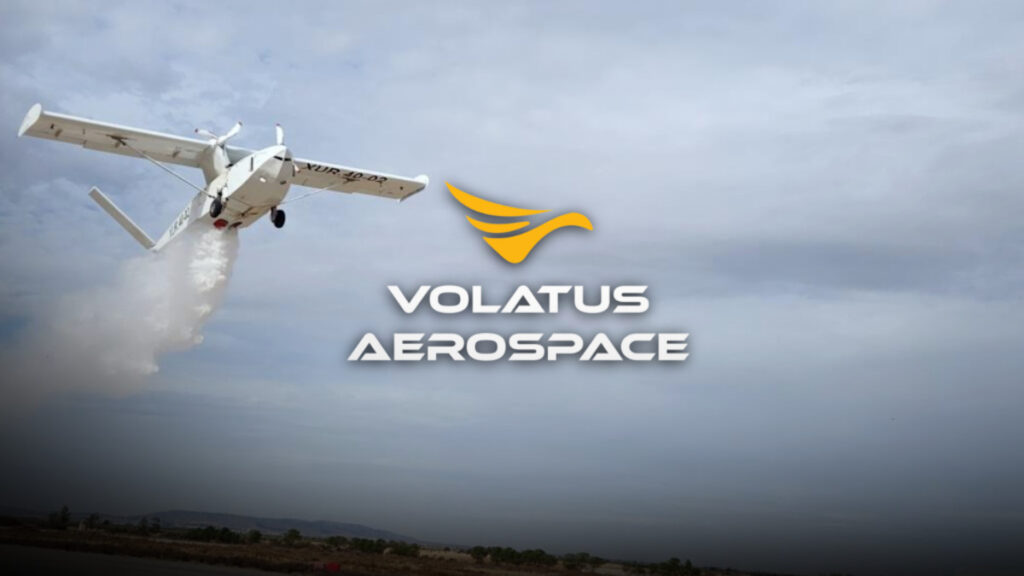

Canadian aerospace firm Volatus Aerospace has partnered with Kraus Hamdani Aerospace to introduce persistent autonomous intelligence and resilient airborne communications to Canada, establishing domestic manufacturing capabilities at Volatus’ facility in Mirabel, Québec.
Under the strategic partnership, Volatus becomes the Canadian Strategic Partner for Kraus Hamdani Aerospace (KHA), bringing the fully electric K1000ULE ultra-long-endurance autonomous aircraft and the Aerial Tier Network Extension ++ (ATNE++) architecture into the country. The initiative targets critical operational needs across emergency management, public safety, critical infrastructure, Arctic domain awareness, and defense, with an initial focus on transforming wildfire detection and response capabilities.
The K1000ULE platform features an open systems architecture with a minimal logistical footprint, capable of carrying intelligence, surveillance, and communications payloads over continuous, long-duration missions. Having logged over 6,000 operational flight hours supporting U.S. military and allied operations, the aircraft provides continuous electro-optical and infrared imaging, thermal hotspot detection, fire behavior analysis, live perimeter mapping, and post-incident damage assessment.
“Wildfires are ultimately an information challenge before they become a suppression challenge,” said Glen Lynch, Chief Executive Officer of Volatus. “The earlier incident commanders understand what’s happening, how conditions are changing and where responders are positioned, the more options they have to protect communities and keep firefighters safe. Persistent airborne intelligence and resilient communications fundamentally improve decision-making, enabling governments to respond earlier, coordinate more effectively and strengthen the exceptional wildfire response capability Canada already possesses.”
Supporting the airborne hardware is ATNE++, a mesh-enabled, multi-waveform, self-healing network designed to deliver resilient voice and data bridging across legacy and modern tactical communications. The network operates effectively in contested or degraded environments, providing wind and terrain assessment, firefighter tracking, and unified command support to maintain a continuously updated operational picture during complex emergencies.
“Unlike conventional unmanned aircraft designed for relatively short missions, the K1000ULE was purpose-built for continuous operations over large and remote environments to deliver persistent intelligence and resilient communications in some of the world’s most demanding operational environments,” said Fatema Hamdani, Chief Executive Officer of Kraus Hamdani Aerospace. “Canada has an opportunity to apply these proven capabilities to wildfire management while establishing a sovereign aerospace capability that can also support emergency management, public safety, defence and other critical national missions. Volatus brings the operational expertise, industrial capability and long-term vision needed to make that possible.”
The agreement establishes a framework for progressive domestic manufacturing, systems integration, operator and maintainer training, and lifecycle support. Subject to technical, regulatory, and commercial milestones, aircraft supporting sustained Canadian programs are intended to be progressively manufactured at the Mirabel facility, expanding local supply chain participation and building national sovereign capability.
Volatus has begun engaging federal and provincial governments, regulators, and public safety agencies to evaluate deployment pathways and operational requirements. This agreement marks the second major milestone in the company’s broader initiative to establish an integrated Canadian autonomous intelligence and rapid response architecture spanning emergency management, Arctic domain awareness, and defense.