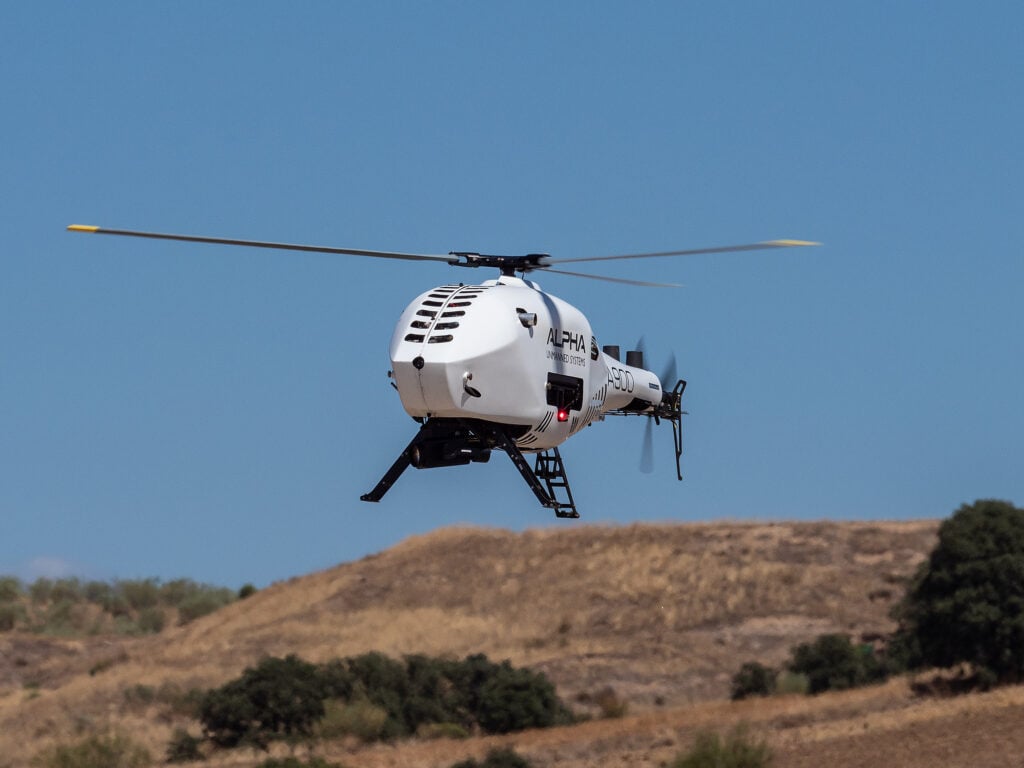
Unmanned Helicopters
Discover cutting-edge solutions from 5 leading global suppliersSabrobotix outlines the advantages of helicopter Unmanned Aerial Vehicle (UAV) platforms, highlighting differences in speed, endurance, payload capacity, and performance in challenging conditions compared to multirotor systems.
 Helicopter UAVs offer extended mission durations due to their efficiency during forward flight, maintaining consistent performance at cruise speeds exceeding 70 km/h. In contrast, multirotor systems consume more power during forward motion, which can reduce overall flight time. This efficiency, combined with forward flight speeds of up to 150 km/h, also enables rapid transit, allowing helicopter UAVs to reach distant locations more quickly than conventional multirotors.
The combined effects of speed, endurance, and efficiency contribute to increased operational range. Helicopter platforms are able to cover larger areas within a single mission without compromising capability.
Performance in challenging weather conditions is another key factor. The cyclic-pitch rotor system provides greater control authority and efficiency in demanding environments, allowing helicopters to maintain stable control in adverse conditions where multirotors are more affected by strong winds.
From an aerodynamic standpoint, a helicopter rotor blade functions as a rotating wing rather than a propeller, enabling more efficient lift generation across varying flight conditions. This lifting capability also supports higher payload capacities, as the cyclic-pitch rotor system allows helicopter UAVs to carry heavier loads, while multirotors experience reduced efficiency when operating with increased payloads.
Together, these characteristics support operational versatility. Helicopter UAVs are suited to applications including intelligence, surveillance, and reconnaissance; search and rescue; logistics and resupply; and industrial and infrastructure inspection.
While multirotor UAVs continue to serve important roles, helicopter platforms provide advantages in scenarios where speed, range, payload capacity, and performance in challenging conditions are critical.
Visit the Sabrobotix website to learn more.