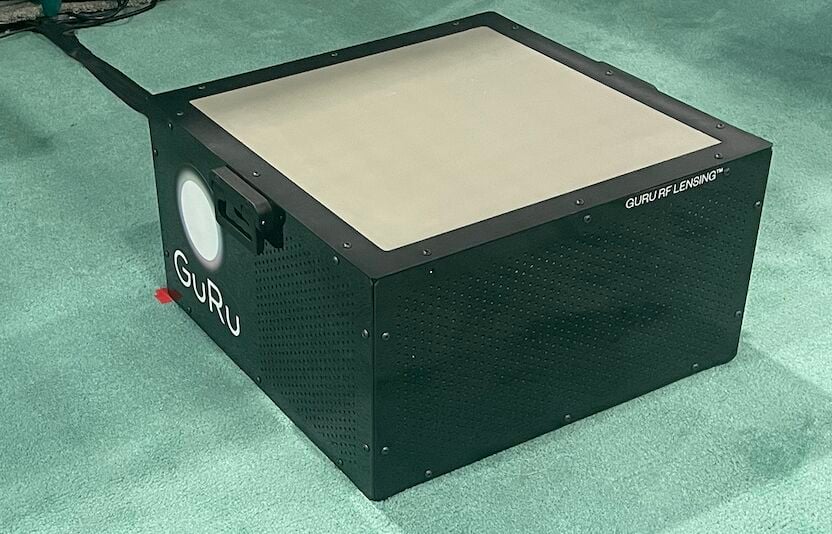




GuRu Wireless is developing 24 GHz millimeter-wave wireless power transfer technology designed to keep unmanned aircraft systems (UAS) airborne for extended periods without the need for conventional battery swaps or landing-based charging.
In this Q&A, the company discusses how its focused RF energy delivery works, the practical challenges of powering moving aircraft, and the results of its persistent flight demonstrations. It also outlines its roadmap for increasing power delivery, extending range and supporting coordinated multi-aircraft operations.
1. Could you provide an overview of GuRu Wireless’ wireless power transfer technology and explain how its 24 GHz millimeter-wave approach differs from conventional wireless charging and power delivery solutions?
GuRu Wireless develops wireless power technology that delivers usable electrical energy over distance through focused radio-frequency beams. A ground-based Generator Unit converts electrical power into 24 GHz RF energy, while a Recovery Unit on the receiving platform converts that energy back into DC power to operate equipment and recharge its battery.
Conventional inductive charging generally requires close proximity to a charging surface. GuRu’s approach enables power delivery across an air gap while the receiving platform remains operational, including during flight.
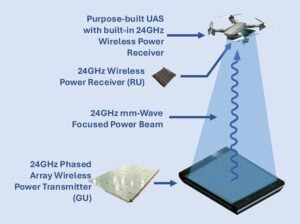
At 24 GHz, the short wavelength supports compact antenna elements and electronically controlled arrays. Our proprietary beamforming and GuRu RF Lensing® technology shapes, steers, and focuses energy onto the receiver. The architecture is modular, allowing transmitter and receiver configurations to be tailored to the application’s power, distance, and form factor requirements.
2. GuRu’s technology is designed to enable persistent flight for small UAS. What are the key advantages that continuous in-flight wireless power could offer operators compared with conventional battery swaps, landing-based charging, or tethered systems?
The principal advantage is continuity of operations. Battery swaps and landing-based charging interrupt an aircraft’s mission and can require additional aircraft, personnel, and ground equipment to maintain coverage. In-flight recharging creates the opportunity to sustain an airborne capability without repeatedly landing to replenish energy.
Compared with tethered systems, wireless power removes the physical cable connecting the aircraft to its power source. This provides greater freedom to maneuver within the system’s operating envelope and avoids tether handling, drag, snagging constraints, and importantly the location of the power source.
An aircraft can replenish energy in a designated airborne charging zone, then return to its mission position. Multiple aircraft can coordinate these cycles to maintain coverage and custody of threats. Persistent operation still depends on available ground power, weather, maintenance, and aircraft reliability, but battery endurance no longer has to dictate every mission interval.
3. GuRu has demonstrated continuous wireless recharging of UAS, including multi-aircraft operations. What have these demonstrations revealed about the practical requirements for deploying persistent wireless-powered drone systems in real-world environments?
Our most mature capability is persistent flight with a single small UAS carrying an operational intelligence, surveillance, and reconnaissance (ISR) payload. We can demonstrate this TRL 7 capability live, with the aircraft replenishing its battery in flight. That demonstration shows why the aircraft, payload, and power delivery system need to be designed together. The system has to deliver enough usable power to sustain flight and support the payload while maintaining an adequate battery reserve.
In a separate TRL 5 indoor demonstration, two small aircraft without ISR payloads remain airborne using a single 24 GHz Generator Unit. One aircraft recharges in a designated airborne zone while the other flies a short mission pattern. The aircraft automatically exchange positions at predetermined battery voltage thresholds, without pilot intervention.
The dual-aircraft demonstration showed what changes when a second aircraft enters the picture. Each aircraft must recover enough energy during its charging interval to complete its next mission leg, and both aircraft must coordinate the handoff. For field deployment, the next step is to validate that timing and energy margin with operational payloads, in representative weather, and when charging or a handoff is interrupted.
4. What are the key technical factors that determine the efficiency and range of GuRu’s wireless power transfer system, and how are you addressing challenges such as power conversion, beam alignment, atmospheric conditions, and maintaining consistent energy delivery to a moving UAS?
Efficiency depends on how effectively the ground transmitter converts electricity to RF energy, how much of that energy the airborne receiver captures, and how efficiently the receiver converts it back to usable DC power. Practical range depends on the size of the transmitting and receiving arrays, the aircraft’s position and orientation, and how much power it needs to sustain flight and operate its payload.

Our 24 GHz phased array uses electronic beam steering and smart RF lensing to focus energy on the receiver as the aircraft moves within a designated airborne charging zone. The aircraft’s battery provides an energy buffer during maneuvers and while it operates outside the charging zone. For outdoor deployment, we account for precipitation along the beam path, wind-driven changes in aircraft position and attitude, and a clear line of sight between the transmitter and receiver.
To date, GuRu has logged hundreds of hours of flight testing, demonstrating wireless power delivery and in-flight recharging across multiple aircraft configurations.
5. Looking ahead, what developments are currently in GuRu Wireless’ technology roadmap, particularly in terms of increasing power delivery, extending range, supporting multiple aircraft, or reducing the size and weight of the airborne equipment?
Our roadmap focuses on delivering more mission capability from the complete system. Priorities include increasing usable DC power at the aircraft, extending practical operating distances, improving conversion efficiency, reducing airborne receiver size and weight, and developing mobile GU charging capabilities to enable convoy and maritime overwatch of vehicles and vessels on the move.
We are also developing coordinated multi-aircraft configurations that combine in-flight charging with useful sensor payloads. One planned configuration uses two Generator Units and three aircraft to support persistent flight and ISR through coordinated charging and mission rotations.
These objectives are closely connected. A lighter receiver reduces aircraft energy demand, while more efficient power delivery can increase the energy available for flight and payloads.
Our development priorities are guided by end-user requirements and operational assessments. The goal is to establish configurations that can transition from demonstrations into dependable mission capabilities that support the persistent autonomous unmanned battlespace.
Find out more about GuRu Wireless’ RF power beaming systems for drones.