Wireless Power Transfer Technology for Drones & UAV
Wireless Power Transfer (WPT) technologies enable drones and UAVs to receive electrical energy without physical connectors, supporting autonomous charging, extended mission endurance, and reduced operational downtime. These systems encompass inductive and resonant inductive charging, capacitive power transfer, RF and microwave power beaming, laser-based energy delivery, and surface-based charging architectures.
This page showcases suppliers of drone wireless power transfer solutions supporting BVLOS operations, persistent surveillance, infrastructure inspection, logistics, agriculture, and defense missions.
If you design, build or supply Wireless Power Transfer (WPT), create a profile to showcase your capabilities and connect with visitors who have an active requirement for your solutions.
The Complete Guide to Wireless Power Transfer Technology for Drones & UAVs
Overview by
William Mackenzie
Updated:
Introduction to Wireless Power Transfer for Drones & UAVs
Drone Wireless Power Transfer (WPT) technology represents a significant shift in how electrical energy is delivered from a stationary or mobile power source to a receiving system without physical contact. For designers and operators of Unmanned Aerial Vehicles (UAVs), integrating a wireless power system directly addresses the primary constraint of modern battery design: flight endurance. By moving away from mechanical tethering or manual battery swaps, autonomous charging infrastructure allows platforms to complete continuous mission cycles with minimal human logistics.
Compared to traditional cable-reliant ground support equipment, automated wireless drone charging systems provide high survivability and operational readiness in harsh environments. These deployment platforms can be integrated into remote sensor nodes, mobile military vehicles, or urban drone hubs. As defense and commercial sectors expand the use of unmanned systems for persistent surveillance, critical asset inspection, and logistics networks, the deployment of stable wireless power delivery mechanisms is central to achieving true operational autonomy.
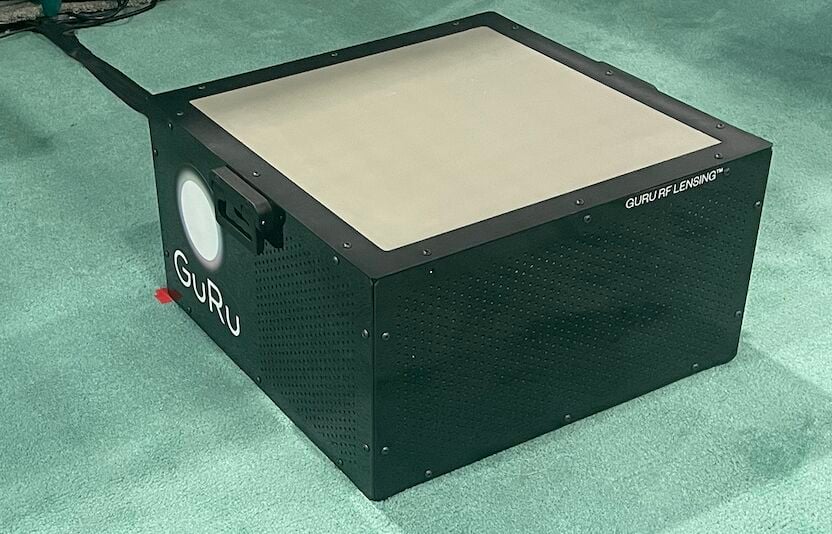
Wireless energy transfer technology for UAVs from GuRu Wireless.
The main operational advantages of drone wireless power transfer technology include:
BVLOS Capabilities:BVLOS operations require unmanned platforms to execute long-range trajectories far from their central command stations. Establishing a distributed wireless power network across an operational sector allows aircraft to land, recharge, and resume flight patterns without manual retrieval. This distributed architecture dramatically extends the practical radius of a single platform.
Eliminating Operational Friction and Human Intervention: Manual battery swapping presents significant logistical challenges in remote, marine, or contaminated environments. A fully automated wireless drone charger removes human labor from the turnaround cycle. This architectural shift lowers lifecycle costs and improves platform availability by removing mechanical wear items like connectors and doors.
Enabling Autonomous Drone Ecosystems: True fleet automation relies on the tight integration of flight platforms, landing infrastructure, and fleet management software. Advanced drone wireless power systems serve as the hardware foundation for these networks, creating a closed-loop system where aircraft self-manage their energy state based on real-time mission requirements.
Core Types of Wireless Energy Transmission
Inductive and Resonant Inductive Coupling
Inductive wireless energy transfer relies on near-field magnetic coupling between tightly aligned transmitter and receiver coils. This approach is highly efficient at close proximity and serves as a reliable solution for precise landing pads.
To mitigate alignment sensitivity, resonant inductive wireless power transfer employs tuned LC circuits designed to oscillate at identical frequencies. This method significantly improves transfer efficiency over greater physical gaps and accommodates minor landing offsets, making it a highly practical configuration for autonomous outdoor platforms.
Capacitive Wireless Power Transfer
Capacitive wireless energy transmission utilizes high-frequency electric fields established between conductive plates on the ground station and the aircraft. This mechanism allows for incredibly thin and lightweight wireless power receiver architectures on the drone. By reducing the onboard weight penalty, capacitive setups assist in protecting the critical Size, Weight, and Power (SWaP) budget of sub-scale UAV platforms.
Surface-Based Wireless Power Distribution
Surface-based distribution networks bypass the need for exact spot landing geometry by energizing wide-area conductive grids or segmented arrays. When a platform lands anywhere on the active matrix, the system detects its presence and routes power specifically to those coordinates. This approach is highly suited for high-throughput logistics hubs and multi-uav drone swarms.
Radio Frequency (RF) and Microwave Power Beaming
Far-field RF energy transfer utilizes dedicated transmitters to project electromagnetic waves over long distances to a distant platform. An onboard RF power transmitter can broadcast energy to a specialized wireless power receiver designed to capture and rectify the wave front.
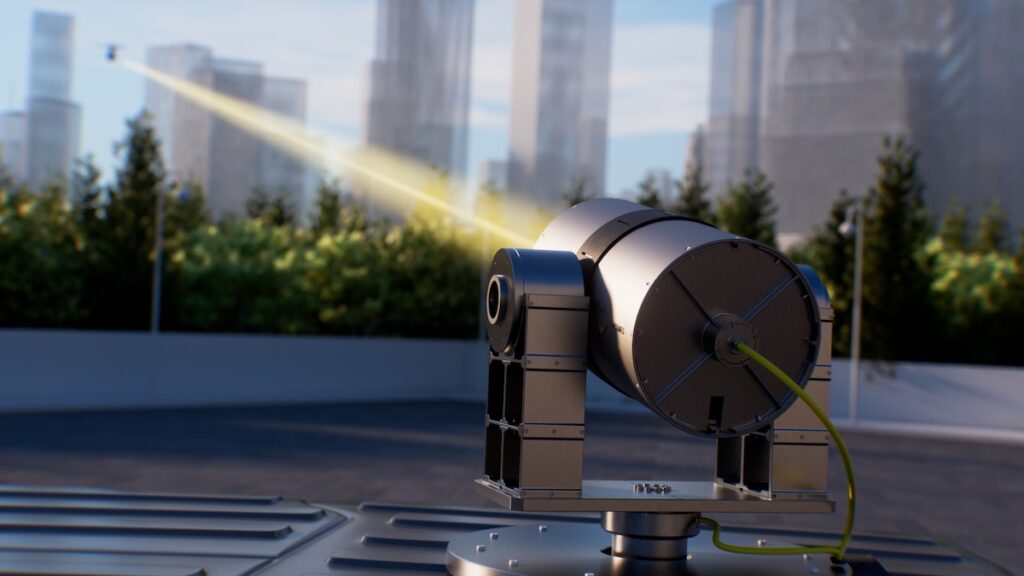
When scaled to higher power levels, microwave power transmission utilizes highly directional, phased-array antennas to beam energy directly to airborne assets. While atmospheric attenuation and safety boundary management present clear engineering hurdles, RF wireless power remains a prime candidate for sustaining in-flight UAV operations.
Laser-Based Optical Power Delivery
Laser power transmission projects a tightly collimated beam of monochromatic optical energy to high-efficiency photovoltaic receiver cells mounted on the drone body. This highly directional RF wireless charging alternative can track and energize aircraft at high altitudes. System designers must account for atmospheric turbulence, cloud cover, and strict line-of-sight conditions when engineering these optical links.
Wireless Drone Charging Infrastructure
Autonomous Charging Stations
These rugged enclosures protect internal sub-systems from environmental extremes while housing the primary wireless power transmitter electronics. They serve as secure field locations featuring integrated thermal management, local diagnostics, and secure communication uplinks.
Smart Landing Pads and Charging Docks
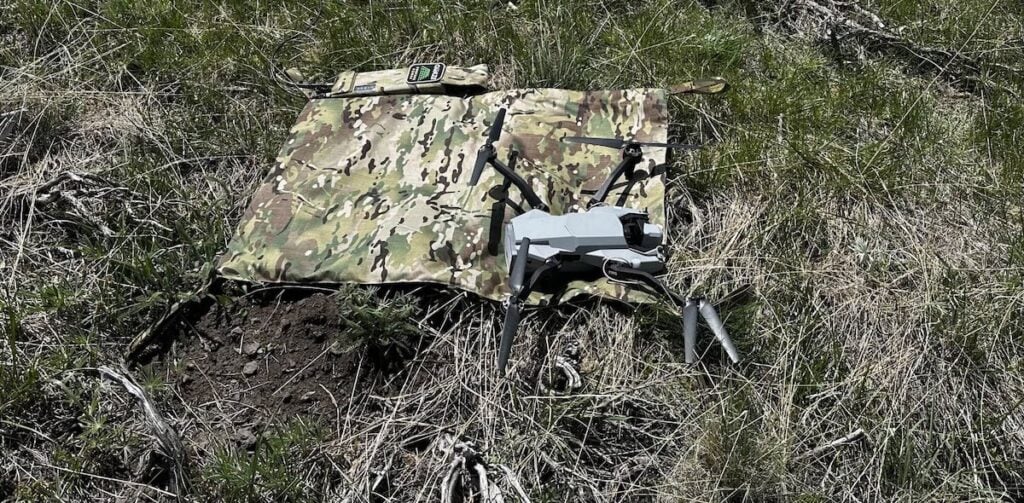
Smart pads combine precise optical or radio-frequency landing guidance with integrated charging loops. These systems monitor local weather conditions, evaluate the battery state-of-charge upon touchdown, and regulate dynamic power profiles to optimize cell life.
Drone-in-a-Box Systems
Drone-in-a-box architectures represent the complete integration of automated storage, environmental protection, telemetry processing, and UAV wireless charging. These self-contained assets can be permanently deployed to remote industrial assets or border areas for automated, on-demand operations.
Mobile and Vehicle-Mounted Charging Platforms
Integrating wireless drone charging hardware into land vehicles, tactical trucks, or marine vessels enables dynamic mobile base capabilities. These systems allow field units to launch, recover, and power reconnaissance assets directly from moving platforms without manual handling.
System Architecture: Transmitters, Receivers & Energy Management
Ground-Side Power Generation and Management
The ground segment functions as the primary energy conditioning layer. It rectifies AC grid power or manages localized DC storage arrays fed by renewable generation sources. High-frequency inverters convert this energy into the precise drive currents required by the transmission hardware, implementing strict safety interlocks to detect foreign objects before energizing the pad.
Onboard Power Reception Sub-systems
The onboard wireless power receiver is engineered around stringent SWaP parameters. The incoming energy captured by the receiver elements must be filtered, regulated, and step-down converted to match the nominal bus voltage of the drone propulsion and avionics batteries.
Rectennas, Receiver Coils, and Energy Harvesting Integration
The physical component layout depends heavily on the chosen transmission topology:
Inductive Systems: Rely on lightweight planar litz-wire coils shielded with ferrite backing material to suppress unwanted Electromagnetic Interference (EMI) on the drone avionics.
RF and Microwave Systems: Employ highly efficient rectifying antennas (rectennas) that capture wireless RF power and convert the high-frequency radiation into clean DC electricity.
Advanced Implementations: Often pair these components with secondary solar or thermal harvesting circuits to capture ambient energy, further extending flight profiles.
Applications of Wireless Drone Power Transfer
Industry Sector
Typical Operational Use Case
Primary System Benefit
Infrastructure & Utilities
Linear inspection of cross-country power lines, pipelines, and remote substations.
Eliminates field technician deployment; enables continuous automated inspection intervals.
Agriculture & Environment
Broad-acre crop scouting, multispectral soil mapping, and forest fire monitoring.
Supports permanent, multi-station farm networks for real-time agronomic data capture.
Logistics & Delivery
High-cadence fulfillment cycles between automated regional distribution hubs.
Persistent tactical perimeter security and situational monitoring during critical events.
Maintains constant airborne assets for uninterrupted command views without manual battery swaps.
Offshore & Maritime
Offshore wind turbine inspection, platform security, and marine research data tracking.
Safely conducts drone operations from autonomous ocean vessels and remote offshore structures.
Emerging Trends in Drone Wireless Power Networks
Dynamic In-Flight Recharging Networks
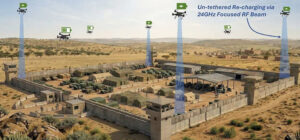
The ultimate objective for long-range unmanned operations is the elimination of mid-mission landings. Research teams are actively proving out localized dynamic charging corridors where drones fly through focused RF power transmission vectors, collecting supplementary energy mid-air to achieve infinite range profiles.
Wireless Power Distribution for Autonomous Drone Swarms
As cooperative swarm mechanics evolve, charging large groups of aircraft simultaneously becomes a significant logistical hurdle. Multi-frequency wireless networks and wide-area surface arrays allow entire fleets to land on shared infrastructure and receive dynamically balanced energy allocations without complex physical plugging configurations.
Space-Based and High-Altitude Energy Delivery
Advanced programs are evaluating the integration of orbital or stratospheric solar-tracking power platforms. These systems project ultra-focused laser or microwave energy down to High-Altitude, Long-Endurance (HALE) platforms, paving the way for atmospheric satellites that can operate continuously for months at a time.
GuRu Wireless demonstrated its long-range wireless power beaming system at the MOSA Summit, enabling persistent small drone flights through continuous airborne recharging without battery swaps, landings, or physical tethering connections
Deep-tech startup SunCubes is deploying SimScale's AI-powered cloud simulation platform to design and validate laser-based wireless charging technology capable of powering unmanned aerial vehicles continuously during flight without physical contact
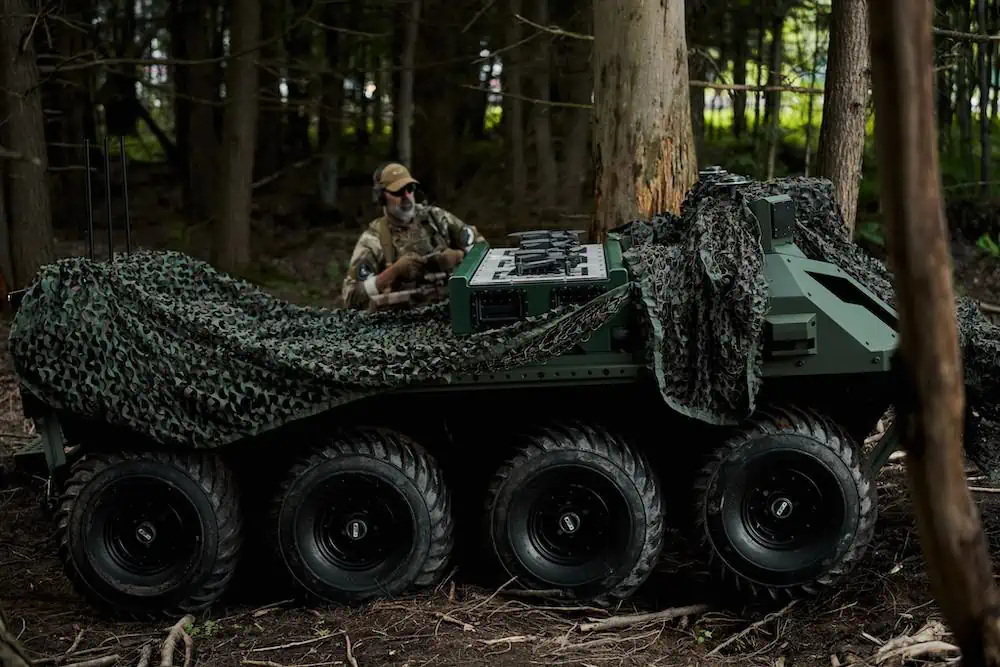
Quaze Technologies has joined Red Cat Holdings as the U.S.-based defense and robotics company expands wireless power transfer and autonomous charging capabilities for unmanned air, ground, and maritime systems operating in demanding environments
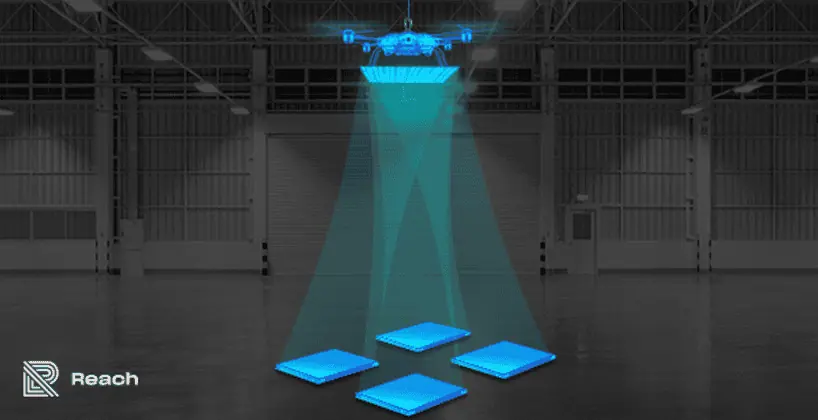
The demonstration took place at NASA's Ames Research Center and showcased Reach's Wireless Power-at-a-Distance solution by beaming 256 watts of power at a drone in flight
Powered by magnetic resonance Quaze Technologies’s Drone Swarm Tactical OverWatch remote charging solution enables easy and reliable wireless charging for remote or autonomous devices on land, sea or air
The latest unmanned systems news, straight to your inbox.
Get our weekly roundup of technology developments, new products and industry news.
THANK YOU FOR SIGNING UP
Thanks for joining us. Check your inbox.
We've sent you an email. Click the confirmation link to complete your subscription to the weekly eBrief. In the meantime, explore the latest news, suppliers and technologies on UST.
Advancing Unmanned Systems Through Strategic Collaboration
UST works with major OEMs to foster collaboration and increase engagement with SMEs, to accelerate innovation and drive unmanned systems capabilities forward.