Tilak.io develops ground control station software for unmanned aircraft systems, with work spanning PX4 and QGroundControl integration, customized operator interfaces, dedicated desktop applications, and deployment on hardware suited to field operations.
Its approach is shaped by experience from real flight operations, where interface design has a direct effect on how quickly a Pilot in Command can interpret aircraft behavior and respond. Bright sunlight, time pressure, competing system information, and rapidly changing mission conditions can all influence how effectively a ground control station is used.
Rather than presenting every available function at once, Tilak structures its software around the information and controls needed at a particular point in the mission.
Extending QGroundControl for Specific Aircraft and Missions
QGroundControl provides the foundation for a number of Tilak’s customized ground control solutions.
Using an established platform means that proven core functionality does not need to be recreated for every project. Tilak can instead concentrate development effort on the elements that differ between aircraft and operational concepts, including interfaces, workflows, payload controls, and system integrations.
This allows an existing software framework to be adapted to the requirements of a particular UAS while preserving functionality appropriate to the operator’s established way of working.
Not every program is suited to modification of an existing ground control platform. Where mission requirements call for a different software architecture or operating model, Tilak can build a dedicated desktop application instead.
Both development routes are intended to deliver software that can be understood quickly, operated reliably, and used effectively outside controlled test environments.
Prioritizing Decisions Rather Than Data Volume
A ground control station may have access to a large amount of aircraft, payload, and mission information. Displaying all of it simultaneously, however, does not necessarily improve situational awareness.
Tilak approaches interface design by considering what the Pilot in Command must understand or accomplish at each stage of an operation. Information is prioritized according to whether it contributes to a decision, supports an action, or provides relevant mission control awareness.
Secondary data can therefore remain outside the main operational view until it becomes useful.
This is particularly important during demanding flight conditions. An operator may be monitoring several systems while also dealing with environmental limitations such as difficult screen visibility. When an event requires a response within seconds, the interface needs to make the relevant change apparent without forcing the operator to search through unrelated information.
The design objective is not to reduce access to system data, but to control when and where that information is presented.
Adapting the Fly View to Mission Phase
During active flight, the fly view provides the operator with the principal operational picture. Information commonly shown there includes aircraft position, trajectory, attitude, flight mode, and system status.
Tilak can configure this interface so that mission-specific controls appear according to operational context rather than remaining permanently visible.
A multispectral payload illustrates this approach. Before takeoff, the operator may need to capture an image of a color reference target as part of the calibration process. At that stage, the required controls can be made available directly within the operational interface.
Once the aircraft is airborne and that task is complete, those same controls no longer need to occupy space in the fly view. They can be removed automatically without requiring the operator to switch screens or manually reorganize the interface.
The result is a display that changes with the mission instead of asking the operator to manage a fixed collection of controls throughout the entire flight.
Keeping Configuration Complexity Away from the Operator
Additional UAS capability often brings additional parameters, settings, and control options. If each one is exposed directly through the ground control station, software can become progressively harder to configure and use.
Tilak addresses this by moving appropriate complexity into the application itself.
Automation, predefined logic, and mission-specific workflows can determine how certain functions behave without requiring the operator to configure every underlying parameter during normal use. The aircraft or payload may still depend on substantial software complexity, but that does not mean the same complexity has to be reflected in the user interface.
This distinction is important for operational usability. A simple interface does not imply a simple system. In many cases, the opposite is true: considerable engineering work is required behind the interface so that only the relevant choices reach the operator.
Tilak’s approach is therefore to preserve system capability while reducing the amount of low-level management required from the Pilot in Command.
Connecting Software Development with Field Hardware
Ground control requirements can extend beyond the application itself.
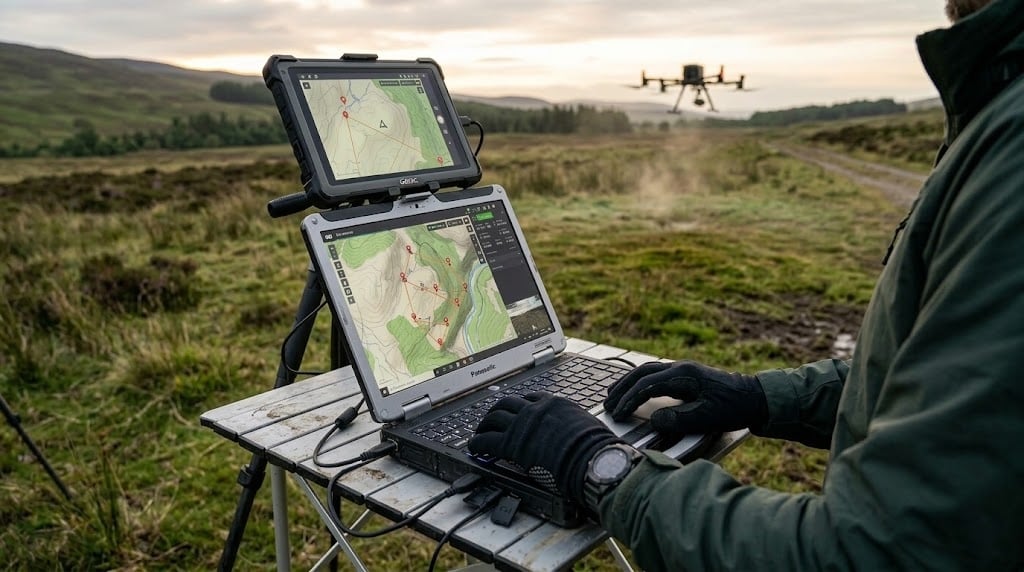
Tilak can integrate customized QGroundControl software onto dedicated hardware, including rugged tablets intended for field deployment. This makes it possible to consider the software interface alongside device configuration, connectivity, and the physical operating environment.
The company also develops dedicate applications for aircraft, payloads, and operational workflows where a more specialized solution is required.
Combining flight controller and command and control application integration with custom application development and mission-appropriate hardware allows the ground control system to be configured around the practical requirements of the operation.
For UAS crews, the intended outcome is a ground control environment in which complex aircraft and payload functions remain accessible without dominating the operator interface, leaving the information required for mission execution clearly presented during real operating conditions.