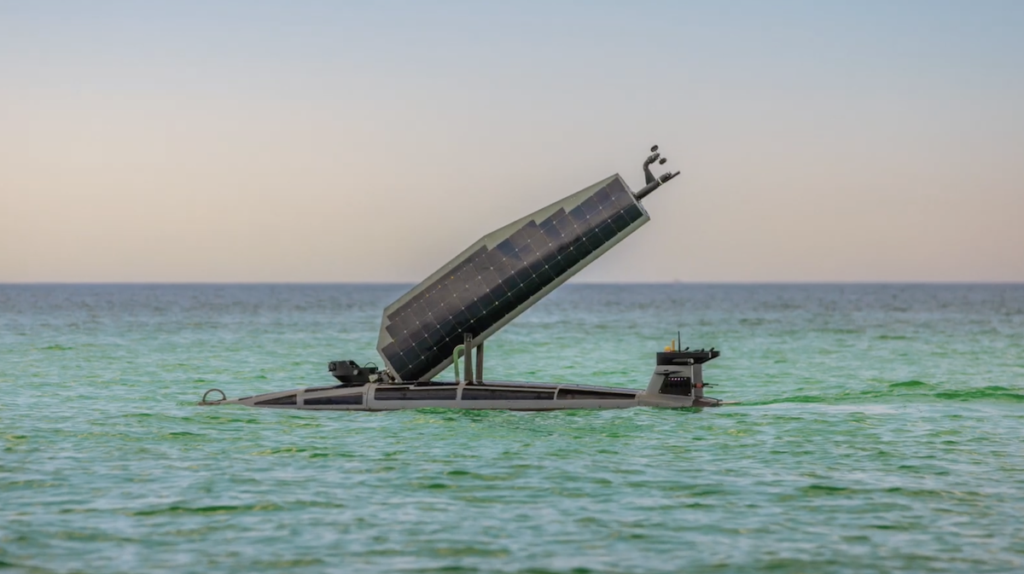
Maintaining a camera on a target from a small unmanned vessel requires continuous compensation for platform motion. NEPI by Numurus provided the edge-compute hardware and software environment for a new sensing payload aboard Ocean Aero’s TRITON autonomous marine vessel, with Ocean Aero progressing to final on-water product testing within three months of Numurus delivering the NEPI-ready hardware stacks.
The project brought together a SIDUS Solutions high-speed pan and tilt and four DeepWater Exploration cameras, comprising two visual and two infrared units. The payload automatically stabilizes the cameras and tracks targets of interest while TRITON is underway, including in rough seas.
For this second collaboration with Ocean Aero, Numurus supplied its S2X hardware incorporating an NVIDIA Jetson Orin NX processor with NEPI edge-AI and automation software, together with engineering and software support.
Compensating for USV Motion
Detecting and tracking targets from a small unmanned surface vessel presents a stabilization challenge because the platform is continuously affected by wave motion. As the vessel moves, equipment mounted to it also moves, pulling a camera away from its target.
Persistent tracking therefore requires the sensing payload to compensate for vessel motion in real time while interfacing with and controlling multiple onboard systems.
For the TRITON payload, attitude, heading and roll information from the onboard attitude and heading reference system (AHRS) and inertial navigation system (INS) drives the pan and tilt against wave motion. Image-based stabilization is then applied, followed by target-detection offsets in the final control solution.
Implementing the control algorithm required integration with the high-speed pan and tilt, four cameras, AHRS, GPS, INS and the USV’s control system, as well as onboard AI detection models.
Integrating Sensors, Control Systems and AI
Ocean Aero used Numurus’ turnkey NEPI hardware and software rather than developing a significant amount of the required custom hardware drivers and AI model-management capabilities in-house.
NEPI provided a suite of plug-and-play sensor and control-system drivers, AI model management and a browser-based user interface. Using these existing capabilities allowed Ocean Aero’s engineering team to focus on development of its in-house stabilization and tracking control system.
Numurus also carried out NEPI software customization required for the specific Ocean Aero implementation.
The project was subject to a short development timeframe, with Ocean Aero seeking to achieve its objective without overloading its existing engineering team. According to the project information supplied by Numurus, using the NEPI hardware, software and engineering support saved Ocean Aero more than six months of in-house development while limiting its engineering team’s efforts to a three-month period.
From Edge Compute to On-Water Testing
The project used Numurus S2X hardware incorporating an NVIDIA Jetson Orin NX processor with NEPI software. Numurus delivered NEPI-ready edge-compute hardware stacks together with project-specific hardware driver updates.
Within three months of that delivery, Ocean Aero was conducting final on-water product testing before shipping the new solution to a number of customers.
Using NEPI’s existing hardware drivers and AI model-management capabilities allowed Ocean Aero’s engineering team to concentrate on development of the stabilization and tracking control system rather than undertaking much of the associated middleware development itself.
Adapting the Solution for Other Missions
The hardware and AI processing used for the project operate through NEPI’s hardware and software abstraction APIs. According to the project information, this allows the resulting solution to be adapted for other mission information and automation tasks.
Ocean Aero’s engineering team has also gained familiarity and experience with NEPI through the project, providing a basis for adapting the solution to other custom mission requirements. Numurus can provide further support when required.
For the TRITON payload, the combination of NEPI-ready edge-compute hardware, project-specific hardware driver updates and engineering support allowed Ocean Aero’s team to concentrate on its stabilization and tracking control system. Within three months of Numurus delivering the hardware stacks, Ocean Aero was conducting final on-water product testing before shipping the new solution to a number of customers.