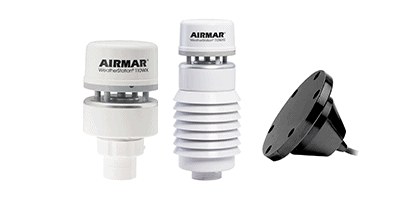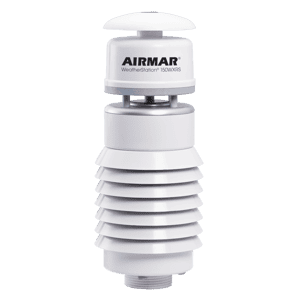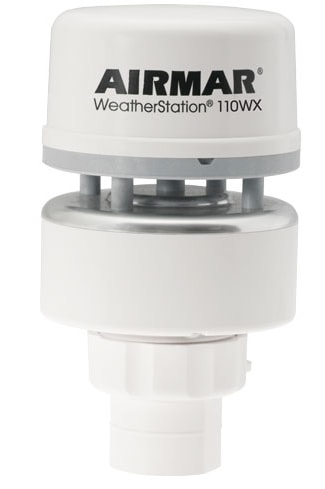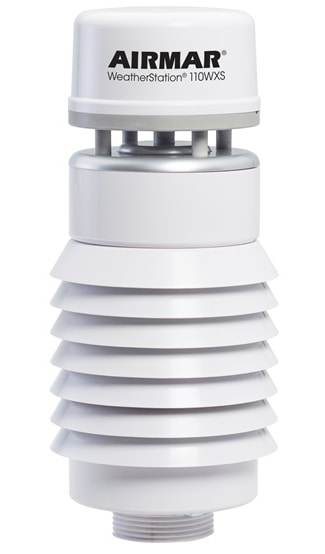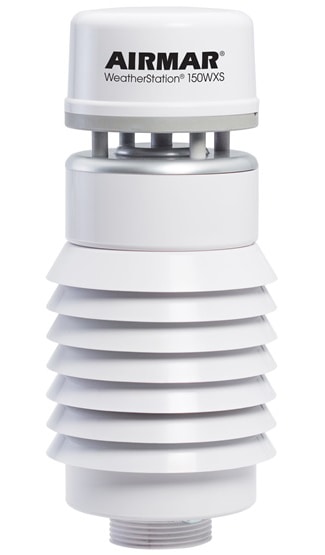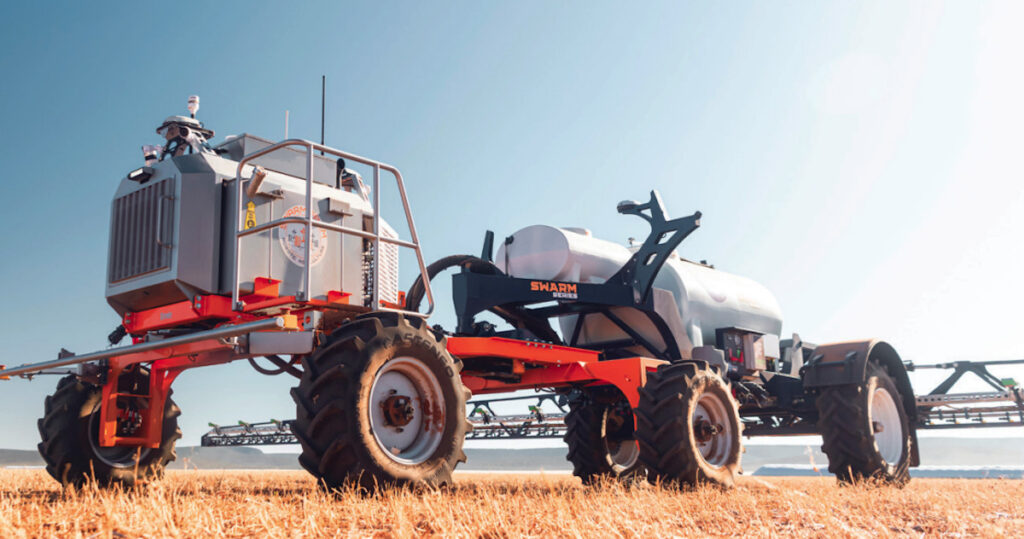
Airmar Technology Corporation’s WeatherStation® instruments are supporting SwarmFarm Robotics’ autonomous agricultural spraying systems with real-time environmental, positioning and motion data.
SwarmFarm has integrated Airmar WeatherStation instruments into its SwarmBots since 2019, with more than 300 units deployed across customer fleets. The instruments provide onboard weather measurements used for autonomous spray control, application records and regulatory compliance.
Onboard Weather Measurement
SwarmBots fitted with Airmar WeatherStation instruments record temperature, Delta T, wind speed, wind gust, wind direction and GPS position every five seconds.
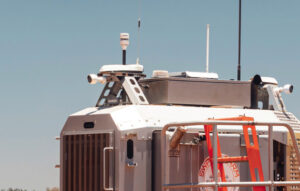
Image courtesy of SwarmFarm
SwarmFarm uses this data to create an as-applied map containing weather conditions captured at the nozzle. Vehicle velocity and orientation are also used to correct observed wind measurements, producing a more accurate static wind observation from a moving robot.
Airmar WeatherStation instruments can provide up to seven weather measurements, together with motion-based data from an integrated GPS/GNSS sensor, 3-axis rate gyro, compass and accelerometers.
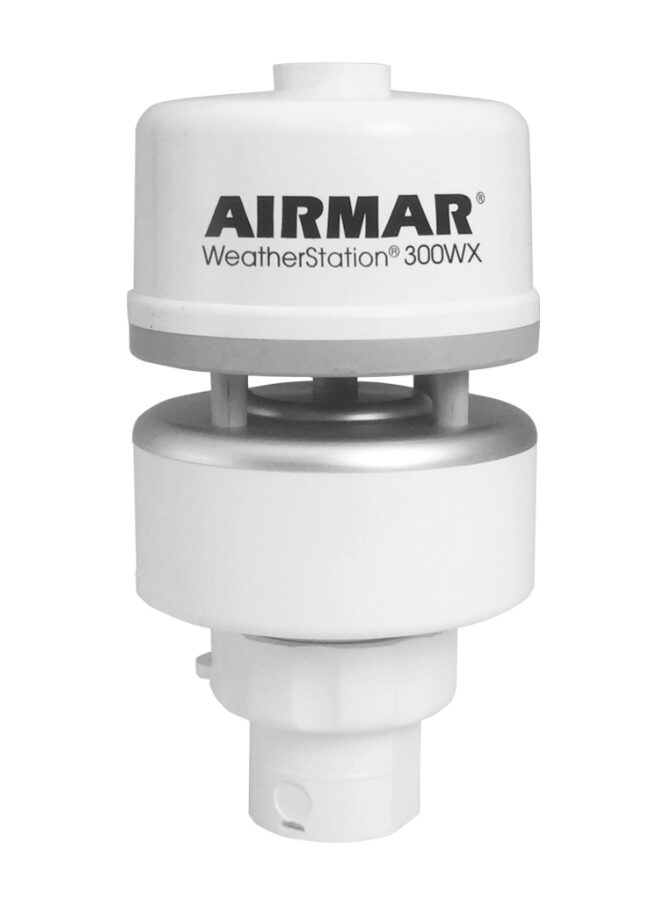
300WX Wind and Environmental Sensing
Airmar’s 300WX series measures apparent wind and dynamic true wind from a moving vehicle, accounting for motion-induced airflow when calculating actual wind speed and direction relative to North.
The series measures apparent wind speed and direction, air temperature and barometric pressure, with relative humidity available on select models. It also calculates dew point and heat index.
Wind speed accuracy has been improved to 1.5 knots RMS at 20 knots. The 300WX also provides data for Delta T and wet bulb temperature calculations. Delta T is particularly relevant to spraying because it influences droplet evaporation and drift potential.
Autonomous Spray Control
WeatherStation data is incorporated into SwarmFarm’s automated spray-control process.
Operators use the SwarmView app to set weather limits for individual spray jobs according to chemical label instructions. If conditions exceed those limits, such as wind speed becoming too high or Delta T becoming too low, the SwarmBot automatically stops spraying.
Spraying resumes automatically when conditions return to the specified range. A “Snooze” mode can also place the SwarmBot into a low-power state during adverse conditions before operation resumes.
Connectivity and Integration
The 300WX series supports CAN (NMEA2000®), J1939 and ISOBUS output protocols, with automatic baud rate detection at 250 kbps and 500 kbps.
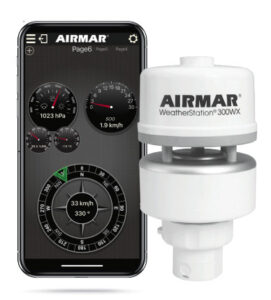 Bluetooth® connectivity through Airmar’s CAST™ app allows sensor configuration, real-time data viewing and wireless firmware updates at distances of up to 33 meters (100 feet). The app supports digital, graphical and hybrid data layouts.
The instruments use a compact, all-in-one design with no moving parts, and models are available with IP64 and IP67 ratings.
SwarmFarm currently connects Airmar WeatherStation instruments to its SwarmBots through a serial interface, while the additional 300WX protocols provide options for future integration.
Supporting Compliance and Future Development
In Australia, spray operations are subject to weather limits, buffer zones and record-keeping requirements. By recording conditions directly on the SwarmBot, Airmar WeatherStation instruments provide a record of conditions at the point of application.
Potential future developments include rain detection from a moving vehicle, atmospheric inversion detection and confidence metrics for weather observations.
Airmar’s current 150WXRS reports rainfall amount, duration and intensity, but is intended for stationary installations. Future development may extend rain detection to moving platforms.
The SwarmFarm deployment demonstrates how onboard environmental sensing, motion data and autonomous control can be combined to support robotic agricultural spraying.
For more information, visit the Airmar Technology Corporation website.