




Wingman360 Teammate is an AI assistant for the compliance and certification work of UAS and manned aviation organisations. It answers questions from the organisation's own approved documents and the applicable regulations, and shows the paragraph each answer came from. It drafts the documents authorities ask for, so that the responsible engineer reviews and signs rather than starts from a blank page.
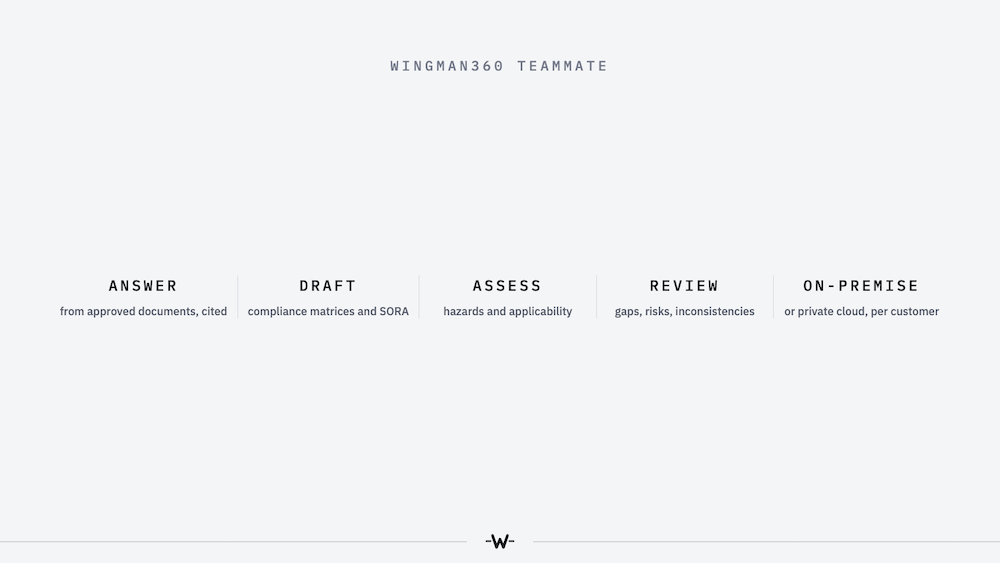
The assistant works from a controlled corpus: the organisation's expositions, manuals, procedures, records and engineering documents, plus the regulations that apply to it.
Administrators decide what enters the corpus and at which revision; users read from it and cannot change it. Every answer cites the document and paragraph it was taken from, so a reader can check it against the source.
The regulatory texts available today cover EASA (Part 21, Part 145, Part-CAMO, Part-IS, the UAS Regulations (EU) 2019/947 and 2019/945 with their AMC and GM), FAA (14 CFR Parts 21, 107 and 145), JARUS SORA 2.5, and military airworthiness under EMAR and NATO STANAG 4671.
What it drafts- Certification-basis compliance matrices under EASA Part 21 and FAA procedures, with each entry traced to the clause it comes from
- JARUS SORA 2.5 assessments, ConOps sections and the operational safety objective evidence that goes with them
- Functional hazard assessments and hazard logs structured to SAE ARP4761A and ED-135
- UAS operations manuals, expositions (MOE, CAME) and organisation-approval documentation aligned with the customer's templates
- Weight and balance computations backed by scripts, and jurisdiction and category applicability checks
- Audit responses, procedure amendments and engineering justifications, for review
The assistant does not approve, release or sign anything. Classification decisions, releases to service and authority submissions stay with the nominated persons.
Where it runsEvery customer runs a dedicated, isolated deployment. Two models are offered: a private cloud instance provisioned for the organisation alone, or an installation inside the organisation's own infrastructure.
The on-premise installation can run with a fully local model, so that no data and no model call leaves the network; this is the configuration used for defence and other restricted environments.
Access is role-based, the knowledge boundary is read-only for users, and the corpus is curated with human approval.
How the claims are checkedLavionic publishes RDB-1, a benchmark that measures whether a local model inside an organisation’s own perimeter can match cloud models on one task: a technical report a domain expert would sign, written from 96,180 spreadsheet cells, 8,561 PDF pages and 872 review comments of a completed regulatory assessment.
In the first edition the best local model on Wingman360 Teammate scored 74 of 100, level with the best cloud model on the same harness. The method, data set and results are on wingman360.ai/benchmarks.
UAS operators and LUC holders, UAS manufacturers and their suppliers, design and production organisations (DOA, POA), Part 145 maintenance organisations and CAMOs, defence airworthiness teams, and aviation consultants and auditors.
Further reading on wingman360.ai
- Can AI be trusted for aviation compliance documentation?
- Certification-basis compliance matrix: EASA Part 21 and FAA
- AI assistant for EASA Part 145 and CAMO organisations
- On-premise and air-gapped AI for aviation and defence
- Functional hazard assessment with AI: ARP4761A, AC 25.1309
- Wingman360 vs ChatGPT, Claude and Gemini for aviation work
- RDB-1: Regulated Document Benchmark





